

Stephen Baxter, “Northland: Book Two – Bronze Summer”, Gollancz, £14.99, 424 pp, 2011.
First published in different form in Concatenation, online, April 2012.
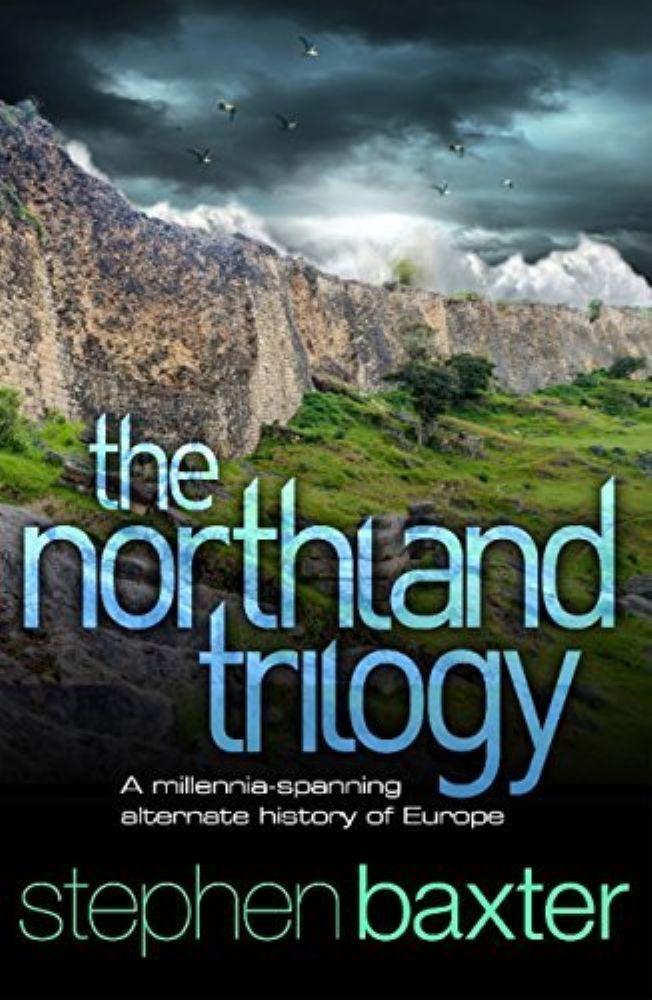
Following Book One: Stone Spring (ON, 8th February 2026), Stephen Baxter continued the Northland series (Fig. 1) with Bronze Summer (Figs. 2 & 3), still set on the plain of what in our world is the North Sea.


After about 5000 years, the Wall, begun to protect settlements there against tsunamis, has grown into a near-permanent barrier, tended with concrete called ‘growstone’ by the inhabitants of Extelur, a peninsula on the north edge of the land bridge to ‘Albia’, still forested throughout.
What I may have missed (though I’ve looked hard for it) is the reason why Northland hasn’t been invaded from the sea on the southwest. Presumably the Thames is still a tributary of the Rhine, which flows into the English Channel (Figs. 4, 5 & 6). Note the differing interpretations of the extents of Doggerland and the forming Channel in the period 8000-5000 BC, which have allowed Stephen Baxter to create this alternative history in which the advance of the North Sea has been halted, while what will become the Channel is called ‘The Cut’, beginning around where Dover is now.


The description of the southwestern shoreline doesn’t include any natural or man-made barriers to stop the sea advancing there into the plain, now submerged, which we call ‘Doggerland’; though there is a mention (p.290) of managing the rivers on that shore “to keep them from tearing at the land”. If the Frontispiece map in Bronze Summer (to which I don’t currently have access) is accurate, the sea level is generally lower than in our world: Ireland is larger, and the Hebrides, Orkney and Shetland are single land masses joined to Albia, as Orkney is in Fig. 4. Perhaps, too, the rebound of Britain as the glaciers retreated was less of a see-saw than it has been in our world. I’m sure Stephen Baxter has an answer to my question, but I can’t find it here, only guess at it.
History, too, has taken a different course. In Stone Spring the Northlanders had already reached Iceland c.6000 BC (and why not?), and here they have regular transatlantic crossings and trade with the Olmecs of Central America. (Thinking of Brian Aldiss’s Helliconia and Harry Harrison’s Eden trilogy, which is set in an alternative South America, I wondered why the dedication is to Aldiss rather than Harrison.) Since the book jacket speaks of “drought-plagued lands around the Mediterranean”, before what was the beneficial Roman Warming in our history, the ‘BC’ date on the map made me wonder how different this history was going to get; and when the italicised preface warns of a coming volcanic eruption, I had a moment of confusion, wondering if we were to get a new version of Atlantis-as-Thera. But no, the volcanic threat is “on an island in the Western Ocean”, and the BC date is 1151, so the explosion of Thera has presumably come and gone long before this book is set.
What does happen is an explosive eruption of Hekla on Iceland in 1159 BC, bringing climate downturn to Britain and the Mediterranean region just as it did in our world. But the countries of the eastern Mediterranean are already importing food from Northland, particularly potatoes, the magic food from the Americas. With Troy in ruins and the Hittite empire fragmented by wars, dispossessed warlords set their sights on Northland as a possible base from which to rebuild their power and reconquer the middle east. Despite their use of bronze, the Northlanders have retained a society which is largely Mesolithic and Neolithic, so the clash of cultures which follows is eerily like the one between hunters and farmers which Neil Oliver envisages in A History of Ancient Britain (Weidenfeld & Nicolson, 2011), though set a thousand years later and triggered by the arrival of iron.
We follow the confrontation primarily through three characters: Milaqa, a misfit in Northland, an unwilling ambassador to the Middle East, and dangerously attracted to Qirum, a landless warlord from Troy, despite his relationship with Kilushepa, an ousted Hittite queen. But it’s lesser characters who’ve stayed with me: Mi, the archer girl who can outshoot the best of men; Caxa, the Olmec sculptress, saved by the volcano from an early death on her return to the Land of the Jaguar, which never happens. There are many stories within this novel, all worth following as they add up into the epic.
Duncan Lunan’s recent books are available from booksellers or through Amazon; details are on Duncan’s website, www.duncanlunan.com.




Leave a Reply