
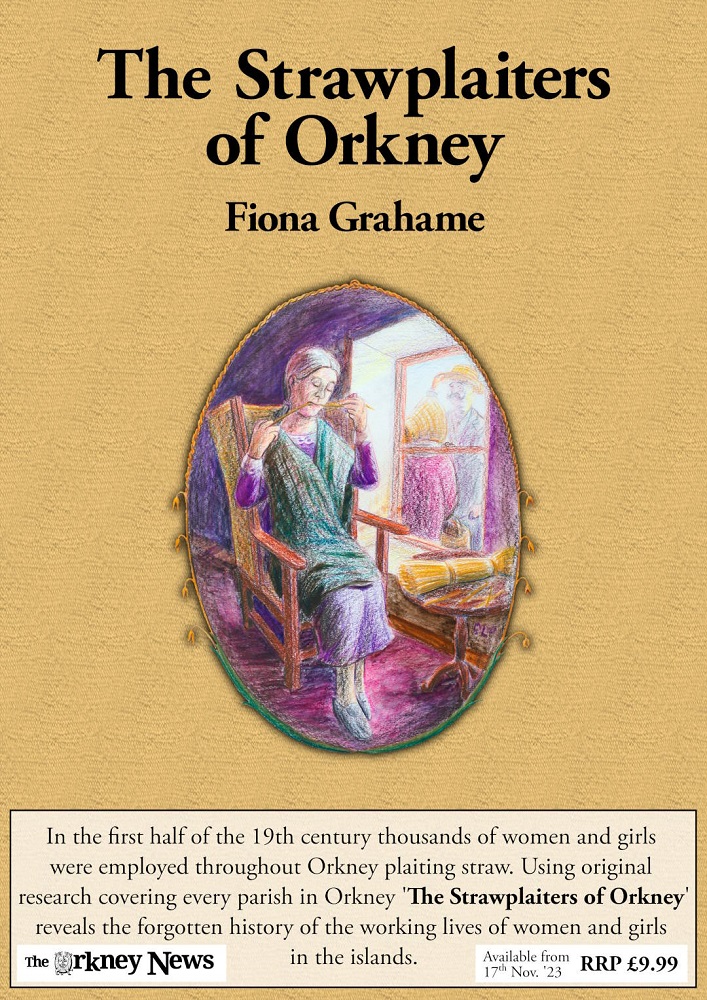
Over the course of its 50+ years of straw plait manufacture and bonnet making in Orkney, the industry employed thousands of women, some in workshops, and others within their own homes.
For International Women’s Day, and Women’s History Month this article highlights the unseen women, girls and children, whose skills kept the industry going and made large profits for a few merchants.
In 1821, at the height of the trade in strawplait and bonnet making in Orkney, 12 year old Isabella Harvey was plaiting straw at Skithva, in the parish of Sandwick. Her sisters were also plaiting straw.
“The principle branch of manufacture carried on here is straw plaiting, which occupies almost all our younger females; or, in summer, reaping and preparing the 9 acres of rye that furnish the materials. The seeds are sown thick, that the straw may be long and fine. The stems are cut down before the grain ripens, tied near the lower end into very small bundles, steeped in boiling water for an hour, spread on the ground to bleach, and carted to the manufacturer’s house, where the upper part between the highest joint and the grain, which only in general is used, is pulled out; cut to a proper length, sifted or sorted to different degrees of fineness, and made up into small bundles, which are distributed to the girls who take them to their own houses to be plaited; they are paid according to the fineness of the straw, and excellence of the work.” Statistical Account of Orkney, Parish of Sandwick, The Reverend Charles Clouston, Minister.
It was an occupation with very particular health hazards as the straw had to be kept moist as it was being worked. This meant that the plaiters had to moisten it by passing it between their lips causing cuts, sores, and for some, mouth cancer.
For Isabella and her two sisters, it was, however, an important source of income. They were living with Jannet Oman (Omand) , a widow of at least 40 years old, possibly a relation, or a trader in straw plait running a workshop within her home. All female households were numerous in Orkney at this time as many men were away: in the military; at sea; or employed with the Hudson’s Bay Company. This meant that the running of crofts had to be done by the women and girls who remained in Orkney. A source of income was essential – while they waited on the men to return (if ever) or for their wages to arrive.
You can read more about this period in the islands’ history in ‘The Strawplaiters of Orkney’ by Fiona Grahame, published by Orkney News Ltd. ISBN 978-1-9196105-2-8. Available from all good bookstores worldwide.



Leave a Reply