
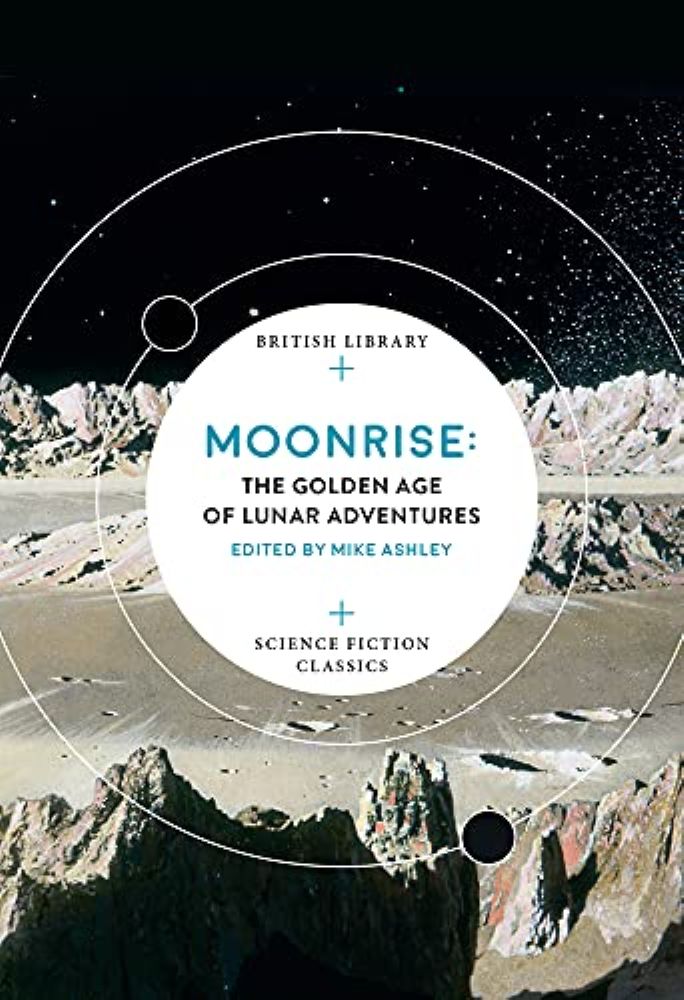
“Moonrise, The Golden Age of Lunar Adventures” and “Lost Mars, The Golden Age of the Red Planet”, edited by Mike Ashley, £8.99 each, pbk and eBook, British Library, 224 pp., 2018.
First published in different form, Interzone 275, May 2018


These two collections were the first of a new series of ‘British Library Science Fiction Classics’, each prefaced with a scholarly introduction. The covers are by Chesley Bonestell, from The Conquest of Space, (1950, Fig.1) and The Exploration of Mars, (1956, Fig. 2).

But unlike, say, The Science Fictional Solar System, edited by Asimov, Greenberg & Waugh, (1979, Fig. 3), the main emphasis isn’t on classic stories from the Golden Age of SF, but rather on the period when speculative fiction was still part of mainstream fiction, along with a selection of what that led to. As one might expect from an editor of Mike Ashley’s experience, there are well-known names here, though sometimes with less well-known stories, and some surprising inclusions of authors little-known or even forgotten.
Moonrise begins with ‘Dead Centre’ by Judith Merrill, from Fantasy & Science Fiction in 1954, to illustrate the longing for the Moon which filled SF at the dawn of the space age. But then the first third of the book is taken up by ‘A Visit to the Moon’ by George Griffith (1901), ‘Sunrise on the Moon’ by John Munro (1890s), and a long extract from The First Men in the Moon by H.G. Wells (1901). What’s most striking is that all three knew the Moon was airless and waterless, all three found ways to put life on it nevertheless, and all three were right to some extent.

Wells and Munro postulated that the lunar atmosphere froze out during the night (Fig. 4 ) and was released again at every sunrise (conveniently overlooking that in that case, we could see it), but air and water remained fluid below the surface, as in Griffith’s story. What little atmosphere the Moon actually has is extremely tenuous, and when the Galileo spacecraft detected water vapour over the sunlit face of the Moon, it seemed so unlikely that the finding was kept quiet for years. It turns out that water is generated when hydrogen ions in the solar wind combine with oxygen sputtered from the surface rocks. Most of it is disassociated again by solar ultraviolet as the day goes on, but some gets captured in the cold traps of shadowed craters at the poles, as Munro suggested in his dramatised essay.

The samples brought back by the Apollo missions at first suggested that all the volatile elements and compounds had been expelled from the Moon, in the collision with the proto-Earth that formed the Earth-Moon system. The ‘rusty rock’ brought back by Apollo 16 was an exception, but put down to laboratory contamination (Fig. 5).


But then it was realised that the glass beads of the orange soil brought back by Apollo 17 (Fig. 6), and the green glass brought back by Apollo 15 (Fig. 7), had formed below the lunar crust in the presence of water and been excavated by impacts. Enough examples have now been found to make it clear that there must be earthlike rocks within the Moon, with a much higher water content than previously suspected. It’s not likely that there will be lakes or even seas as Griffith, Wells and Edgar Rice Burroughs described in fiction, and maverick astronomers like Arran’s V.A. Firsoff (Fig. 8) believed might actually exist – but the fiction writers were nearer the truth than anyone has imagined for nearly a century.

Moonrise continues with stories from the 1930s, 40s and 50s, including ‘Sub-satellite’ by Charles Cloukey and ‘Nothing Happens on the Moon’ by Paul Ernst (stories we’ve all heard of but hardly anyone has read). ‘Lunar Lilliput’ by William F. Temple dates from the early days of the British Interplanetary Society, ‘Whatever Gods There Be’ by Gordon R. Dickson is another take on the plot of the 1950 film Destination Moon (Fig. 9), and ‘Idiot’s Lantern’ by John Wyndham is extracted from his themed collection The Outward Urge (Fig. 10).


‘After a Judgment Day’ by Edmond Hamilton suggests that machines will go on into space from the Moon when we leave off. But none of these have had the impact of Arthur C. Clarke’s ‘The Sentinel’, from 1951 (Fig. 11), which was already famous long before Kubrick optioned it for 2001, A Space Odyssey.

Many of the stories in Lost Mars are more recent, yet seem more dated because for the most part the predictions have not been borne out – at least not in fact. Revisiting Walter M. Miller’s ‘Crucifixus Etiam’ after so many years, one can’t help thinking that it might have inspired the ending of the Arnold Schwarzenegger Total Recall.
This collection begins with H.G. Wells and his story ‘The Crystal Egg’ – particularly interesting, as Ashley says, if viewed as a precursor to The War of the Worlds. Though the Martians of the story are not the same as the novel’s, there’s more than a suggestion that they’re spying on Earth and have already begun to establish a Fifth Column – precursors, perhaps, of the Quislings foreseen by the Artilleryman, and whom he joins in Stephen Baxter’s authorised sequel The Massacre of Mankind (Gollancz, 2017, Fig. 12).

‘Letters from Mars’ by W.S. Lach-Szyrma (1883) demonstrates that Schiaparelli’s ideas about the canali of Mars had considerable impact even before Percival Lowell’s writings in the 1890s. ‘The Great Sacrifice’ by George C. Wallis (1903) is presented as a counter to the general portrayal of Martians as hostile which began with Wells.

Most SF readers will have their own favourite Mars stories which they may think ought to be here. Stanley G. Weinbaum’s ‘A Martian Odyssey’ (Fig. 13) and Ray Bradbury’s ‘Ylla’ would be on most lists, but Ashley takes his cue from them and surrounds them with stories in which humans are the destructive invaders, except for a hero who opposes the trend. P. Schuyler Miller’s ‘The Forgotten Man of Space’, Marion Zimmer Bradley’s ‘Measureless to Man’, and J.G. Ballard’s ‘The Time-Tombs’ are all in that category.

Arthur C. Clarke’s The Sands of Mars (Fig. 14) is praised in the Introduction for looking “at a balanced and appropriate way to develop a Martian colony”, but both the stories about doing that, the Miller one and E.C. Tubb’s ‘Without Bugles’, have it done by a workforce which has been tricked into coming to Mars and trapped into staying.
What may raise eyebrows is the absence of Leigh Brackett and Edgar Rice Burroughs, despite the influence with which they’re credited. Ashley somewhat undermines that by writing that “alas” there’s no evidence that Burroughs was himself influenced by earlier writers, but surely his achievement is all the greater if it was original. As the writer whose Mars stories directly inspired the careers of figures as diverse as Robert Goddard, Carl Sagan and John Young, should he not have an extract here, comparable to the Wells one in Moonrise?
As a parting thought, it’s worth recalling that just after E.E. ‘Doc’ Smith published the first interstellar novel as The Skylark of Space, 1928, the scientific view of the origin of the Solar System shifted from Kant’s Nebular Hypothesis to Sir James Jean’s collision model, in which ours might well be the only planetary system in the Galaxy. SF writers ignored him, rightly as it turned out. More than half of Moonrise is devoted to stories in which the Moon has temporary atmospheres and water below the surface, both now known to be true. All but one of the stories in Lost Mars have the planet bearing life, now or in the past. And with the possibility gaining ground that life originated on Mars and was brought here by meteorite, and/or may be responsible for the methane outbreaks detected by spacecraft on orbit and on the surface – and with the Viking soil experiments being re-evaluated after the Phoenix Lander’s findings – there’s at least a possibility that the Lost Mars writers may be right as well. (See review, Rod Pyle, Destination Mars, ON, 2nd November 2025.)
Duncan Lunan’s recent books are available from bookshops and through Amazon; details are on Duncan’s website, www.duncanlunan.com.

Leave a Reply