
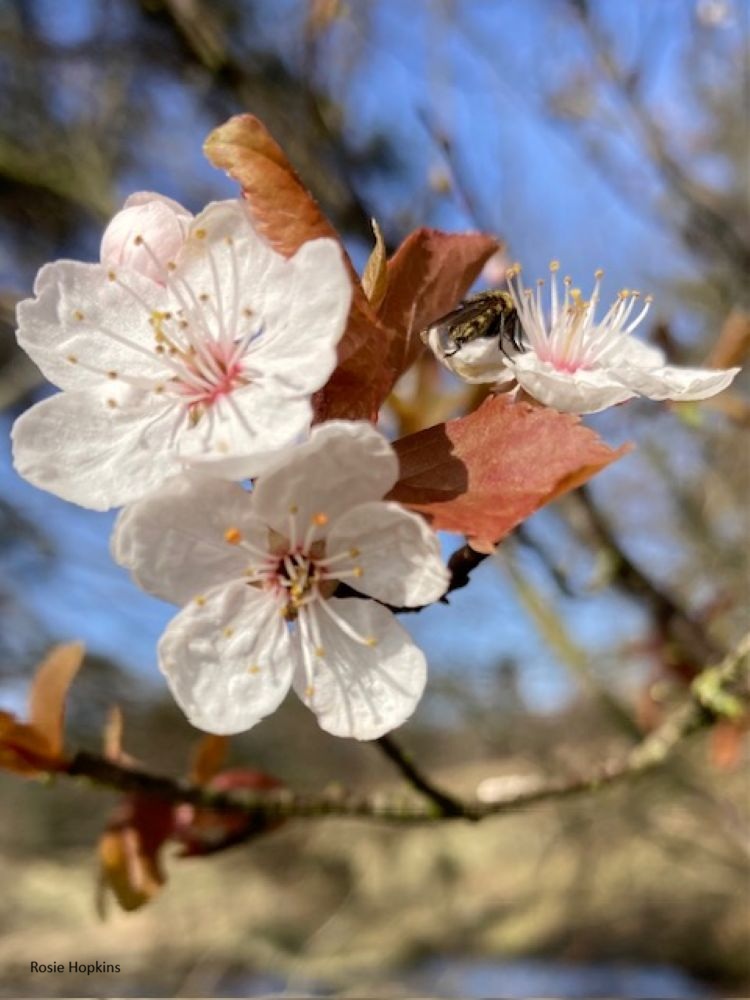
By Rosie Hopkins.

Beside the River Devon, two trees with blossom – one Cherry Plum, but I’m not sure of the other.


Neither have thorns so the traditional herald of Spring, the Blackthorn, it is not.
An exciting discovery on the Devon Flats yesterday, 23 March, between Dollar and Tillicoultry, Butterbur in its infancy and evidence of beavers reintroduced to Scotland in 2009 after being hunted to extinction in the 16th century.


The river Devon is one of several tributaries of the River Forth which flows through three Scottish counties; Perthshire, Kinross-shire and Clackmannanshire, where it joins the river Forth.
The source of the river is in Perthshire, on the slopes of Blairdenon Hill in the Ochil Hills, at an altitude of 1,800 feet. At various times, the upper areas of the river have been dammed. The high-level reservoirs are named Glenquey and Glensherup, after the Devon’s high-level tributaries, and Upper Glendevon (Upper Frandy) and Lower Glendevon (Lower Frandy). The still lower level Castlehill Reservoir at Glen Devon was created around 1975.
The Devon then flows east and southeast through Glendevon, turning southwest at Crook of Devon in Kinross-shire, where the river takes a sharp turn, continuing westwards, meandering across the valley along the foot of the Ochil Hills. It reaches the River Forth to the west of Alloa at the small village of Cambus. The catchment covers an area of 181 km2. The River Devon.




Leave a Reply