
Elections to the Scottish Parliament take place on Thursday 7 May. In this series we look at what decisions are made in our parliament which affect daily lives in Scotland. So far we’ve looked at Education and NHS Scotland.

Transport
Transport Scotland is the national agency whose objective is to deliver the Transport policies of the Scottish Government which have been agreed to by MSPs in the Scottish Parliament.
There are some aspects of Transport which remain in the power of the UK Government. These include:
- bus and coach licensing
- the Highway Code
- vehicle standards
- driver training and testing
- driver and vehicle licensing
- maritime, aviation and railway safety
- the accessibility of public transport
Through the Scottish Parliament, Scotland can decide upon:
- setting drink and drug-driving limits
- speed limits
- some aspects of railways, including Scottish passenger rail franchises
- concessionary travel schemes
- cycling
- parking
- local road pricing (including congestion charging)
- promotion of road safety
- road signs

Concessionary Travel
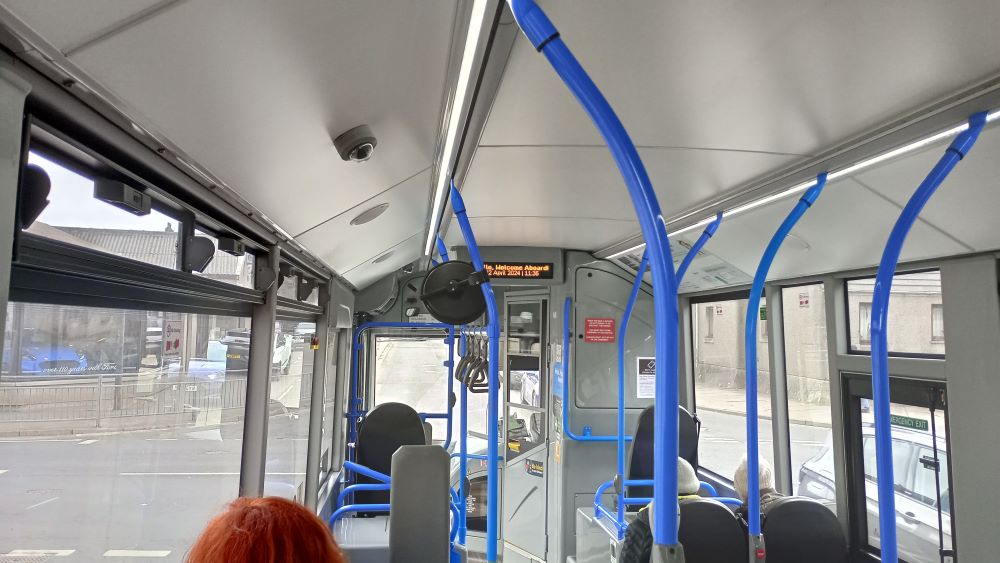
Over 2million Scots travel freely by bus, and some islanders get free ferry journeys.
Young people up to the age of 22 have free bus travel. Over 800,000 have chosen to do so using their National Entitlement Card (NEC). From 1 April 2025 this card can also be used by islanders in Orkney, Shetland, and the Outer Hebrides for free inter island journeys.
People over the age of 60, or have a disability, can also receive free bus travel. For eligible people of any age with a disability, companions travelling with them can access free travel. There are also two return free ferry journeys from Outer Hebrides/ Orkney/Shetland to the Scottish Mainland a year.
Currently running in Orkney, Shetland and the north of Scotland is a flat rate £2 bus fare in a pilot scheme for a year.

Ferries
There is a lot of debate in Scotland over replacing its aging ferry fleet to the islands. There is also discussion, particularly in Shetland, over the protentional for constructing fixed links/tunnels, as seen in Faroes.
Since 2007, the Scottish Government has invested over £2.2 billion in the Clyde and Hebrides Ferry Service and the Northern Isles Ferry Service. This includes not only the running of the ferries, but subsidising fares, infrastructure, and new vessels.
The current Northern Isles Ferry Services contract (NIFS3) run by Serco/Northlink expires on 30 June 2028. A public consultation was launched on 22 July 2025 for NIFS4 and ran for 13 weeks, closing on 20 October 2025. Click on this link to view the Report, and summary of responses.
It will be up to MSPs in the next Scottish Parliament how much they will permit the new Scottish Government to spend on Ferries.
CalMac Ferries Ltd provide the Clyde and Hebrides ferry services under tendered contract with Scottish Ministers. Click on this link for information about CMAL (Caledonian Maritime Assets Ltd.) On 17 March 2026 CMAL announced that it had awarded the contract to build two freight flex vessels for the Northern Isles to Guangzhou Shipyard International Co., Limited (GSI).
The 140m long freight flex ferries will replace the Helliar and Hildasay on the service operated by Serco NorthLink Ferries. They will provide extra freight capacity and capability for quicker crossings on the routes, and will have the flexibility to allow space for up to 200 passengers to travel at peak periods. – CMAL
A contract to build seven small electric vessels was awarded to Remontowa, Gdańsk, Poland in March 2025, following a competitive tender process. SVRP phase one represents a £160 million investment from the Scottish Government, with the shipbuilding contract valued at £147.5 million. Delivery of the first vessel is expected in 2027. The new ferries will serve key routes including Colintraive–Rhubodach, Lochaline–Fishnish, Tarbert–Portavadie, Iona–Fionnphort, Sconser–Raasay, Tobermory–Kilchoan, and Tayinloan–Gigha.

Roads
Locally, roads are maintained by the Local Authority. Transport Scotland is responsible for ongoing maintenance work across its network of trunk roads, bridges and other structures.

Railways
ScotRail (1 April 2022) and Caledonian Sleeper (25 June 2023) passenger services are in public ownership in Scotland. ScotRail Trains Limited and Caledonian Sleeper are owned and overseen by Scottish Rail Holdings Limited (SRH Limited), which is wholly owned by the Scottish Government. Visit the SRH website for further information.
There is a range of discounted fares available for those eligible when travelling by train in Scotland:
- Jobseekers across Scotland with free travel to interviews and a Monthly Season ticket for their first month at work.
- Veterans Railcard
- Kids for a Quid
A number of other railcards offer UK-wide discounts for rail travel, including:
- 16-25 Railcard
- Senior railcard
- Two Together Railcard
- Disabled Persons Railcard
- 26-30 Railcard
- Family and Friends Railcard
Find more information and apply for discounts at the Railcard website.
Scotland’s rail network supports over 13,000 jobs – 9,000 of those directly. There are hopes to open new stations and routes.

Air Travel
Air fares to the islands are expensive.
An Air Discount Scheme subsidises air fares for residents in the islands and has been extended to at least 31 March 2027. It gives a 50% discount on core air fares for residents of Caithness and parts of Sutherland, Colonsay, Islay, Jura, Orkney, Shetland and the Western Isles on eligible routes, it also applies to students from these areas who are studying away from home. Registered Third Sector organisations who have employees/volunteers that have their permanent/main residence in an eligible area can also apply. Those wishing to use this scheme need to register for it.
It would be up to MSPs in the newly elected Scottish Parliament and the new Scottish Government on whether or not it wished to continue with this scheme. Some routes (lifeline) in Scotland are subsidised by the Scottish Government and Local Authorities.
Highlands and Islands Airways (HIAL) is a Non-Departmental Public Body, wholly owned by the Scottish Ministers. It has a Board of Directors accountable to the Scottish Ministers. HIAL is responsible for the operation of the following 11 airports: Wick, Barra, Benbecula, Campbeltown, Dundee, Inverness, Islay, Kirkwall, Stornoway, Sumburgh, and Tiree.
Scotland’s four main airports operate on a commercial basis.
Glasgow Prestwick Airport was purchased by the Scottish Government in November 2013 to protect jobs and safeguard a strategic infrastructure asset. The airport operates as a commercial business at an arm’s length from the Government. It employs 300 workers.

MSPs will decide on Scotland’s future Transport investment – vital to creating a strong, resilient and sustainable economy. The concessionary travel schemes encourage people to use public transport and play a key role in reducing isolation and loneliness. Ferries, and/or fixed links, are part and parcel of living in a nation of islands. How will the MSPs elected in May ensure that these are adequately funded?
This a short slice of some of the important aspects covered by ‘Transport’.
Fiona Grahame

Leave a Reply