
By Rosemary Ramsay.
In March this year I was fortunate enough to be one of a group of six ordinary people (four women and two men) going on a trip to Uganda with a rather extraordinary small charity, the Uganda Support Fund.
The Uganda Support Fund (USF) was formed in 2005 ,after the daughter of a friend of a friend of mine (Claire) went on a GAP year working trip to Uganda and explained about the poverty she saw at first hand on her return and organised a trip to Uganda for her mum (Sylvia) and some nurse colleagues of Sylvia’s who wanted to do something to help.
On completion of her teaching degree, Claire returned to Uganda where she lives and teaches (so can ensure money raised by USF gets to those for whom it is intended). Since then, over 45 people have visited Uganda and USF projects (at their own expense) to see how the money is used and to help with practical projects like painting walls and constructing small items like shelving.
Through fundraising, as well as direct debits to the charity, about £3000 is being raised annually, USF has helped lift many orphaned children and families out of severe poverty. Over the years the charity has built a school, a community centre/church, as well as a piggery in remote areas and has enabled numerous water wells and bore holes to be constructed. USF has paid for schools and orphanages to be refurbished and has trained midwives, nurses, teachers and a doctor. Grants have been made for paid for vocational training and there have also been individual sponsorships of children and young adults and food, mosquito nets, mattresses and books purchased for families and institutions.
Some background information about Uganda. (The bit I googled before going!)
Uganda, often referred to as the Pearl of Africa, because of spectacular landscapes, rich biodiversity and very welcoming people is a landlocked country in East Central Africa which is centred directly on the equator. Official Languages are English (widely used in business, government, and education) and Swahili. The current president is Yoweri Museveni. He has been in power since January 26, 1986, and is currently serving his seventh consecutive term in office.
From what I was told, in particular by our drivers was that while they did not view their government as perfect, they valued the relative peace and saw some progress since 1986, colonisation and the Idi Amin years having been oppressive and turbulent. Judging by posters displayed, it would seem that there had been many women candidates in the elections held towards the end of last year. I was told that 85% of the population identify as being Christian and I certainly saw many churches of different denominations. Indeed while in Uganda I had the opportunity of attending possibly the most ecumenical service I ever have. It was being taken by a Japanese minister and the congregation comprised many nationalities.
Before the trip.
There was a fair bit of preparation to be done prior to going on this trip. Many injections, and the packing took a bit of thought. There were particular things recommended for inclusion in personal packing (sunhat, sunscreen, insect repellent) and, of course, malaria tablets were an absolute must.
Also, we were to take one extra suitcase which would be filled with items which would be left along with the case, in Uganda. My extra case was full of towels, sheets and shoes many of which were donated by kind friends in Orkney. I could take 2 x15kg cases with me on the Loganair flight down to Norwich, where I met up with the group organiser, Sylvia and the rest of the group (who, incidentally, like me, were not chosen for any specific skills or qualifications, just the desire to make even a small difference to the lives of people we would meet in Uganda). Both cases were made up, by the trip organiser to just under 23kg, the maximum allowed by KLM, by adding other items, in particular, children’s reading books. We flew from Norwich to Amsterdam, then Amsterdam to Kigali, Rwanda where there was a brief stop before going on to Entebbe, Uganda. We arrived late at night and stayed at the airport hotel.
The Trip
The following morning we began the 70 mile journey from Kampala to Jinja. We left early as we needed to get to the school before their day finished and it was estimated that the journey would take possibly upwards of five hours.
How could going the equivalent of roughly twice across Orkney take that long?
Many reasons. Lots of traffic during some parts. By each side of the road, ran concrete ditches wide and deep enough for a tyre, even a lorry tyre plus the side of a lorry to slip into, causing a partial obstruction. Then there were the ”bodas” or “boda bodas”!

These were motorbikes which transported passengers (sometimes two or three people behind the driver), or goods such as wooden planks the width of one, or both lanes of the road. Add to this pedestrians weaving in and out of the traffic, often trying to sell bottled water, fruit or halved, roasted chickens on sticks to the occupants of vehicles forced to stop due to the surrounding chaos.
There were spells when our amazingly skilful driver was able to manoeuvre the minibus and drive relatively unimpeded (although chickens, goats, the occasional dog or even cattle carried on appearing ).
The suburbs were populated by many very small shops constructed mainly from wood, corrugated iron and chicken wire. There were buildings under construction with men perched on scaffolding made from bamboo or at the side of the road, welding with no safety wear or equipment. The countryside varied greatly. Sometimes it was dry arid soil where people, both men and women, the latter often with small children close by or babies strapped to their backs by means of slings made from fabric, could be seen breaking up the very hard clumps of earth with hand tools. At other times we passed through the most beautiful lush green areas which produced the best pineapples, water melons and mangoes that I have ever tasted.
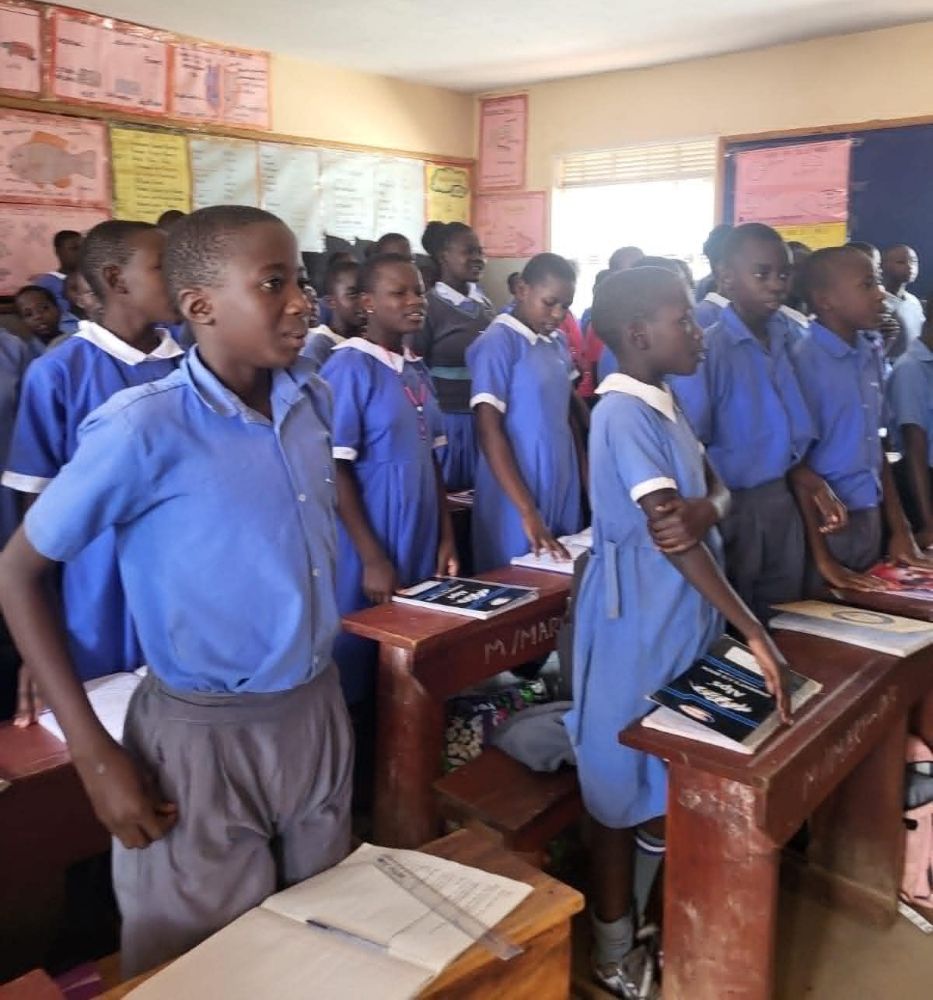
On arrival at the school, we were shown round. The children were excited to see us and very smart in their clean tunics. That is expected, although how their parents managed to achieve such laundering with their limited access to clean water, I do not know.

The classrooms had broken and uneven concrete floors, and were divided by what looked like plasterboard walls. At home time we walked, guided by the headteacher, to the village where the children lived.

It was about a mile and a half along a deeply rutted red clay road. Some children carried smaller siblings on their backs. The houses were tiny and largely fashioned with wood and wire but people were very pleased to see us and wanted to show us their houses. The charity, via Sylvia, gave out small sums of money and as many children as possible received sweets.

We were aware many would not eat until the next day at school when a simple meal of rice and beans would be produced in the cookhouse over a wood fire in large black pots.

The following day we painted a classroom, spent time speaking with the children whose ages were about 4-14 and goods were handed out, in particular shoes and books. How these children smiled, sang and danced through their day despite seemingly having so little.

In the evening, we took a boat ride to the source of the Nile and it rained. How it rained! But, it was like having a warm shower. The river teemed with hippos and on the banks, we saw crocodiles, one about eighteen feet long. While excited to see these fascinating creatures and glad to see them thriving, I was conscious of being in a sturdy boat, as opposed to the very much smaller, lighter craft in which those fishing for a living or simply needing to cross the river had to put out.
During the next few days, we visited an orphanage, more schools and a project that aims to help children through music.
AIDS is still an issue in Uganda and so is poverty. I was told that only 2% of the population are over 60 years of age. The orphanage was staffed by one elderly nun and a few young people, all who were very kind and attentive to the children who ranged in age from a few weeks to about two years old. Children were picked up if they cried and fed, the tiny babies received formula milk and had nappies of sorts but the older babies and toddlers were mainly dressed in tee shirts and had no nappies.
The charity brought the orphanage a range of children’s toys but what they really seemed to want was the large sack of rice that we stopped off for on the way. Staff were kind but they really seemed just to manage to feed and clothe these wee ones rather than have the time to interact/play with them which is possibly why the children seemed to sit quietly for fairly long periods of time. We were told that generally the best outcome for these babies was to be adopted by relatives, although sometimes this meant they would become servants to the adopting family.
Over the next few days, there were visits and donations of goods made to other schools, one which was partly residential where some children boarded all the time as they were orphans. The dormitories were full of bunk beds on which there were mattresses and under which were small suitcases where the children’s few belongings were kept. There was usually a housemother to each dormitory. Once again, we found that children were very respectful, very well behaved and very aware of the need to behave well and learn.
The next few days were a mixture between donating food and particularly requested items (eg a kettle for a nurses’ home and clothes for individual people and families known to the charity) and going a circuitous route back to Kampala to see some of Uganda’s amazing wildlife. We saw Savannah and Colobus monkeys, hartebeest, elands, waterbuck and dik dik, buffalo, giraffes and elephants, one crossing over the road not far in front of the minibus. I guessed that they had the right of way.

Despite going once before daybreak and once after dark, we never did see any lions or leopards. At one of the places we stayed there was a family group of warthogs which, as all visitors were reminded, were wild (and thus not to be fed) where they were supplied with water to drink and in which to wallow. Thus the warthogs, staff and paying guests co-existed harmoniously – unlike baboons! One evening, a baboon appeared on the veranda of the dining area we used and swiped a bag containing teabags. Undaunted, the lady to whom these belonged gave chase and managed to retrieve them from a somewhat surprised baboon!

Our African animal experience culminated in a visit to a rhino sanctuary. I still look back at that day and almost cannot believe that there was no fence between us and a family group of rhinos. Our young guide who was quite evidently passionate about his work exuded calm as he briefed us on where to stand and of the need to be quiet. He proudly told us that within the sanctuary there were fifty-five rhinos and they had not lost any to poachers and explained that there was a ranger allocated to each rhino group. We indeed saw the ranger who was guarding the group we were close to. He was armed with two rifles, one we were told he shot into the air if a rhino appeared to be getting too close to a tourist, one heavier weapon was for use against poachers.
By this time, I had seen many people of working age in many different jobs. Tourism, in various forms employed many people. (And how hard working were the smiling staff who looked after us in the various places, and what long hours they seemed to work.)
Towards the end of the trip we visited a recycling plant where waste paper was turned into many functional and /or beautiful items: discarded bottles became useful jugs and tumblers or really decorative vases and glasses and plastic drinks bottles formed really strong rope.

The last evening was spent watching a professional group of Ugandan traditional dancers which was spectacular, but what I really took away with me was the pride they had in their culture and the strong anti-war sentiment woven into the compere’s comedic narrative.
An amazing trip, an amazing country. Definitely to be recommended as a holiday destination, or maybe join one of Sylvia’s trips?
Uganda Support Group details :- Uganda Support Fund’s bank account is with Barclay’s, the sort code is 20-49-11 and the account number is 03829898 should anyone wish to donate any sum however small. USF is managed by Sylvia Webster and Clare Bakashaba who work voluntarily and accounts are produced yearly, at no cost to the charity. All funds raised go directly to the projects.
Contact number – 07747774631 or 01953 529781 for more information.
Facebook page: Uganda Support Fund

Leave a Reply