
Continuing with our Tourism theme this week we look back to the 19th and 20th centuries. Top author of his day Sir Walter Scott visited Orkney. Like tourists today one of the places he went to was the Standing Stones of Stenness in August 1814.
He was so inspired by the Stones and other tales he heard in Orkney including that of Pirate John Gow, that much of his novel ‘The Pirate’ is drawn from his time in the islands.
‘These immense blocks of stone stood around the pirate in the grey light of the dawning, like the phantom forms of antediluvian giants.’

Tourism to Orkney really took off in the 19th century with novels like ‘The Pirate’ and other writers who published accounts of their travels. Transport improved greatly with the introduction of a steam ship service sailing regularly. Thurso railway station opened in 1874 as the rail network expanded.
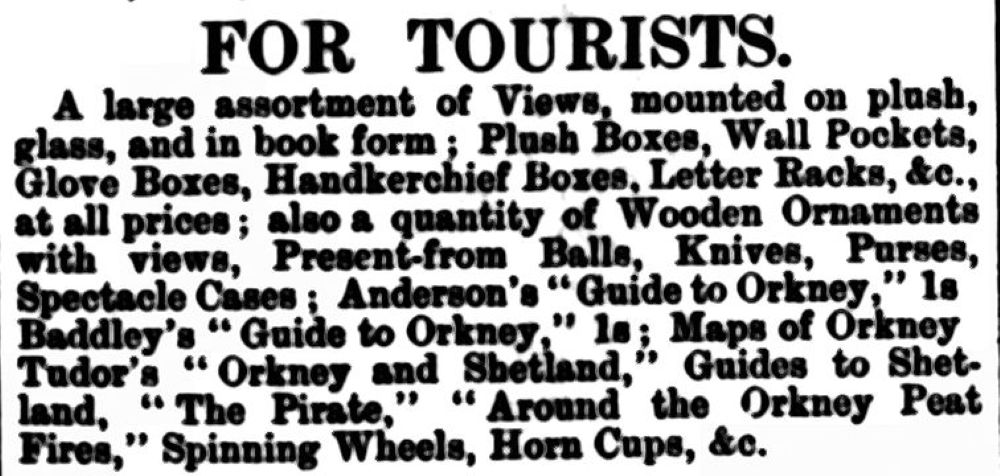
Souvenirs and postcards helped spread the word as visitors took away from Orkney not only memories but gifts for friends and family.


During both World Wars, the only people arriving and departing Orkney were service personnel as the islands became a giant fortress.
Promoting Orkney as a Tourist destination, especially for Americans, again came to the attention of the islands’ councillors in the 1950s. At a meeting in Kirkwall Town Hall in September 1957, Mr W. A. Nicholson, Manager and Secretary of the Scottish Tourist Board declared that Tourism might become Orkney’s second most important industry. Nicholson could foresee a time when ‘Americans might be landed from cruising liners in Kirkwall.’ (As reported in The Orkney Herald, 24 September 1957.)
It’s interesting that many of the same topics and ideas came up for discussion then, as now.
” Treat your tourists well, said Mr Nicholson. Be courteous and hospitable… Signpost your places of interest and see that good maps are available. ..An information centre would be well worthwhile”

John Gow and Sir Walter Scott.
On his visit, Walter Scott heard of the Orkney pirate John Gow captured off the island of Eday in 1725 and who was subsequently hanged in London. Thora Gordon, having married the pirate by handfasting at The Odin Stone in Stenness, walked to London to clasp his dead, decaying hand so that she could be released from her marriage vows.
“Gow, Williams, Belvin, Melvin, Winter, Petersen, Rollson and Mackauley were taken in 3 carts to Execution Dock, Wapping and executed on 11th of June 1725. Gow hung for four minutes when the rope broke. He climbed the ladder for a second time and was hung again. The bodies of Gow and Williams were cut down, tarred and rehung in Chains facing each other.”
In the early 19th Century Orcadians were still travelling to the Stones of Stenness which held a magical draw for them. Lovers would drink of the waters of the nearby well at Bigswell. From there they would go to The Odin Stone. This standing stone was just to the north of the ring at Stenness. It was said to be 2.5 meters high and 1 meter wide but its most important feature was a hole bored through it. The Odin Stone was believed to contain great healing and positive powers. New born babies would be passed through the hole to ensure they had good health. People visited the stone and left offerings at its base. For lovers, the ceremony of handfasting joined them in a binding marriage.
If Captain John Mackay who leased the Farm of Barnhouse had completed his task to destroy the stones we would not have them today for visitors and local alike to enjoy. You can read about that episode here:
A John Gow trail has been developed by The UHI Institute for Northern Studies in partnership with J Gow Distillery. The trail tells the story of John Gow, and the locations associated with his intriguing adventures. The trail is the result of a whole year of research conducted by Dr Andrew Lind from the UHI Institute for Northern Studies and the J. Gow Distillery located, Lamb Holm. There’s a printed fold-out map and leaflet. Additionally, the map and leaflet are available for download to mobile phones.


Click on this link to download the map and leaflet from the UHI Institute for Northern Studies website.
Fiona Grahame

Leave a Reply