
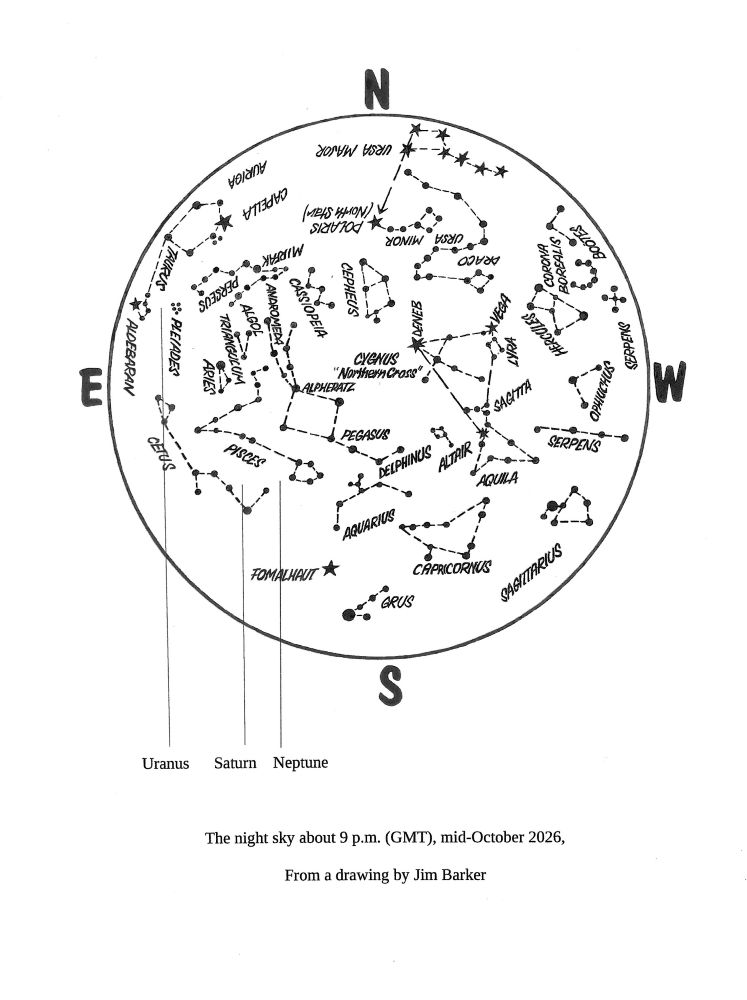
The Moon is New on October 10th and Full on October 26th, meanwhile passing close above Mars on the morning of the 5th, Jupiter on the 6th, and Regulus in Leo on the 7th, going on to pass Saturn on October 23rd and 24th, and occulting the upper Pleiades on the night of October 27th-28th, 2-3 nights after the end of British Summer Time on the 25th.
The planet Mercury is too close to the Sun to be visible from here, though at its greatest distance from the Sun on October 12th.
Venus is also invisible from this latitude this month, at inferior conjunction with the Sun on the 24th.
Mars moves through Cancer, rising at 00.30 a.m.. The Moon passes close above Mars on the morning of the 5th, occulting it as seen from NW Canada and China, and Mars is directly in front of the star cluster Praesepe, ‘the Beehive’, on the mornings of the 11th and 12th, overtaking Jupiter as the month goes on (see below).
Jupiter in Cancer reappears in the morning sky, rising around 4.30 a.m., below the waning crescent Moon on the 6th. At the end of the month Jupiter is below Mars and above Regulus, in the morning sky, and at 10.18 a.m. on the 6th, Jupiter will be occulted by the Moon, in daylight from here but well seen from the United States. By the end of October, Jupiter will be in the same binocular field as Mars. As Jupiter nears its equinox in December, its four major moons will take part in an increasingly complex series of eclipses and occultations, detailed in the October issue of Astronomy Now and after.
Saturn in Pisces is at opposition, its nearest to Earth, on October 4th, visible all night long, passed by the Moon on October 23rd and 24th. The current issue of Astronomy Now points out that the rings will temporarily be brighter than usual and as bright as the planet’s disc, for a few days around opposition, due to a reflection process called ‘the Seeliger effect’.
Uranus, in Taurus, rises at 7.30 p.m., 5 degrees south of the Moon on October 1st and 28th, approaching opposition with the Sun next month.
Neptune in Pisces sets at 5.30 a.m..
On the night of October 21st-22nd, the Earth makes its annual crossing of one of the meteor streams from Halley’s Comet, coming from Orion with best visibility in the morning after Moonset. As the comet passed its furthest distance from the Sun in 2023, and won’t be back until 2060-61, very little is expected this time – but you never know when you might catch a stray meteor from it, during the crucial dates.
Duncan Lunan’s recent books are available from booksellers; details are on Duncan’s website, www.duncanlunan.com.




Leave a Reply