
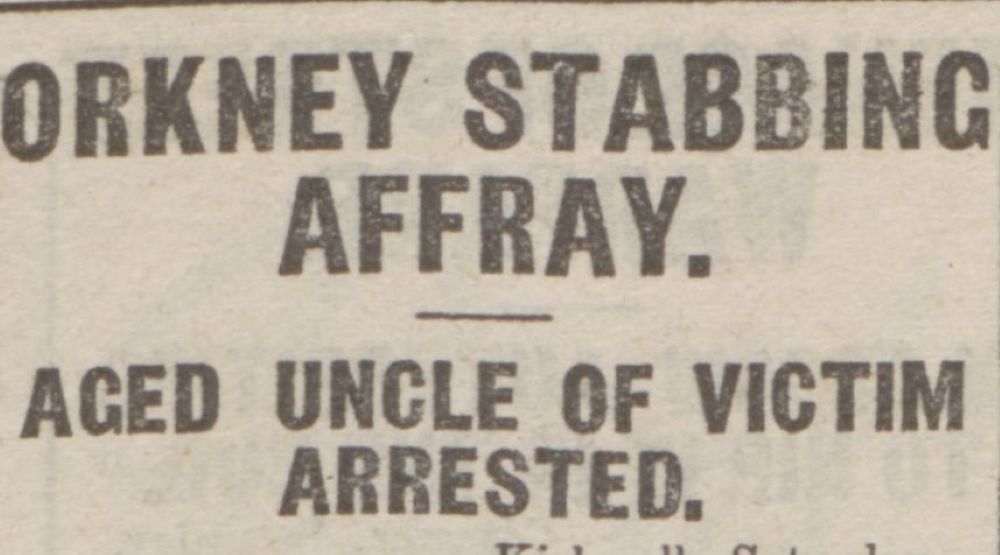
A family feud came to a crisis point when on the night of 5 October 1926, John Thomas Wishart, aged 74, of The Academy, South Ronaldsay, stabbed William Simison, aged 51, a farmer of Barswick, in the back, to the endangerment of his life.
Seven years ago John Wishart returned from America where he had spent most of his life. He went to live at first with his nephew, William Simison, and stayed there for about 3 weeks. Then they fell out. According to Wishart he had since been subjected to abuse and stone throwing by young men at his home.
On 5 October, his wife had gone to bed but Wishart stayed at the window looking out over his property. He saw someone coming, went out and challenged them. He said that Simison attacked him, punching him to the ground. He had lost his temper and responded by stabbing him in the back.
According to inquiries made by the Fiscal, there was no evidence of consistent abuse of Wishart, except for one incident 3 years ago, where some children had thrown clods of earth at his house. It was also stated that Simison had not entered Wishart’s property on the night of the attack, but was walking past his house on his way home having been out looking for the travelling van on its return from St Margaret’s Hope.
Wishart seized Simison by the throat having crept up on him, continued to follow him and stabbed him twice in the back. Simison staggered home despite bouts of feeling faint. He did not realise he had been stabbed until he felt the blood trickling down his back. Medical aid was summoned in the form of Dr Dewar and the stab wounds were discovered. He had two wounds in his back: one on the left shoulder 2 and half inches in length; and the other 3 and a half inches long. There were also two incisions on his left arm. He was in a very weak state.
John Wishart pled guilty. He was sentenced to six months imprisonment. In sentencing him the Sheriff said that it was a particularly vicious assault.
“It was an assault with a knife, which was entirely foreign to all sentiment in this country. Had accused been a younger man he would have sent him to prison for a long period.” – The Sunday Post, 31 October 1926




Leave a Reply