
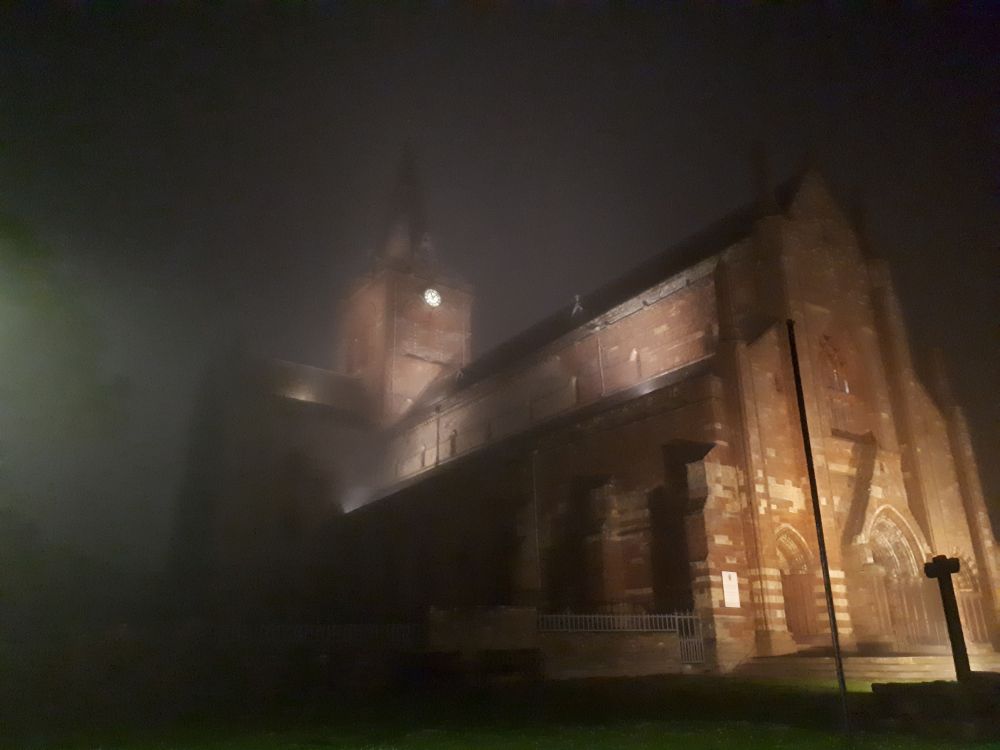
Image credit: Sean Page.
For Halloween, Lynn Campbell, Curriculum Leader at UHI’s Institute for Northern Studies, uncovered a haunting tale while researching eighteenth-century Orkney—a story of an ancient cathedral, a midnight wager, and a ghost demanding the return of its missing head.

Once upon a time, near St Magnus Cathedral in Kirkwall, stood a building with a long and remarkable history. Originally part of the cathedral complex, it housed the Chaplain’s Chamber and the Subdean’s Manse. Over time, its purpose changed, and by 1819 it had become Calder’s Inn, one of Kirkwall’s principal hotels.
The inn stood directly opposite St Magnus Cathedral, whose sandstone walls had watched over Kirkwall for centuries.
By then, the cathedral’s nave was still being used for burials. As space became scarce and new graves were required, the remains of earlier occupants were disturbed. Bones were dug up and moved aside, often with little ceremony. Skulls and skeletons accumulated in corners of the ancient building, their identities and stories gradually forgotten. It was an eerie setting—particularly after nightfall, when the cathedral fell silent and the narrow streets around it were wrapped in darkness.
One evening, two guests at Calder’s Inn found themselves discussing ghosts and supernatural happenings. One of the men was clearly enjoying the conversation and did his best to frighten his companion with stories of restless spirits and haunted places. His efforts, however, appeared to have little effect.
“Ghosts?” scoffed his companion.
“I don’t believe in such nonsense!”
“Don’t you?” replied the first.
“Then I’ll wager you haven’t the courage to enter St Magnus Cathedral at midnight and bring me back a skull.”
The challenge was deliberately outrageous. The cathedral was dark, silent, and filled with the remains of the dead. Surely even the most confident sceptic would hesitate before entering it alone in the middle of the night, but the second man refused to be intimidated.
“Is that all? I’ll do it. What’s the wager?”
“A bottle of claret.”
The bargain was struck.
When midnight arrived, the sceptical guest crossed the road from Calder’s Inn and entered the cathedral. The familiar building must have seemed entirely different in the darkness. Without daylight streaming through the windows, the great stone interior would have been filled with deep shadows, while every footstep echoed beneath the vaulted roof. He made his way towards the corner where the discarded bones had been piled. Keeping his nerve, he rummaged among the remains until his hand found a skull. He picked it up, satisfied that he had completed the challenge, and turned towards the exit.
Just then, a deep voice boomed out of the darkness.
“Give me back my head!”
The man was startled. Whether the voice came from the shadows, from the stonework, or from some hidden prankster, he could not tell. In panic, he flung the skull towards the sound.
“Here! Take it, then!”
For a moment, there was silence.
But the man still needed a skull to win his wager. He could not return to the inn empty-handed, so he bent down and picked up another. Clutching it tightly, he prepared to leave the cathedral once more.
Again, the voice rang out.
“Give me back my head!”
This time, the man paused. The demand seemed impossible. If the ghost had already received one head, why was it asking for another?
Then he remembered his own argument: he did not believe in ghosts.
“Well, you can’t have two heads!” he called into the darkness.
“And if you’re not satisfied with the one I’ve given you, you can jolly well find another for yourself!”
With that, he left the cathedral, skull in hand, and returned to Calder’s Inn.
Whether he was greeted with laughter, astonishment, or a well-earned bottle of claret is not recorded. Hossack, who preserved the tale, leaves the wager unresolved. Perhaps the sceptical guest won his prize. Perhaps his companions refused to believe that he had truly entered the cathedral. Or perhaps the story’s real purpose was not to settle a bet, but to remind listeners that old buildings—and the dead who lie within them—should never be treated too lightly.
Even today, St Magnus Cathedral remains one of Orkney’s most atmospheric landmarks. Its ancient stones have witnessed centuries of worship, burial, conflict, and change. And somewhere in its shadowed depths, if the old story is to be believed, a headless ghost may still be waiting for someone to return what was his.


Leave a Reply