
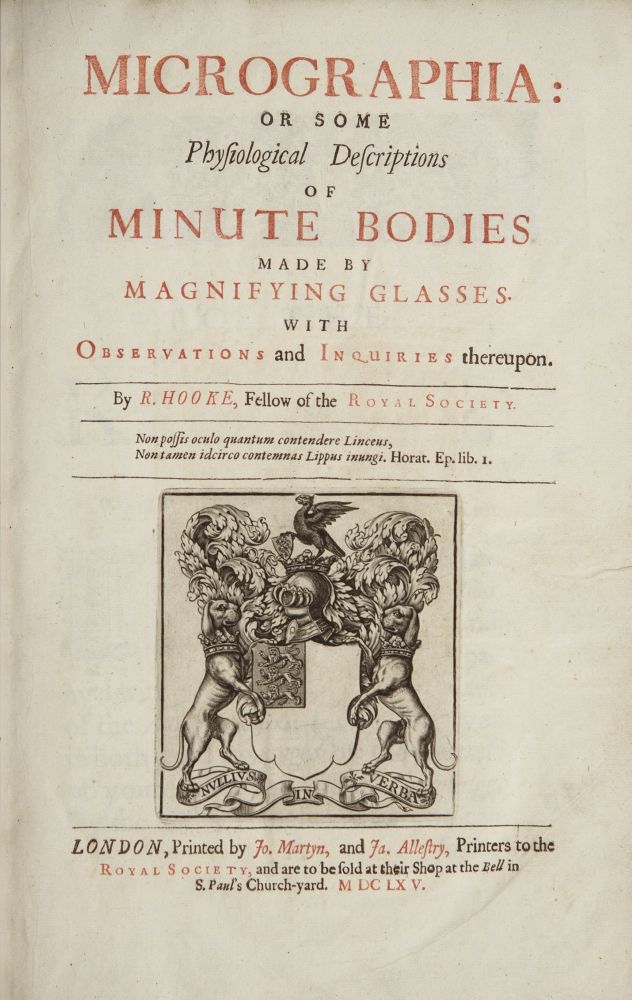
On 1 November 1665, Robert Hooke‘s landmark work “Micrographia,” with drawings using a microscope and coining the word “cell,” was published by the Royal Society.
Hooke was a Fellow of the Royal Society and from 1662, he was its first Curator of Experiments.
In 1663 and 1664, Hooke made his microscopic, and some astronomic, observations, which he collated in Micrographia in 1665. His book, which describes observations with microscopes and telescopes, as well as original work in biology, contains the earliest-recorded observation of a microorganism, the microfungus Mucor.

Hooke coined the term “cell”, suggesting a resemblance between plant structures and honeycomb cells. The hand-crafted, leather-and-gold-tooled microscope he designed and used to make the observations for Micrographia, which Christopher Cock made for him in London, is on display at the National Museum of Health and Medicine in Maryland.
Hooke’s work developed from that of Henry Power, who published his microscopy work in Experimental Philosophy (1663); in turn, the Dutch scientist Antonie van Leeuwenhoek went on to develop increased magnification and so reveal protozoa, blood cells, and spermatozoa.





Leave a Reply