
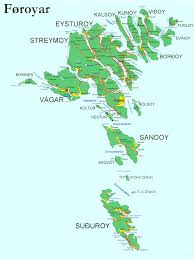
This is the first in a series of articles about self governing Islands and what we in Orkney can learn from their governance. The Islands Bill is currently making its way through the Scottish Parliament and it will see more powers transferred to Orkney.
The Faroes are an archipelago (several small islands) about half way between Iceland and Norway. The distance from Kirkwall, Orkney to Torshavn, Faroes is 247 miles. As a comparison the distance from Kirkwall to Edinburgh is 210 miles.
Like Orkney the Faroes were once under the control of Norway today they are mainly self governing and along with Greenland are part of the Kingdom of Denmark. Denmark retains control over: defence, police, justice, currency and foreign affairs. The capital of Denmark, Copenhagen is 816 miles from Torshavn.

In 1940, during the Second World War the islands were invaded by Great Britain in response to the threat from Nazi Germany’s advance into Norway. Returned to Denmark after the war the Faroes became self governing in 1948.
Although Denmark is a member of the European Union the Faroes are not, however, they do benefit from agreements made and EU funding as a result of Denmark’s membership. The Faroe Islanders consider themselves as European and have both a fisheries and free trade agreement with the EU. They maintain control over their fisheries.
“At present the Faroese government is assessing the possibility to widen the scope of cooperation to the so called four freedoms – the free movement of goods, services, capital and persons. They are also participating in EU’s research cooperation programme HORIZON 2020.” (FaroeIslands.FO)
The main energy supplier of the Faroe Islands, SEV, has officially announced that their goal is to have 100% green energy production by 2030 although to date 50% of the islands electricity is produced by fossil fuels. This is in comparison to Orkney where over 100% of our islands electricity needs is regularly produced through renewables (mainly wind).
The population of The Faroes is more than double that of Orkney at 48,308 with about half living in the main urban areas. The language spoken is Faroese which has its roots in Old Norse. In Orkney although the Old Norse based language of Norn was once spoken the remnants of it is mainly in place names.
It might surprise readers to find out that 80% of the Faroese People are Evangelical Lutherans, the established church , with a further 10% being Christian Brethren.
Fishing is of tremendous importance for The Faroes accounting for between 90 and 95% of total export value, and around 20% of the GDP. The Faroes has a 200 miles exclusive fishing zone but it also fishes in the waters of other nations through agreements.
Much further down but still of importance to the economy are tourism and wool production/goods. The ancient Faroese proverb “Ull er Føroya Gull” – “Wool is the Faroese Gold” is still relevant today.
This heavy dependence on one industry in the Faroes is in contrast to the economy of Orkney where although agriculture is important there is more of a mix with tourism, fisheries and renewables all playing a valuable role.
The Løgting with 33 elected members is the parliament of the Faroes. (With a claim to be the oldest parliament in the world). Two representatives are also elected to sit in the Danish Parliament. Voter turnout is very high in elections (88.8% in 2015) compared to Orkney (62% 2016). The Faroes are further divided into 30 municipalities for local government who have their own tax raising powers.
The Faroese Government has the power to negotiate international agreements for:
“external trade relations, customs, taxation and financial policy, business regulation, conservation and management of fisheries and all other utilisation of natural resources, energy and the environment, the labour market, social security, emergency preparedness, education, research and culture.” (FaroeIslands.FO)
It is hoped to extend this to immigration policy.
The additional powers coming to Orkney Islands Council will be nowhere near as significant as those held by the Faroese Parliament, even the Scottish Parliament does not have some of those. How we use the powers we do acquire, as in the revenue and management of the Crown Estate, is extremely important for the economic viability of our islands with the exit of the UK from the EU and the impact it will have.
The Faroe Islands have one tradition which has brought their islands into worldwide condemnation: The Grind. Every year 100s of pilot whales are herded into the shallows of the islands and slaughtered. The haul also includes bottlenose dolphins, Atlantic white-beaked dolphins, Atlantic white-sided dolphins and harbor porpoises. Sea Shepherd whose mission statement is to: ” end the destruction of habitat and slaughter of wildlife in the world’s oceans in order to conserve and protect ecosystems and species”, actively campaign using direct action to prevent the annual slaughter and “ to push the increasing global momentum to end this bloody and brutal practice.”

Although the Faroes are self governing over many aspects of their islands Sea Shepherd maintain that the Danish Government is responsible for allowing the continuation of the annual slaughter of whales.
“It is the position of Sea Shepherd that Denmark fails to fulfill its obligations under the Berne Convention for a number of reasons:
- The Faroe Islanders, who are Danish nationals, deliberately kill protected species that are listed under Appendix II of the Berne Convention, to which Denmark is a signatory state.
- While the Faroe Islanders claim that the grind is not a commercial hunt, grind meat is sold in supermarkets, hotels and restaurants, contributing to a trade that is even marketed to other European visitors to the Islands.
- The long-finned pilot whale passes through Faroes waters on an annual migration route to feed in Arctic waters. A single grind can completely decimate, and sometimes completely eradicate, an entire pod. This slaughter occurs in, and around, Danish territorial lands.”
Consumption of this whale meat is considered by many in the international community to be unsafe due to the large number of pollutants found in it. According to Sea Shepherd ‘ Meat resulting from the grind contains high amounts of arsenic, cadmium, zinc, lead, copper mercury, and selenium.’
By looking at how other island groupings use their devolved powers we in Orkney can consider in a more informed way how we will use ours. We can also consider how accountable we feel our islands’ politicians are and should be. Devolving more powers to Orkney brings with it the responsiblity of our local authority to make agreements that are not only beneficial to Orkney but also reflect the moral standards of the People of Orkney when it comes to the protection of wildlife. Future articles in The Orkney News will look in more depth at this aspect of our local governance and its ongoing relationship with The Faroes.
Reporter: Fiona Grahame


Leave a Reply