
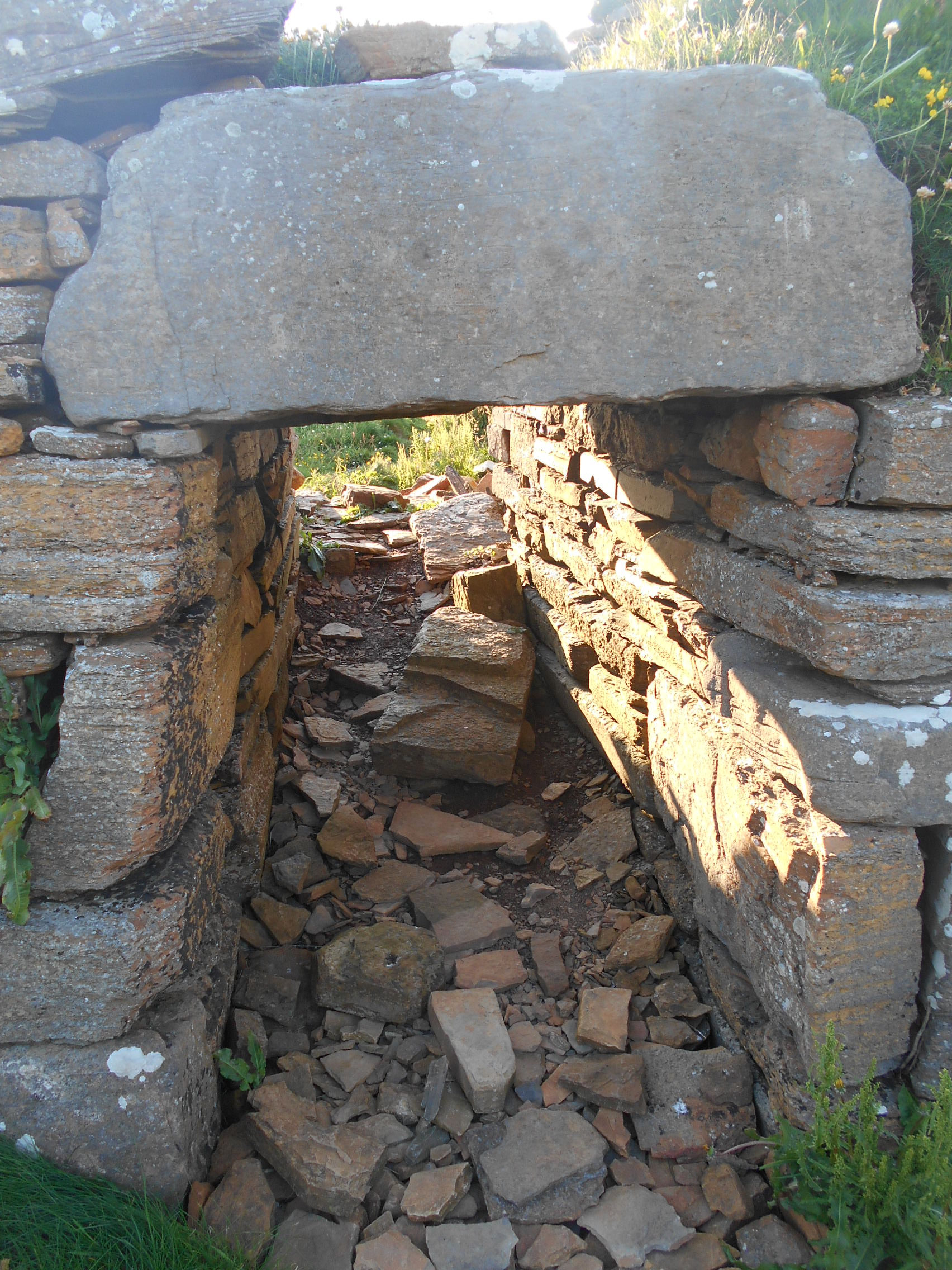
by W.G.T. Watt, of Skaill (from Orcadian Papers 1905)
These ruins are situated on a low-lying and flat promontory in the township of Outertown and parish of Stromness. They face Hoy Mouth, always in a state of commotion owing to the strong tide running to and fro through it, and which, in a westerly gale with the tide meeting the full roll of the great Atlantic waves, is probably one of the grandest sights in Orkney. But to add to the grandeur of this, there are, immediately across the sound, the lofty hills of Hoy, bleak, black and barren, with ragged cliffs against which the great waves dash and fall off in huge volumes of foam.
A bold beautiful landscape and sea piece to look at! Then to the north-west of the ruins are the dark, beetling cliffs of the Black Crag, 360 feet high, which gives shelter to the township from the cold north wind; while the green fields and well cultivated land round about form a pleasant contrast to the bold cliff scenery and boisterous sound. In winter the scene has peculiar charms, but in summer the effect is even greater, the whole surrounding landscape and, as a rule, less turbulent ocean being then lit up and mellowed by the bright and most exquisite colouring of the sunset, which is not surpassed even by “the glorious tropical” sunsets which I have had pleasure of witnessing. On the whole, a more romantic or picturesque spot for a dwelling would be difficult to find in Orkney.

I have frequently observed that the broch builders invariably pitched on a site not only suitable for natural defence but one that likewise had pleasant surroundings, so we are not surprised to find at Breckness the remains of a large and most interesting broch. I recently inspected the ruins, and came to the conclusion that the broch must have had an interior diameter of over 30 feet, with walls at least 16 feet thick. We may suppose that, looking to the measurements of other brochs, notable those of the broch at Mousa in Shetland, the one at Breckness was 50 feet or more in height, and no doubt similar to other buildings of the kin in the matter of its interior plan, all brochs having been designed very much alike. They were dry built circular towers, on an average between 40 and 50 feet, and walls from 12 to 15 feet thick. The outer and inner walls were well built, the intervening space being filled in with loose rubble work.

The entrance to a broch is generally about S.E., and the passage that runs through the thickness of the wall to the interior court is between 5 and 5 1/2 feet high, and about 3 feet wide. On the right hand side at the inner end there is generally a guard chamber. Off the court also are one or more small chambers in the thickness of the walls. from the ground floor a narrow stair leads to galleries. Light to the stairs and galleries is received from small windows looking into the court, but no windows, so far as I know , look outside from the external wall. In the case of the Broch of Burwick, however, which I partially excavated in 1881, I am inclined to think that above the passage over the doorway there has been a chamber with a small peep-hole or outlook. Around the top of the tower may have been a landing with parapet, from which the inhabitants could assail an enemy with comparative impunity.

Thus you may picture the Broch of Breckness. We have no certainty as to the period when brochs were erected, or what race of people inhabited them, though it is generally supposed that they were Pictish; but one thing is certain, they are of great antiquity, and the fact of the sea having encroached on the hard rocks of Breckness and carried away more than half of the Broch there, notwithstanding that it is a good deal sheltered from the fierce attacks of the Atlantic by the skerry of Braga and an outlying promontory, is sufficient proof of its great age.
From what I can gather, there is no doubt the Norsemen found the brochs peculiar buildings of defence on their arrival in this country about the ninth century. In Norway, I understand, no brochs or remains of brochs have been discovered.
I have never heard of any relics being found in the broch at Breckness, but a few years ago I came on a skeleton in the bank close to the broch. It lay full length in a grave, the sides of which were built with sea-worn stones, and which was covered with flat shore stones. Nothing was found in the grave by which to form any opinion as to the time when the internment had been made, but no doubt it was an ancient grave. There may be a number of such graves about the same place, as a broch when in ruins was a favourite spot for the people of early times to bury their dead in, but as a rule it was by cremation the ashes being placed in small cists similar to those found in tumuli.
Next week: More from W.G.T. Watt of Skaill and “Bishop Graham”




Leave a Reply to theorkneynewsCancel reply