
“An organisation that has to threaten its members to stop them leaving is not a club but a protection racket.” (Jeremy Hunt, talking about the EU).
“Now is not the time” (Theresa May).
 The great poet that was Lord Byron had a phrase he used about his hero Robert Burns. “The antithetical mind”, he called him. He meant that the key to Burns’ genius, ageless appeal and eternal relevance lay in his ability to look at things from a different perspective; to peer through the looking glass from the other side. It’s a trait never better illustrated than in the “Address to the Unco’ Guid”, which reminds us that our transgressions are part of our DNA – “to step aside is human”, he writes – and that rather than condemning folk for their “daffin’ sins” we should walk a mile in their shoes and consider what has brought them to act as they do.
“Then at the balance let’s be mute,
We never can adjust it;
What’s done we partly may compute,
But know not what’s resisted.”
2014 was the year I heard a great example of an antithetical mind. I’d driven to Airdrie to hear farmers, industry leaders and politicians make the case for independence. The farming arguments were as strong then as they are now – the very different nature of Scotland’s farming industry, its higher relative importance to the GDP, the fact that it supports 340,000 jobs, a food and drink industry that turns over eighteen billion a year. But, as often happened at meetings in 2014, the best points were made not by politicians but by people you’d never heard of.
A young lady – a farmer from the borders – framed the argument for independence in a way I’d never heard before and I’d never forget.
Here was the gist of her argument.
“Imagine the question posed the other way round” she said. “An independent nation is asked to decide whether to surrender its sovereignty to a larger union. It would be allowed a measure of autonomy, but key aspects of its governance would be handed to another nation. It would be used as a military base by the dominant power and tied to an economy over which it had no control.
It would have to be desperate. Only a nation in which the institutions of governance had collapsed or which had been ruined economically would contemplate this drastic step. Most nations faced even with such catastrophes choose to retain their independence – in fact, will fight to preserve it – rather than surrender to a dominant foreign power.
Imagine allowing that larger nation to run your economy. Imagine allowing it to decide which wars you were going to fight in. Imagine giving them your taxes and then begging for pocket money. Imagine getting ruled by governments you didn’t vote for and cannot vote out. Yes, we are voting to leave rather than to join, but what’s the difference? How is the argument altered by the fact that Scotland is considering whether to regain independence rather than whether to lose it? The answer is: there is absolutely no difference whatsoever”.
Presenting the argument this way changes the burden of proof. The question is no longer “should Scotland be independent” but is now “why on earth wouldn’t we?”. Now bring that into the context of Brexit and Scotland’s continuing journey towards independence, whether through a second referendum, or a Westminster election, or a Holyrood vote.
Let’s channel our antithetical selves for a minute and imagine that the EU Referendum had turned out rather differently. Imagine that Vote Leave hadn’t achieved its crucial two percent swing by means of a ten percent overspend; that we’d never heard of the Brexit bus, that David Cameron had actually tried a bit harder. Imagine it was 52:48 remain. Imagine that that result had been achieved by the remainers promising – by making a, ahem, “vow” – the euro-sceptic English public (and Brexit, make no mistake, is an English project) a further series of opt-outs and greater representation in Brussels. Now imagine if none of that was delivered and, actually, powers were taken from the British government in the name of European unity. Imagine the British Government told Brussels they were asking the voters again, as the deal they had been promised turned out to be a con and because this betrayal represented democratic effrontery on an epic scale. Then imagine if, with a Gallic shrug, the EU said “ce n’est pas le moment”.
Now is not the time.
There would, quite understandably, be the mother of all backlashes to this constitutional outrage. And yet the scenario describes, down to the last detail, the situation which currently faces the people of Scotland.
 Which takes us, with heavy hearts, to this week’s Conservative Party conference, held in a building in Birmingham funded by the European Union. I’m not joking. That delicious irony, along with Theresa’s dancing (which, true to their flagship policy, was seriously lacking in any sort of freedom of movement) were two moments of light relief in a deeply depressing few days. Ruth Davidson, in a speech aimed clearly at the same hardline unionist / no surrender vote she cravenly pursues in Scotland, promised that Scotland would not be permitted an independence referendum until at least 2027 – and this just a week after Labour branch office manager Richard Leonard promised roughly the same thing.
This is deeply troubling on a number of levels. For one thing, Ruth Davidson is the leader of a defeated opposition party in a Holyrood that voted for right to request a section 30 order to hold a second independence referendum and for the Holyrood EU Withdrawal Bill which would see devolved EU powers returning to Edinburgh in the spirit of devolution – a bill whose legality is currently being considered by the Supreme Court. How strong, how precious is this union when one partner is dragging another through the court? And what kind a person votes against her own parliament? And her own country?
For make no mistake, when Ruth talks about 2027, she means for as long as the Tories are in office. Only they aren’t in office, as they hold only 23% of the seats in Edinburgh. In that context, the fact that the vast majority of the Scottish media spins this as an “independence is dead” story speaks volumes. But of course what Ruth really means is that there won’t be a referendum for as long as the Tories are in power in England. Which means that, given that Labour have ruled out a second vote as well, the chances of being granted another shot at independence by London ever again are precisely zero. And it also means that Scotland is not Ruth Davidson’s country. Britain is Ruth Davidson’s country.
What should alarm us all is how quickly the unionist position has hardened. Margaret Thatcher firmly believed that all that was needed to bring about Scottish self-determination was for us to vote in a majority of pro-independence MPs at a general election. That in itself, she believed, was a mandate for independence – something those of us who wish to be free of the Westminster yoke should bear in mind if and when a snap general election is called soon. Indeed, every Prime Minister from Harold Wilson to David Cameron understood that the Union was a voluntary arrangement and that Scotland could leave any time of its choosing. Even as recently as 2016, Ruth Davidson, whilst not wanting another referendum, nonetheless described the blocking of it as constitutionally improper. Even Theresa May’s “now is not the time” soundbite was taken in good faith. Not now, maybe, but soon. But now we know that not only is now not the time. There will never, ever, be a time when Westminster allows another referendum.
So what has brought about this hardening of the unionist position? Clearly, a big part of the answer is Brexit – and how to pay for the hard version of it that they are clearly desperately trying to achieve in an act of nihilistic disaster capitalism. Brexit needs to be financed, and that’s why Scotland is crucial – the same reason Thatcher needed Scotland to break the miners, to de-industrialise the UK, to fight wars. Our job is to bankroll Brexit Britain. Without Scotland, Brexit is literally unaffordable. And that surely explains a lot. It explains a power grab that rolls back devolution and the Scotland Act. It gives context to the ripping up of Sewel and the beginning of the end of Barnett. Ruth’s 2027 will mark nearly a decade since the illegally won Brexit vote that Scotland didn’t want anything to do with and eight years since leaving the EU. That gives the establishment plenty time to achieve the dream double whammy of doing what it always did – stealing Scotland of its resources to pay for its own vanity projects – whilst making Scotland so impoverished, not only financially but also culturally and, crucially, spiritually. They said in 2014 we were too poor to be independent. We weren’t. But being asset stripped for a decade changes things. By 2027 we genuinely wouldn’t be able to be independent. We’d be broken. And broke.
But I think the biggest reason for this establishment assault on Scottish democracy is that the 2014 referendum scared them to death. I genuinely believe that their sole purpose since 2014 – having come so close to losing – is to make sure that independence never, ever, happens. It’s what they do. Actually, it’s all they do. It explains EVEL. It explains Brexit. There’s a great line that the blogger Paul Kavanagh uses in which he imagines The Scotsman headline the day after we reclaim our independence: “Blow for Sturgeon as SNP loses its raisin d’etre”. But you put in the words “Davidson” and “Unionist” and the line works even better. Without the Yes movement, Ruth Davidson has no purpose. None of them do.
So what is to be done?
What we must remember is that neither Ruth nor anyone else can take independence off the table. Only the people of Scotland can do that, and we have a triple locked mandate – a Westminster majority, a Holyrood majority and a section thirty order – that means we can call a second referendum whenever we want. But however energised the Yes movement is, we need our government to be bold. With the SNP conference starting this weekend, we need our government to be both honest and brave. Honest enough to say what is clear and in plain sight – that we will never be granted a second referendum by an establishment whose sole duty is to belittle and impoverish Scotland. And brave enough to admit this and to say that what really needs to happen is a second referendum within the lifespan of the current Scottish Parliament (because the section 30 mandate runs out in 2021), or making a likely UK snap election a plebiscite election a de facto referendum – or simply walking.
In 2014, we became the first country to vote against ourselves. Voting No was never going to be viewed as an article of faith but as a betrayal of weakness. We invited the British establishment to punish us for our impudence. It’s therefore no surprise that the last two weeks – indeed these last four years – have been nothing short of the all-out assault on Scottish democracy that we effectively invited upon ourselves on September 18th 2014 in an epic act of self-harm.
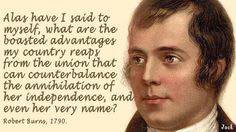
Robert Burns once wrote:
“I have often said to myself what are the boasted advantages which my country reaps from a certain Union that counterbalance the annihilation of her Independence, and even her very name!”
Scotland is at a crossroads and desperately needs bold thinking, moral courage and antithetical minds. This week’s SNP conference in Glasgow would be as good a place to start as any.



Leave a Reply to Bernie BellCancel reply