
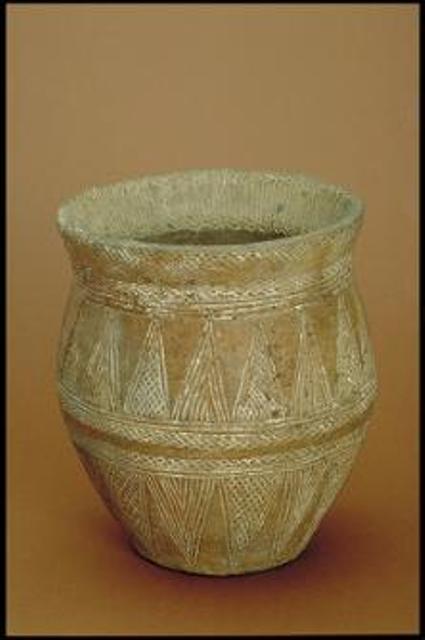
The Beaker People who inhabited the North of Scotland 4,000 years ago will be the subject of a Channel 4 programme later this year.
The programme will feature artefacts from the University of Aberdeen’s museum collection, said to be the finest in Europe.

The university’s collection consists of 80 skeletons and the many objects they were buried with.
Who were the Beaker People?
Living between 2,400 and 1,200 BC the Beaker People are so named because of the distinctive shaped pots they produced. These were a different shape to the ones produced by earlier people’s in the area.
This was the period known as the Bronze Age. It was a time of great change of climate, technology and of cultural practices.
A study of DNA [The Beaker phenomenon and the genomic transformation of northwest Europe]produced by an international team of researchers and scientists examined DNA from over 400 prehistoric skeletons, drawn from sites across western and central Europe. It looked at skeletal evidence from before and after the arrival of the Beaker People.
From the research it appears that there was a mass migration from the continent of Europe into the British Isles.
‘We found that the skeletal remains of individuals from Britain who lived shortly after this time have a very different DNA profile to those who came before. It seems that there is a large population turnover.’ Professor Ian Barnes, Research Leader in Ancient DNA at the Natural History Museum
The Channel 4 programme, The Bone Detectives, will feature the skeleton of a woman whose bones were found in a grave cut into solid bedrock at Achavanich in Caithness in 1987.
Known as ‘Ava’, modern DNA research techniques showed that she was descended from European migrants who arrived in Britain a few generations before she was born. Her remains were found alongside a Beaker, among other things.
She will be compared with a man whose burial was found on the farm of Newlands, near Oyne in Aberdeenshire, which is now in the care of the University’s museum collections. As well as a Beaker, he was buried with an item which has been identified as an archer’s wrist-guard, while the programme will also show a set of mint-condition flint arrowheads found in a burial from Borrowstone Farm near Aberdeen.
“The North-east of Scotland was one the areas that had very strong connections with the European Beaker phenomenon 4,000 years ago. On top of that, their burial in stone cists protected them for thousands of years, until they were discovered by farming, road and house building since the nineteenth century. Finally, the strong links between the University’s medical school and its museum meant that anatomists were well-placed to collect, study and curate the skeletons and other finds.” Neil Curtis, Aberdeen University’s Head of Museums and Special Collections
Across the continent of Europe it seems the ideas and technology of the Beaker People spread amongst different groups. It is suggested that the recent DNA evidence points to the Beaker People of the North of Scotland being part of the huge migration from the Continent rather than ideas spreading in the indigenous population.
Aberdeen University Museum’s Leverhulme Trust ‘Beakers and Bodies Project’ has radiocarbon-dated almost all the skeletons from the North-east of Scotland and made various discoveries, including identifying a particular style of Beaker found only in Buchan, and that most of the Beakers had originally had their decoration enhanced with a white paste made from burnt bones.

Readers may also like this: BEAKER FROM A CIST AT MILL FARM, RATHBN, NEARFRASERBURGH, ABERDEENSHIRE, AND A CISTCREMATION INTERMENT AT URY, STONEHAVEN,KINCARDINESHIRE. BY PROFESSOR ALEX. LOW, M.A.,M.D., F.S.A.ScoT
Leave a Reply