
Being a newcomer to around these parts, there are times when traditions that are perhaps engrained for other people, are simply invisible. A word can intrigue where for a local it is simply what it is, and intrinsically understood.
Covid brings challenges but also opportunities. I had set myself a task of recording some of the towns and villages of the coastal area of Ayrshire with my camera, but that is now a Tier 3 area and we are Tier 2 so never the twain should meet . For now. So I set my sights more locally in my closest town, Stranraer.
Stranraer’s history is long and intriguing.
It was at one point Gaelic speaking. The name is a possible derivation from “An t-Sròn Reamhar.” To my untutored eye there seems to be a bit of a question mark over whether the English is derived from the Scottish or Irish Gaelic. With the last part of this referring to fat or thick in the Scottish version probably with an eye to the geography it has been thought of as “ The Fat Nose “or the “ Broad Headland .“ Equally with Stran referring to a burn and the Irish Gaelic “ Ramhar” referring to “ swarming “ it could mean “ Burn Swarming with fish .” ( Which at one point it certainly was.)
Possibly your choice of derivation reflects the size of your nose?
In 1307 two of the De Brus brothers supported by Reginald de Crawford and Malcom McQuillan brought 18 galleys and 1,000 men to Loch Ryan. The purpose was to press Robert 1st’s claims in Annandale and Carrick. It didn’t go so well . Something of an understatement! They were met by a force supportive of Edward 1st, only 2 galleys escaped and the leaders were captured. The Brus brothers and Crawford were executed and McQuillan’s head was sent as a present to Edward 1st . There is no record of what he did with it, perhaps he collected them?
These days support for Westminster in the South of Scotland is rather more civilised and restricted to returning Unionist MPs. For now.
But it isn’t the first time that history has repeated itself.
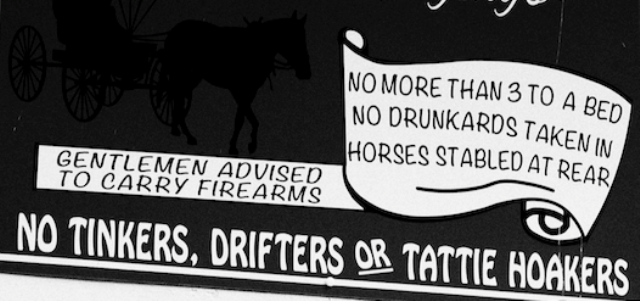
One of my photographic subjects is a pub . On the side is a sign taken from its history, it provides the advice that they serve excellent food ( they do ) and lodging . The latter adds :-
“Gentlemen advised to carry firearms – No more than 3 to a bed. No tinkers, Drifters or Tattie Hoakers “
But being from “ down south” I could guess at but didn’t know for sure what a “Tattie Hoaker” was .
So I did some research . For this is I am grateful to the website of the inishtrahull Journal (https://www.inishtrahullinitiative.com/inishtrahull-journal ) who were reflecting on the work and migration patterns of people from their area.
Until 2011 Stranraer was the key port for people coming to Scotland from Ireland, the port then moved to Cairnryan with disastrous financial consequences for the Town that we still feel these days . For 150 years, ferry traffic was central to the economy of the Town. Its architecture reflects different periods of Victorian influence much of which is now fading and in some cases, literally, collapsing .
A significant portion of the ferry traffic was through what the Journal refers to as “ a small army” of Irish workers who came to take in the early potato crop. They came from Mayo, the Donegal Islands, Leitrim, Cavan and Longford and laboured in; Ayrshire ,Perth, Fife and beyond . Often they would come over in squads of 30, some extended family groups, usually from very small communities and often accompanied by a senior woman who served as their cook. They included men women and children, some as young as 12 and 13.
Concerns about their living conditions were heard as early as the 1890s with people being housed in the most squalid of circumstances . Crowded into barns or cattle sheds where the evidence of the cattle’s very recent turn out into the field was only too evident . Sometimes they shared the byres with the animals. Poor food, no running water, no toilet facilities. One Doctor commented “ I had never myself seen human beings lodged so utterly indefensibly as regards to hygiene and human decency. “
Cynical hypocrisy is of course historically universal but it is a genre that the Victorians unabashedly excelled within . Apart from disease, which naturally was the fault of the workers, “ the moral welfare” of the workers was of concern as was the possibility of a perceived moral deficiency leaking into the population of their hosts . I remember seeing the vilification of Irish workers in a journal relating to Wigtown in the 1900s and wondered what vitriolic focus of that unexpurgated racism, was .
One outcome is that workers were often locked into their accommodation at night . Two terrible fires in 1922 killed a mix of nine migrant workers and settled Irish labourers and in Killintilloch in 1937, 10 young men and boys were burned to death in a similar incident . The women and girls had been put into another building. Coming from a very close community can you imagine their distress as their men folk were being burned to death and they could do nothing about it ?
Of course these days we are far too civilised than stoop to demonise migrant workers whose chosen labour we eschew yet benefit from………Eastern European pickers and Chinese cockle pickers perhaps might beg to differ.
Their living circumstances might be more sanitary. Those who supported Brexit for other reasons would passionately disassociate themselves from the views of extremists but the latter provide uncomfortable evidence that bigotry, like cynical hypocrisy, is more a hardy perennial than a freak aberration .
So Tattie Hoakers are Potato hawkers or pickers and I have learned something .
But in so small a lesson is also every aspect of the human condition. Joy, hope, despair, exploitation, and a dangerous sense of “ otherness ” that mutates and transfers itself through the generations .


Leave a Reply to Bernie BellCancel reply