
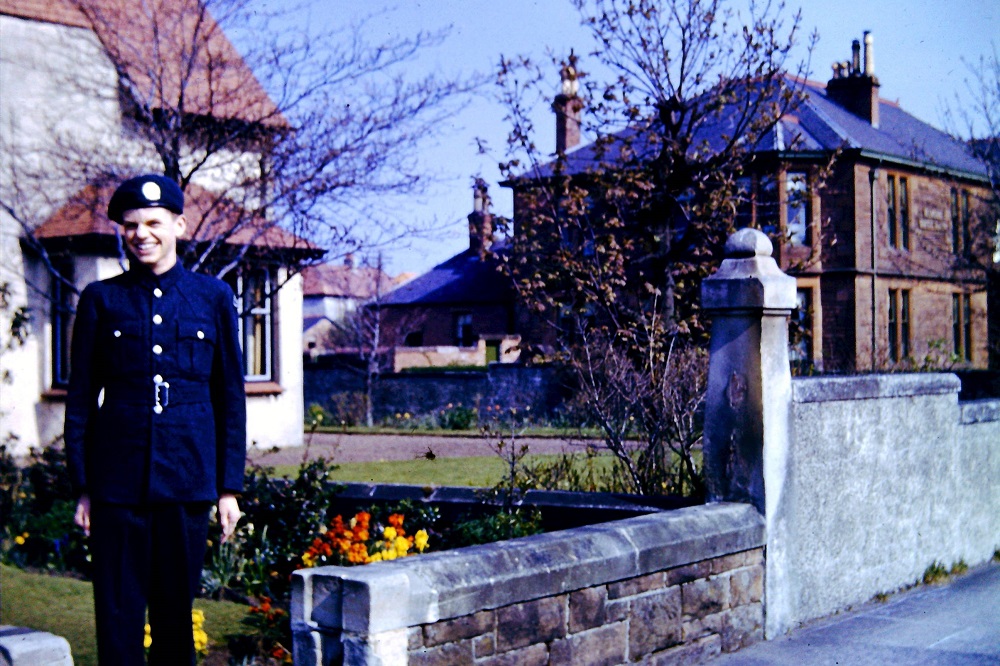
After sending in ‘Launcher Development’ last week, I realised that I had finally created a print version of one of my first ever talks. After I left in 1963 I was asked back several times to give talks to the Scientific Society at Marr College, and word must have got out about them, because I was asked to repeat ‘Launch Vehicles’ and ‘Rocket Aircraft’ to the Ayr squadron of the Air Training Corps, which I was in for a year in 1959-60 (Fig. 1), but had to give up because it clashed too heavily with my school work.

The Marr College talks were given with an Episcope, a huge brass machine like a Magic Lantern, but able to project pages from books. It generated so much heat that they could only be shown for a few seconds, before having to be removed because the pages started curling. As I remember, for the ATC talk I had no projector at all. But the other big difference was in the audience reaction: the Marr pupils were more interested in the launch vehicles, but with the ATC cadets the rocket aircraft talk went down much better.
In 1924 Hermann Oberth published The Rocket into Interplanetary Space in German, leading to formation of the first European spaceflight society, and the first attempts at rocket-propelled aircraft were made by Max Valier the same year, using solid-fuel rockets (Heinz Gartmann, The Men behind the Space Rockets, Weidenfeld & Nicolson, 1955). Valier was considered too much of a showman by the new-formed Society for Space Travel (VfR), but after his death in a rocket-powered car, David Lasser dedicated the first English-language nonfiction book on spaceflight to him as ‘the first martyr of spaceflight’ (Fig. 2. Arthur C. Clarke considered that book to have triggered his interest in space).

The VfR attracted the attention of the German Army because rockets were not banned under the 1918 peace treaty, and after its key members had been conscripted, when the group moved to Peenemünde to develop the A4 long-range missile, its facilities were adjacent to those used by the Luftwaffe to develop the F.103 pulse-jet Flying Bomb, or cruise missile as it would be called nowadays. As Hitler designated the two projects ‘V1’ and ‘V2’ there was a lot of confusion between them in post-war years. The film Operation Crossbow (1965) credits Germany with being able to launch an A9/A10 missile against New York towards the end of the war.

By 1944 there was a winged version of the A4, the A4B, with an intended range of 300-400 miles. (Fig 3) According to the late Dr. Arthur Hodkin, it was intended to hit Prestwick, which was Eisenhower’s major staging post into Europe throughout the US participation in the war, and Glasgow, where Churchill had intended to base his government if the German invasion of southern England had succeeded. The one successful launch in January 1945 ended when a wing broke off on atmosphere entry; as the V2 had no attitude control after engine cut-off, up to a third of them broke up due to entering atmosphere at the wrong angle. The more advanced A-9 would have been a winged V2 designed for hypersonic flight. Launched by the A10 booster, which would have been the size of a Thor missile rather than a Saturn V (see last week), it was intended to be capable of reaching New York. Allegedly the plan was for the pilot to bail out and deliver the message that unless the USA withdrew from Europe, the next one would carry an atom bomb. The bluff was unlikely to succeed: Nazi Germany was a long way from building a nuclear weapon, much less one that would fit into so small a vehicle.
In 1959 von Braun gave a slightly different account, stating that the 1945 test was actually an A9 whose operational version was always intended to be piloted. “For the war-conscious officials, the object of the A9 was explained as an extension of the range, to almost double that of the A4… we even designated it A4B to give it the benefits of A4’s high priority…”, but inspection of the plans would have revealed a pressurised cockpit and a tricycle undercarriage. (Wernher von Braun ‘From Small Beginnings’, in Kenneth W. Gatland, ed, Project Satellite, British Book Centre, New York, 1958.)

The other rocket aircraft developed at Peenemünde was designed by Alexander Lippisch, with an engine derived from Helmuth Walter’s work on hydrogen peroxide power for submarines. The Messerschmidt 163 Komet (Fig. 4) is still the only rocket fighter ever to achieve operational status. The only allied pilot to fly an Me-163 under power was Eric ‘Winkle’ Brown, who described it as “one of the most dangerous aircraft ever given to a pilot to fly… In effect you were locked in your coffin” because the hood could not be opened above 250 mph, and it flew at 600. For a full description, see ‘Capt. Eric ‘Winkle’ Brown, RN’, ON, 9th April 2023.

In the last days of the war the Germans tried an even more desperate proposal, a vertical take-off rocket fighter, the Bachem BP.20 Natter (Fig. 5). It too had a Walter HTP (High Test Peroxide) motor, adapted for longer endurance, and was hurled into the air by solid boosters, to climb at 37,000 feet per minute and reach a top speed of 621 miles per hour. It had an all-wooden construction, but Germany had neither the materials nor the expertise to make that work; parts of it were nailed together, and in the words of Dr. Kate Pyne (lecture, ‘Vertical Take-off’, British Rocketry Oral History 4th Annual Conference), “It was no Mosquito”. Seemingly they never enjoyed the very productive relationship between British aeronautical companies and furniture manufacturers, particularly in Scotland (Charles McKay, lecture, ‘Helicopters and Aircraft of World War 2’, Glasgow, 7th March 2005). That produced such extraordinary aircraft as the Mosquito, and components for too many others to mention, but including the first prototype of Blue Steel (see next week). The Natter’s only test flight ended fatally for the pilot. Nevertheless orders had been placed for 200 of them, and in Rockets beyond the Earth (McBride, New York, 1952), Martin Caidin includes a graphic description of what it might have been like to fly in combat, as “the forerunner of a new type of rocket interceptor that… will be used for the defence of vital strategic targets against enemy bombers”. Instead of cannon the Natter had 24 Fohn 73-mm. rockets, to be fired “in one blasting salvo”, after which the pilot would separate the nose section and bail out. Like the Me.163, it would be too fast to be tracked by the gun turrets of the bombers, but like it, it would still have been vulnerable to massed defensive fire. At the end of the war, analysis of the Natter’s capabilities helped to establish the reputation of the late Prof. Terence Nonweiler, whom I’ve so often quoted in these articles.
In 1943 a contract was given to Miles Aircraft for a project to reach 1000 mph, well above Mach 1 (see ‘The M.52 and the Douglas Skyrocket’ ON, 30th July 2023). It could and should have given Britain the first penetration of the Sound Barrier – and with jet propulsion, in level flight, at a higher level of technology than the rocket-powered Bell X-1 in which Chuck Yeager was later to achieve it. The test pilot was to be Eric Brown, “because I was the only man in the room with the correct dimensions”. In March 1946, at an advanced stage of preparation for M.52 test flight, the Ministry of Supply summarily cancelled the project, ordering all prototypes, materials, drawings etc to be destroyed. The technical data was passed to the USA, particularly on the ‘all-flying’ horizontal stabilizer which had replaced a conventional elevator, and that was incorporated into the Bell X-1 in which Yeager broke the Sound Barrier the following year.


Whatever else might have been, the first aircraft to achieve faster-than-sound level flight was the rocket powered Bell X-1 (Fig. 6), dropped from a modified B-29 bomber and piloted by Charles ‘Chuck’ Yeager, despite a broken rib sustained in a riding accident days earlier, requiring him to lock the side door into the cockpit with a broom handle. (After all the fuss about the pilot’s safety in the M.52, the X-1 had no escape system at all.) After years of black-and-white photos, it was a real surprise to discover in the mid-1950s in the National Geographic Magazine, followed by the Saturday Evening Post, that the X-1 was actually bright orange for visibility (Fig. 7). The flight was made on 14th October, 1947, and the outcome was kept secret for eight months for reasons which are far from clear. Major-General Fred J. Ascani, who was Executive Officer of the Flight Test programme at the time, implies that the newly independent United States Air Force might have felt Yeager was too much of a ‘hillbilly’ to be presentable in Washington (Gen. C. Yeager and L. Janos, Yeager, an Autobiography, Bantam, 1985). As Eric Brown put it in 2008, “The problem with Chuck is that he’s not cuddly”. Ascani puts the transfer from Army Air Force to USAF “only a few days” before the flight, and others including Brown have suggested that the news may have been suppressed in order not to eclipse that event, but actually the transfer was on 18th September and any news value was well over. One would have thought that the two events would reinforce each other in any case; otherwise, it would be as if Churchill had issued a D-notice to prevent the British press from announcing the ascent of Everest, thinking it would overshadow the Coronation.
The initial secrecy surrounding Yeager’s achievement allowed the creation of a very bad British film, The Sound Barrier (1952), called Breaking the Sound Barrier in the USA. The myths about rocketry generated by inaccurate war films like Operation Crossbow and 633 Squadron pale into insignificance beside the audacity of the claim that British pilots were first to achieve supersonic flight, when in reality our own government had prevented them from doing so. Tom Wolfe has done such an excellent job of demolishing the film’s myths in The Right Stuff (Bantam, New York, 1979). that there’s no need to rebut them here. But for any astronomer, the clincher would come in the final scene where Sir Ralph Richardson supposedly shows his grandson the wonders of the Universe, with a clarity which the Mount Palomar observatory would have envied, through an antique brass refractor from his firelit study. In real life the heat from the fire would ruin the ‘seeing’, and its light would prevent them from seeing much except the reflections of their eyeballs. As he takes the boy off to bed, the last thing we see as the screen fades to black is the whirling regulator balls of the clockwork drive; and if there was no stop on it, as there wasn’t on the one at Airdrie Observatory where I was curator off and on for thirty years, then when the falling weights came to the end of their travel the effect on the delicate clockwork would be like driving a train into the buffers.


The first three X-1s were followed by a series of modified designs from the X-1A to X-1E, in which the pilots continued to achieve higher speeds and greater altitudes (Figs. 8 & 9). However, Mach 2 was to be reached and passed by Scott Crossfield in the US Navy’s Douglas D-558-II Skyrocket, in which Bill Bridgeman set an altitude record for the time of 80,000 feet (see ‘The M52 and the Douglas Skyrocket’, above). Rivalry between the services played a significant part in the programme: both the X-1 and Skyrocket were designed to be air-launched from the B-29 or its B-50 variant (Fig. 10), but had to be capable of takeoff under their own power, however risky and despite the weight penalty of stressing the undercarriage to carry the fuel load, just so they would be eligible for official records under the rules of the time (Fig. 11).


Although Air Force and Navy pilots regularly flew one another’s research aircraft, the Douglas Skyrocket never received an ‘X’ number, though its experimental rôle came under the umbrella of NACA, the National Advisory Committee on Aeronautics (Fig. 12), later incorporated into NASA.

The X-1 series and the later X-2 were all built by Bell, but the X-3 was Douglas’s unsuccessful successor to the Skyrocket. The X-4 and X-5 were built to explore different flight regimes, and not all X-planes were piloted. Not all of them were even aircraft: the X-11 and X-12 were prototype nose-cones for the Atlas missile, and the X-17 was a multistage booster for heat shield tests. The X-23 and X-24 were wingless lifting bodies, but other vehicles in that programme had different designations, like the M-series and FDL-series (see Part 2). Some, like the X-20 and the X-38, never got past the stage of airborne drop tests, some like the X-30 and X-33 never flew at all, and some have achieved flight status long out of numerical sequence, so that the US Air Force flew the X-40 before the X-37 and flew the X-37 and the X-51 simultaneously. (Prototype fighter and bombers often receive ‘XF’ or ‘XB’ numbers but are not part of the main X-vehicle sequence.)
Although it never gained an X-number, it could be argued that only the Douglas Skyrocket achieved the elusive quality which Terence Nonweiler called ‘elegance’. Bridgeman’s reaction on first sight was, “This was the most beautiful airplane that I had ever seen. This was something I had to do now. It was no longer a question of merely wanting to fly the Skyrocket – I had to fly it.” (W. Bridgeman & J. Hazard, The Lonely Sky, Cassell, London, 1956). The Bell X-2, which was targeted to reach Mach 3, looked like a more angular version of the Skyrocket (Fig. 13). It was hard to fly, harder to land (on skids – the need for independent takeoff had been dropped) and ultimately it proved to be a killer.

As the records were achieved, the dangers of experimental rocket flying became increasingly apparent. The rocket engines were still far from reliable. The X-1D had been dropped on fire, exploding in mid-air; Joe Walker received the Distinguished Service Medal for saving the B-29 and trying unsuccessfully to save the X-1A, when it caught fire in the bomb bay and eventually had to be jettisoned. Skip Ziegler and a B-29 crewman were killed when an X-2 exploded just after being jettisoned similarly. ‘Pushing the outside of the envelope’ to ever greater heights and speeds with conventional aircraft shapes produced unexpected incidents where the aircraft would ‘cork out’, in Scott Crossfield’s phrase, falling uncontrollably until the pilots could force them into spins from which they could recover. Another Yeager legend was created when he ‘busted the canopy with his head’ after reaching Mach 2.42 in the X-1A, plunging for 50,000 feet, and Bridgeman spun the Skyrocket for over 6000. Kit Murray had a similar ‘inertial coupling’ event when he took the X-1A to 94,000 feet in 1954, and Kincheloe had a similar experience when he reached 120,000 feet in the X-2. The Skyrocket and the X-2 had the same nose capsule escape system which had been proposed for the Miles M.52. Prophetically, Bridgeman was told, “So far, nobody’s tried it”. The only pilot to do so was Mel Apt, who was well prepared for the X-2 attempt on Mach 3 according to Frank Everest’s book The Fastest Man Alive (F.K. Everest and J. Guenther, Cassell, 1958), but unready and sacrificed to the Air Force’s desire for the record, against NACA’s wishes, according to Scott Crossfield (A.S. Crossfield with Clay Blair Jnr., Always Another Dawn, the Story of a Rocket Test Pilot, Hodder & Stoughton, 1960). When the capsule separated it failed to slow down as intended, and a harrowing film survived from inside the cockpit showing Apt being thrown about like a doll on the way down. Because the nose-cone had separated, the rest of the aircraft came down relatively intact (Fig. 14).

At the NASA/University of Maryland Waverider Symposium in 1990 (see ‘Waverider’, ON, November 27th, 2022), as an aside to his paper, Prof. G. Emanuel of the University of Oklahoma remarked that “We don’t know the required shapes for hypersonic flight. At each stage we go forward with conventional design – the X-1 and X-2 look nothing like the Blackbird” which eventually became operational. But while the X-15 which undertook the next phase was ‘conventional’ in looking like the rocket planes and spaceships of science fiction (Fig. 15), it proved to be the right shape for that phase. While it had its share of accidents in the early days – an explosion in the air, breaking its back on landing, a hydrogen peroxide explosion due to contamination during post-flight safing, and a major explosion of its main rocket engine during a ground demonstration – its only aerodynamic problem and fatality was a breakup at stratosphere re-entry, thought to have caused by misalignment, like the V2 breakups above. But in ten years of operation the three X-15 aircraft flew 199 missions, air-launched from NASA’s B-52 (Fig. 16 – still in use today), over 60 more than the six Space Shuttles achieved in over 30 years.


The X-15 achieved airspeeds of Mach 6.7, still the highest airspeed reached by a piloted aircraft (4,520 mph), and 13 Air Force and civilian pilots took it to heights above 50 miles, qualifying for US astronaut wings. Describing his flight to 24.8 miles (then a world record), Major Robert M. White described how he was monitored by a NASA test pilot in ground control at Edwards Air Force Base. “And from way down on the earth, more than 131,000 feet below, I hear Neil’s matter-of-fact reply: ‘Roger’.” (‘Higher than Man Ever Was: Story by X-15’s Pilot’, Life, 12th September 1960). Nine years later, ‘Neil’ would become the first man on the Moon.
(To be continued)



Leave a Reply