
When the late John Braithwaite was working with me on the Glasgow Parks Astronomy Project, as part of the Jobs Creation Scheme, (1978-79) we and the other ‘Special Projects’ housed in the old Buchanan St. main line station booking office were harassed by a number of inaccurate and highly critical stories which appeared in the Daily Record, apparently due to someone selling copies of our memos. The Underground was being modernised at that time, and there was a huge hole at the top of Buchanan St., so we started a story that a prehistoric fern seed had been unearthed, and been grown in the Special Projects building, but was destroyed by the office cat (to whom it was madly attractive) before the scientists could get to it. (Geoff Holder, The Guide to Mysterious Glasgow, The History Press, 2009).
As far as we know that one didn’t catch on, but you never know. Only 13 years after we built the stone circle in Sighthill Park, with the help of a Royal Navy helicopter and with 1000 children from local schools watching, a front page story in all the Scottish papers, I had already met people from Springburn who swore it’s an ancient monument where the Druids used to conduct sacrifices.

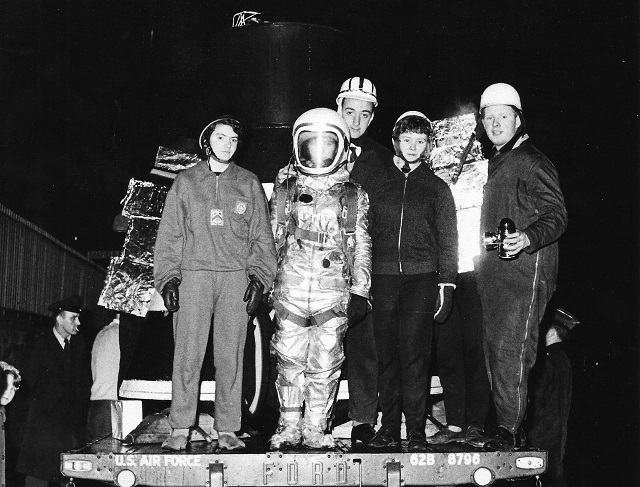
Back in 1964, when my group had borrowed a ‘boilerplate’ Mercury capsule from the US Air Force at Prestwick (Fig. 1; ‘The Mercury Capsule’, ON, August 21st, 2022), it had to be be kept secret until the Charities Day Parade in case some rival group of students sabotaged our efforts. But how were we to publicise the coming attraction, if we couldn’t say what it was? In the previous dry summer there had been several cases where the Army dug up mysterious holes which had opened on farmland, attributed to UFOs, and Sandy Glover (right in Fig. 1) knew a farmer out in Lothian who had gelignite left over from blasting operations. The farmer gave permission for us to blast three craters in the triangle pattern of a ‘typical’ UFO landing, and we planted sightings from the Outer Hebrides all the way to Lothian of a UFO apparently in difficulties, coming in over the Central Belt. Our intention was to come clean at once and say, “But you can see a real spaceship in the Charities Parade on Saturday.” There weren’t enough seats in the car for me to go with the blasting party. But unfortunately the clay soil was very wet and heavy after recent rain, and though each explosion shifted a ton or more of it, it simply made patches of rough ground instead of craters. It settled into craters after the next rain, but we couldn’t wait for that. So the landing report was never made; but we didn’t succeed in stopping all the reported sightings, leading to a small report of the ‘UFO in trouble’ in the weekend press. Nine years later, I discovered that the case is taken seriously in UFO files: the farmer had obviously been silenced by the authorities, because he tried to pass it off as a student hoax… And the compiler refused to remove it, because obviously I’d been got at as well.
In the 1950’s Fredric Brown, who specialised in ‘short-short’ stories of only a few hundred words – ‘flash fiction’, as it’s called nowadays – wrote one in which all the computers in the Universe were interconnected. The new super-machine was asked ‘Is there a God?‘, and replied, ‘There is now‘. In the 1960’s this resurfaced as an urban legend and was told by various newspapers, Reader’s Digest etc, all alleging it had happened in some well-known company, university or scientific institution. The interesting difference was that they all left out the ending: in Brown’s story, the computer really HAD become a God.
Albert Einstein was never able to accept the implications of quantum theory, and the uncertainty principle, which imply that the Universe is basically random. He kept insisting that “God does not play dice with the Universe”. In the end, he said it so often that Neils Bohr replied, “Albert, stop telling God what to do.“


In the 1980s, scientists studying the chemistry of the interstellar clouds deduced, and then created in the laboratory, a new form of molecular carbon with 60 atoms (Figs. 3 & 4), and one of the discoverers was a speaker at one of the IBM Heathrow Conferences which I attended in those years. The C60 was so expensive that a few square centimetres of it would cost hundreds of thousands, “after which the office carpet no longer seemed an extravagance”. Then it was found to exist naturally in chimney soot, where no-one had ever thought to look before. It may have played a very important part in the origin of life, here and elsewhere. In form, it’s made up of hexagons with occasional pentagons, so it has been called ‘Buckminsterfullerine‘, ‘buckyballs’ for short, after the architect who devised the geodesic dome. If you colour a model of it black and white, it’s immediately recognisable: God may not play dice with the Universe, but He does, apparently, play football…

In the 1990s the late artist Ken Palmer tried to resurrect a former Glasgow group called VAST, Visual Artists and Scientists Together. In the 60s, C.P. Snow went to great lengths to close the gap between arts and science, which he characterised as ‘The Two Cultures’ (Fig. 2). As Goering had said, ‘Whenever I hear the word ‘culture’ I reach for my pistol’, it led to the comment “Whenever I hear the words ‘Two Cultures’, I reach for two pistols”, and also, from the biologists, “Whenever I hear the word ‘gun’, I reach for my culture”.


That one came from a book edited by I.J. Good, called The Scientist Speculates (Heinemann, 1962). It’s full of good stuff, but is best remembered for an article by Arthur C. Clarke called ‘Trouble in Aquila, and Other Brainstorms’. That was the one in which Clarke pointed out that almost all the exploding stars seen in the previous hundred years were in one small circle of sky (Figs. 5 & 6); and is the front line moving in our direction? (Fig. 7). The question remains unanswered, by the way – see ‘Novae and Supernovae’, ON, February 6th, 2022.

Clarke has written a number of such far-out essays: Report on Planet Three, the title piece of one collection, (Gollancz, 1972, Fig. 8) is a survey of the Earth by Martian astronomers. Life is obviously impossible here: the gravity is too high, the atmosphere is too thick, it contains deadly poisonous water vapour and worse still free oxygen, which would allow a nightmare phenomenon called fire…

Another of his classics is the one about whether God’s perceptions and speed of action are themselves limited by the laws of the Universe He created, so He can’t break the speed of light. If so, even if he knows how badly things are going wrong here, and is coming back at lightspeed, “it’s anybody’s guess whether He’ll be here in time”. And there’s the one about how Earth was originally colonised by interstellar civilisation, but had to be quarantined after an initially incurable disease broke out. Out of kindness, human memories were wiped before they left; but help is on the way. “If any of you are still white, we can cure you.”


Isaac Asimov went still further, at least within science fiction magazines, in publishing completely spoof scientific papers. ‘On the Endochronic Properties of Resublimated Thiotimoline’ (Astounding Science Fiction, March 1948), is one of several ‘papers’ about a substance which dissolves in water beforeyou add it (Fig. 9). It reappeared in his essay collection Only a Trillion, (Abelard-Schuman, 1957, Fig. 10) along with ‘Päté de Foie Gras’, an article about a goose which lays golden eggs. That’s less important, nowadays, than its ability to absorb nuclear radiation, since the goose is a natural fission reactor. But how do you study it? Since it runs on the same reactions as an exploding star, it really is not a good idea to kill the goose that lays the golden eggs…

Sometimes the laugh goes the other way. The late George Sassoon and Rodney Dale, both Hebrew scholars, wrote a paper and later a book in which they sought to show that the Israelites got their manna from a machine left behind by extraterrestrial visitors (The Manna Machine, Sidgwick & Jackson, 1978, Fig. 11). The paper first appeared in New Scientist, and was hailed by Erich von Däniken as a breakthrough. New Scientist reported with delight that they’d caught him, since he hadn’t realised the paper appeared on April 1st. Then they had to apologise to George and Rodney, who hadn’t seen the significance of the date either, and (rightly or wrongly) were absolutely serious…

Even the most serious workers give way to temptation. In his book, The Creation of the Universe, (Viking Press, 1952, Mentor edition, 1957, Fig. 12) George Gamow explained how he and Ralph Alpher published a major paper on the Big Bang incorporating the name of Hans Bethe, for no other reason than that “It seemed unfair to the Greek alphabet to have the article signed by Alpher and Gamow only…” Alpher collaborated on a later paper with R.C. Herman, who refused to change his name to Delter, but when the theory ran into trouble Bethe was rumoured to be thinking of changing his name to Zacharias.
And on that Biblical note, a belated Merry Christmas and a Good New Year to all!


Leave a Reply