
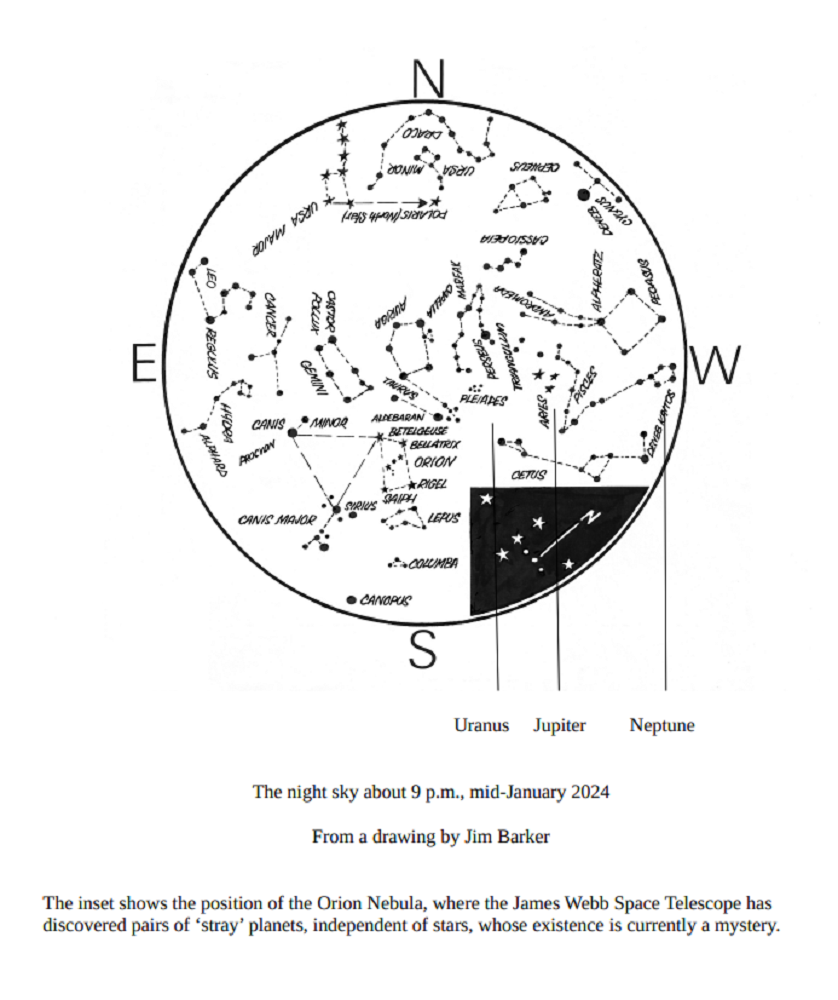

The Moon will be New on January 11th, Full on January 25th. It passes near Venus on the 8th and is near Venus and Mercury on the 9th, passing Saturn on the 14th and Jupiter on the 18th.
The launch of the Astrobotic Peregrine lunar lander, which was planned for Christmas Eve as the maiden flight of the United Launch Alliance’s new Vulcan booster, has been put back to a 4-day window starting on January 8th, due to a Wet Dress Rehearsal (fuelling test) which didn’t go to completion in the allotted time. After launch it should reach orbit around the Moon 17-19 days later, and land after a month near the volcanic dome Gruithuisen Gamma, on the northeast edge of Oceanus Procellarum. This is an intriguing target because it’s one of the mysterious ‘swirls’ on the lunar surface, for which there is currently no explanation. Possibly due to local magnetic fields, though it’s not clear how, these have been studied intensively by Lunar Reconnaissance Orbiter, particularly Reiner Gamma, the first to be discovered. There’s one in Mare Ingenii, one of the few mare basins on the lunar Farside, and another, very interestingly, in the crater Giordano Bruno on the Farside. (See ‘Green Children Part 2’, ON, June 26th 2022, and ‘The Lunar Farside’, ON. June 4th 2023.) The Gruithuisen Domes are scheduled for another exploratory mission called Vulkan in 2026.
Another private US moonprobe was preparing for launch in January: Intuitive Machines’ IM-1, funded by NASA to deliver small scientific payloads to the Moon. Previously called Micro-Nova, then Nova-C, and after several target changes, IM-1 is targeted for Malapert A crater, near the lunar south pole and the mountain which has so often been suggested as a lunar observatory site. It’s to be launched by Falcon-9 and uses the same propellant, for simultaneous fuelling on the pad. However, like the Peregrine-Vulcan launch, it too has been postponed, with the next launch window opening on February 8th.
India’s Chandrayaan-3 moonprobe isn’t finished yet, either, even though its Vikram lander didn’t survive the lunar night, as expected. The propulsion module was sent to the Moon lightly instrumented, because the Chandrayaan-2 probe was still operational and performed the necessary tasks during and after the landing. The few instruments aboard have been performing other tasks, for example evaluating features of the Earth as a habitable planet viewed from a distance, and observing the solar eclipse of October 28th. As a result the propulsion module of Chandrayaan-3 still had 100 kg of propellant in hand, and that has been used to raise its orbit (Figs. 1 & 2) prior to reversing its trajectory and bringing it back to High Earth Orbit on November 10th, while scientists and engineers continue to evaluate its performance with an eye to future missions.


The planet Mercury is below left of Venus mid-month, and at its furthest from the Sun on the morning of the 12th, rising at 5.20 a.m.. On the 8th the waning crescent Moon will form a triangle with Venus and Mercury, well to the right of both, and Mercury will be nearest to the Moon on the 9th.. Mercury is passed by Mars on the 27th, when both will be too near the Sun to be visible.
Venus rises at 5.30 a.m. between Libra and Virgo, near the Moon on the morning of the 8th, becoming harder to see by the end of the month.
Mars is still out of sight beyond the Sun, until spring this year. A day on Mars, or ‘sol’, is 37 minutes longer than an Earth day, which creates personal and social problems for the controllers of solar-powered missions, or even with nuclear-powered rovers, which still need daylight in which to operate. The Perseverance rover and its Ingenuity helicopter have now been on Mars for over 1000 sols, and Perseverance has completed its survey of the river delta which was its main target. (Not to be outdone, Ingenuity has now completed its 62nd flight and is still going strong, much better than expected.) A summary of the results reveals that the floor of Jezero crater is volcanic rock, overlaid by sandstones and mudstones carried in along with boulders by a river which formed 3.5 billion years ago, when floodwaters from Isidis Planitia broke through the crater wall, at least 200 million years after the crater itself formed. They created a lake 22 miles wide and 100 feet deep, within which material dropping out formed the raised delta whose boulder-strewn top the rover has now explored. On the crater floor the rover has now cached 23 samples for future collection, including samples from the delta top, some with a large quantity of fine-grained silica, “a material known to preserve ancient fossils on Earth”, at ‘Bill’s Bay’ and ‘Otis Peak,’ near ‘Ouzel Falls’, along with iron and phosphate, a component of DNA and cell membranes. A NASA statement on December 12th adds, “Both of these samples are also rich in carbonate, which can preserve a record of the environmental conditions from when the rock was formed” and of any life within them. Return of those samples is still a long way off, and China has announced its intention to beat them to it.
Japan’s Hyabusa spacecraft, which successfully returned samples from the asteroid Ryugu, has been redirected to another asteroid called 2001 CC21, which it will reach for a fast flyby in 2026, and beyond that to still another, 1998 KY26, which is particularly fast-rotating, with a period of 10 minutes, and will be reached in 2031.
Jupiter, at the boundary of Aries, Pisces and Cetus, sets at 1.45 a.m., and the Moon passes Jupiter on January 18th. On 24th January, Ganymede comes out of occultation by Jupiter around 8.36 p.m., depending on your location, while Europa ends a transit across Jupiter’s disc at 6.49 p.m., and its shadow leaves the disc at 9.19 p.m..
Saturn, well to lower right of Jupiter in Aquarius, is now off our 9 p.m. map, setting at 8.00 p.m., passed by the Moon on the 14th, and disappearing by the end of the month.
Uranus in Aries, between Jupiter and the Pleiades, sets at 1 a.m.. Uranus appears south of the Moon on the 19th. Because Uranus rotates ‘on its side’ with respect to its orbit, the north pole is now facing towards Earth, and to the James Webb Space Telescope at the L2 point, down-Sun from us. New multi-spectral infrared images of Uranus by JWST show a huge vortical cyclone at the north pole, with circulating storms around it, all hotter than their surroundings (Fig. 3), while a wider view shows a background of distant galaxies (Fig. 4)


Neptune is on the boundary of Aquarius and Pisces, setting around 10 p.m.. Neptune is due south of the Moon on January 15th, and is occulted by it as seen from eastern South America.
The Quadrantid meteor shower peaks on the night of 3rd-4th January, and should be well seen before the waning Moon rises at third quarter (half-full, waning), around 1 a.m..

As predicted last month, Halley’s Comet passed aphelion, its furthest distance from the Sun, on December 9th 2023 (Fig. 5). An informative article by David Dickinson (‘Famed Halley’s Comet Passes Aphelion This Weekend’, Universe Today, online, 6th December 2023) gives more details.
Halley’s Comet was last imaged by the European Southern Observatory in 2003, when it was at magnitude 28. (The brightest stars are at or just above magnitude 1, and the scale is logarithmic, such that magnitude 1 is 100 times brighter than magnitude 6, the limit of human visibility.) At aphelion, the comet’s nucleus was 35.14 Astronomical Units from the Sun (35 times the Earth’s orbital distance, almost 3.3 billion miles or 5.3 billion km), beyond the orbit of Neptune, which captured it into its present orbit no later than 476 BC, when it was seen by Chinese astronomers; though according to information I have, their earliest known sighting of it was 1507 BC. It’s believed to be thousands of years older than that – big as it is, just a remnant of its former self. In 1986, the Giotto mission detected huge voids within the nucleus, where large volumes of gas have previously been heated up and escaped. At its present furthest, the comet is still moving at 2000 mph with respect to the Sun. Isaac Asimov once calculated that even at 2 light-years, where the Sun’s gravity gave way to Alpha Centauri’s, a hypothetical comet would still be moving at more than the speed of sound in atmosphere. If you were out there with Halley’s Comet now, the Sun would be at magnitude -19, still 250 times brighter than the Full Moon.
At present the comet is in the constellation Hydra, the Water-Snake. In 2028 or 2029 it will move into Canis Minor and remain there for decades, before passing very close to the bright star Procyon in Canis Minor (left of Orion, on the upper left of the Winter Triangle, on our January map) in 2049 (Fig. 6). In December 2060 it will be north of Orion, and starting to move rapidly across the sky during the 2061 swing around the Sun, closest but low in the sky from here, in summer that year (Fig. 7).


Duncan Lunan’s recent books are available through Amazon. For more information see Duncan’s website, www.duncanlunan.com.
You can download a copy of the January Map here:

Leave a Reply