
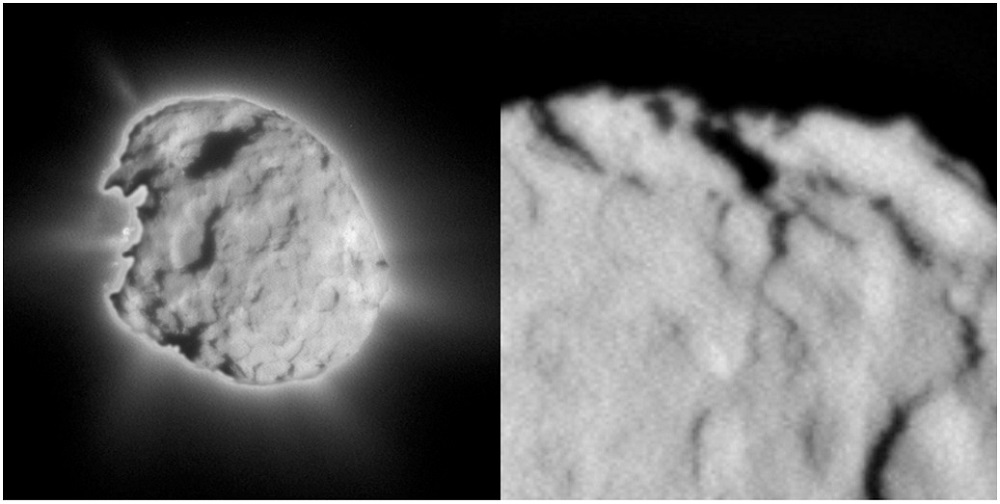
NASA’s Stardust mission 18 years ago collected material from Wild 2, a comet that likely formed beyond Neptune and currently orbits the sun between Mars and Jupiter.

Painstaking analyses of the microscopic samples, recently described in the journal Geochemistry, have revealed a surprising truth about the comet’s origins and history.
When Stardust launched in 1999, many scientists expected the comet’s rocky material would be dominated by the primordial dust that built the solar system — the “stardust” that gave the mission its name.
But the actual samples told a different story: Wild 2 contained a potpourri of dust that formed from different events early in the solar system’s history.
Ryan Ogliore, an associate professor of physics in Arts & Sciences at Washington University in St. Louis has been studying the Stardust samples for several years. He described the discovery that Wild 2 contained a record of “local” events was exciting. “The comet was a witness to the events that shaped the solar system into what we see today,” he said.
Kept in the cold storage of space for nearly its entire lifetime, the comet avoided alteration by heat and water seen in asteroid samples.
“Comet Wild 2 contains things we’ve never seen in meteorites, like unusual carbon-iron assemblages, and the precursors to igneous spherules that make up the most common type of meteorite,” said Ogliore, who is a faculty fellow of the McDonell Center for the Space Sciences. “And all of these objects have been exquisitely preserved within Wild 2.”
After nearly two decades, it may seem like scientists have had plenty of time to analyze the minuscule amount of material returned by the Stardust mission: less than one milligram (picture a grain of sand). However, this material is distributed over thousands of tiny particles on a collector the size of a pizza.
“Nearly every Wild 2 particle is unique and has a different story to tell,” Ogliore said. “It is a time-consuming process to extract and analyse these grains. But the science payoff is enormous.”
Most of the Wild 2 particles are still unstudied and certainly hold many more surprises. As time goes on, the samples can be studied using new techniques that did not exist when the mission launched.
Ogliore explained:
“The Stardust samples, microscopic grains from a body less than two miles wide, contain a record of the deep past covering billions of miles. After 18 years of interrogating this comet, we have a much better view of the solar system’s dynamic formative years.”
Comet 81P/Wild 2: A record of the Solar System’s wild youth, is published in the journal Geochemistry.




Leave a Reply