
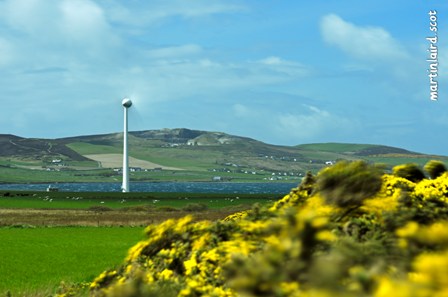
113% of Scotland’s gross electricity consumption in 2022 – the latest figures published – was generated from renewable sources, an increase of 26% compared to 2021.

Energy Secretary in the Scottish Government Neil Gray said:

“This is a significant milestone in Scotland’s journey to Net Zero. For the first time Scotland has produced more renewable electricity than it consumed, demonstrating the enormous potential of Scotland’s green economy.”
“Scotland has the skills, talent and natural resources to become a global renewables powerhouse. Our ambition is not only to generate enough green electricity to power Scotland’s homes and businesses, but also export electricity to our neighbours, supporting jobs here in Scotland and the decarbonisation ambitions of our partners.
“The significant growth in renewables will deliver a climate friendly energy system that delivers affordable, resilient and clean energy supplies for Scotland’s households, business and communities.
“We will soon be publishing our Green Industrial Strategy setting out the steps we will take to maximise the benefits that Scotland’s abundant natural resources can deliver in creating new jobs and opportunities across the country.
“But in a number of areas progress is being held back by factors such as grid capacity and the lack of a market mechanism for the likes of pumped hydro storage, which is why we need urgent investment from the UK Government now and more consistent commitment to industry in the years ahead.”
Consumption of electricity in 2022 dropped by 4% from 2021 with a decrease of 1% in non-domestic consumption and a decrease of 9% in domestic consumption.

Electricity used across Scotland’s households fell although, Orkney, like all the islands and Highlands of Scotland, consumes more because of being off the gas grid and having to rely mostly on electricity or oil.
| Local Authority | Ave household Consumption(kWh) | Total Consumption (GWh) |
| Dumfries and Galloway | 4,242 | 794 |
| East Ayrshire | 3,222 | 403 |
| East Lothian | 3,874 | 460 |
| East Renfrewshire | 3,707 | 218 |
| Na h-Eileanan Siar | 6,492 | 150 |
| Falkirk | 3,449 | 629 |
| Highland | 5,643 | 1,527 |
| Inverclyde | 3,172 | 282 |
| Midlothian | 3,403 | 335 |
| Moray | 4,058 | 466 |
| North Ayrshire | 3,502 | 576 |
| Orkney Islands | 7,493 | 138 |
| Scottish Borders | 4,212 | 514 |
| Shetland Islands | 9,011 | 178 |
| South Ayrshire | 3,571 | 439 |
| South Lanarkshire | 3,635 | 1,079 |
| Stirling | 4,198 | 456 |
| Aberdeen City | 3,387 | 967 |
| Aberdeenshire | 4,632 | 1,197 |
| Argyll and Bute | 5,999 | 487 |
| City of Edinburgh | 3,376 | 2,050 |
| Renfrewshire | 3,077 | 672 |
| West Dunbartonshire | 3,008 | 329 |
| West Lothian | 3,404 | 715 |
| Angus | 4,012 | 508 |
| Dundee City | 3,616 | 572 |
| East Dunbartonshire | 3,610 | 318 |
| Fife | 3,448 | 1,442 |
| Perth and Kinross | 4,601 | 679 |
| Glasgow City | 3,005 | 2,451 |
| North Lanarkshire | 3,280 | 1,250 |
| Scotland | 3,737 | 22,927 |
Warm This Winter is a coalition of more than 40 organisations working together to demand that the UK Government takes real action that will bring down energy bills. They are determined to make energy a key General Election issue.
Energy is mostly a power retained by the UK London Government:
- the generation and supply of electricity, oil and gas
- the exploration and extraction of offshore oil reserves
- coal ownership and exploitation and deep and opencast coal mining
- nuclear energy and safety
The Scottish Parliament has powers to promote renewable energy and energy efficiency, and for onshore oil and gas licensing.
Warm This Winter state “Gas prices are predicted to stay high until at least 2025. It means that, without action to fix the UK’s broken energy system, energy bills will stay unaffordable for millions of people for years to come.”
The energy campaigning group has also published its latest Tariff Watch. It reports that there are covert charges on our energy bills:
- The latest report examines the electricity network costs added to customers’ standing charges.
- It has uncovered 14 obscure charges which are being passed onto our bills through the Ofgem price cap, leading to Electricity Standing Charges surging 119% since winter 2020/21 and accounting for £194 a year per household.
- Among these, customers are paying for “Line Losses” – energy lost while transmitting electricity around the network – but are being charged a set amount, rather than the cost of the actual amount of electricity lost.
- Energy network operators forecast budgets in advance, but complex rules mean that if they overestimate costs, they only have to return a portion of the leftover budget to customers, and get to keep the rest.
- Between 2015 and 2022, these operators spent £933 million less than they forecasted – but only gave around half of that money back to customers.
- Energy firms have underspent on grid upgrade plans, and this lack of investment is keeping electricity prices high, hobbling Britain’s access to cheap, renewable energy despite a thriving industry.
You can read their full report here: Warm This Winter Tariff Watch
And if you are wondering where all the profits go from the energy produced in Scotland, and across the UK system, this is what Tariff Watch tells us:


Fiona Grahame


Leave a Reply to Scotland “penalised by a complex and unfair charging system” – calls to scrap electricity standing charges – The Orkney NewsCancel reply