
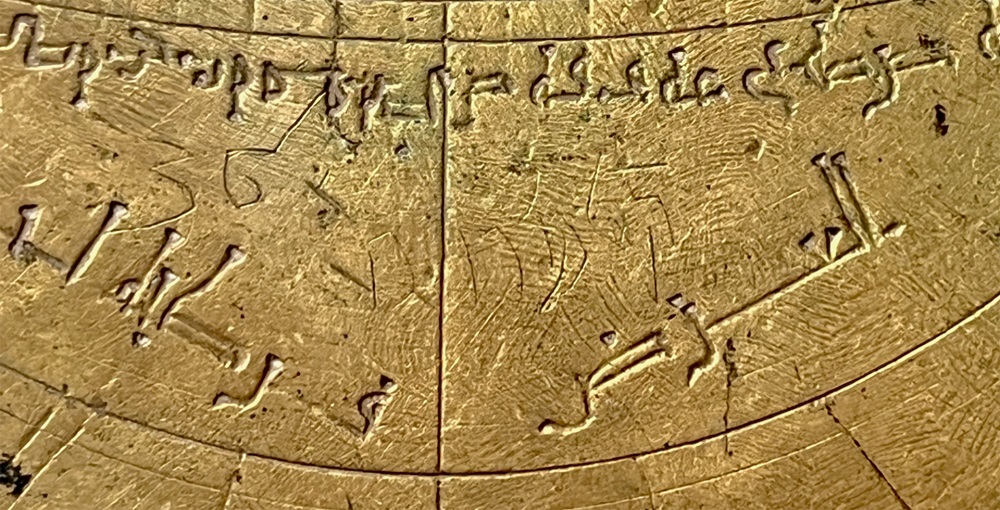
An eleventh century Islamic astrolabe bearing both Arabic and Hebrew inscriptions has been identified by Dr Federica Gigante, from Cambridge University’s History Faculty. It makes it one of the oldest examples ever discovered and one of only a handful known in the world. The astronomical instrument was adapted, translated and corrected for centuries by Muslim, Jewish and Christian users in Spain, North Africa and Italy.

The astrolabe features a ‘rete’ – a pierced disk representing a map of the sky – which is one of the earliest known made in Spain. Remarkably, it features similarities with the rete of the only surviving Byzantine astrolabe made in AD1062 as well as with those of the earliest European astrolabes, made in Spain on the model of Islamic ones.
A calculation of the star position allows a rough timing of the sky for which it was created. Dr Gigante explained that “due to a phenomenon called the precession of the equinoxes, whereby the earth rotates on its axis not in a straight line, but in a “wobbly” manner, like a spinning top about to stop, the stars’ apparent positions above our heads change constantly, about 1 degree every 70 years.”
By analysing the position of the stars on the rete, it is possible to calculate that they were placed in the position that stars had in the late 11th century, and that they match those of other astrolabes made, for example, in AD 1068.
Dr Gigante first came across a newly-uploaded image of the astrolabe by chance on the website of the Fondazione Museo Miniscalchi-Erizzo. Intrigued, she asked them about it.
“The museum didn’t know what it was, and thought it might actually be fake,” Dr Gigante said.
“It’s now the single most important object in their collection.”
“When I visited the museum and studied the astrolabe up close, I noticed that not only was it covered in beautifully engraved Arabic inscriptions but that I could see faint inscriptions in Hebrew. I could only make them out in the raking light entering from a window. I thought I might be dreaming but I kept seeing more and more. It was very exciting.
“This isn’t just an incredibly rare object. It’s a powerful record of scientific exchange between Arabs, Jews and Christians over hundreds of years.
“The Verona astrolabe underwent many modifications, additions, and adaptations as it changed hands. At least three separate users felt the need to add translations and corrections to this object, two using Hebrew and one using a Western language.”


Dr Gigante said:
“These Hebrew additions and translations suggest that at a certain point the object left Spain or North Africa and circulated amongst the Jewish diaspora community in Italy, where Arabic was not understood, and Hebrew was used instead.”
The astrolabe is thought to have made its way into the collection of the Veronese nobleman Ludovico Moscardo (1611–81) before passing by marriage to the Miniscalchi family. In 1990, the family founded the Fondazione Museo Miniscalchi-Erizzo to preserve the collections.
“This object is Islamic, Jewish and European, they can’t be separated,” Dr Gigante said.
Click on this link to access, A Medieval Islamic Astrolabe with Hebrew Inscriptions in Verona: The Seventeenth-Century Collection of Ludovico Moscardo, published in Nuncius



Leave a Reply