
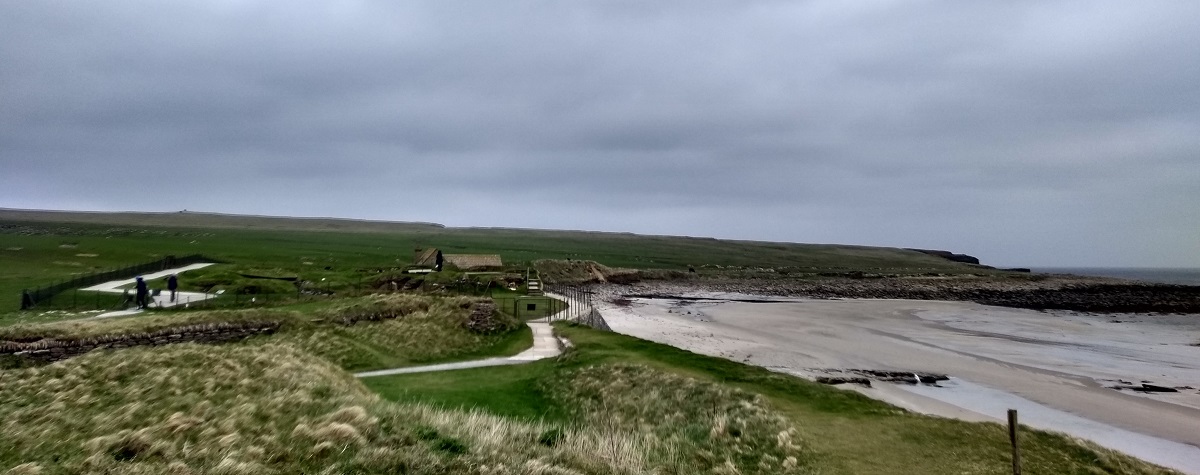
The islands of Orkney are home to some of the finest archaeological sites in the world, including the UNESCO World Heritage Site, in The Heart of Neolithic Orkney, the village of Skara Brae.

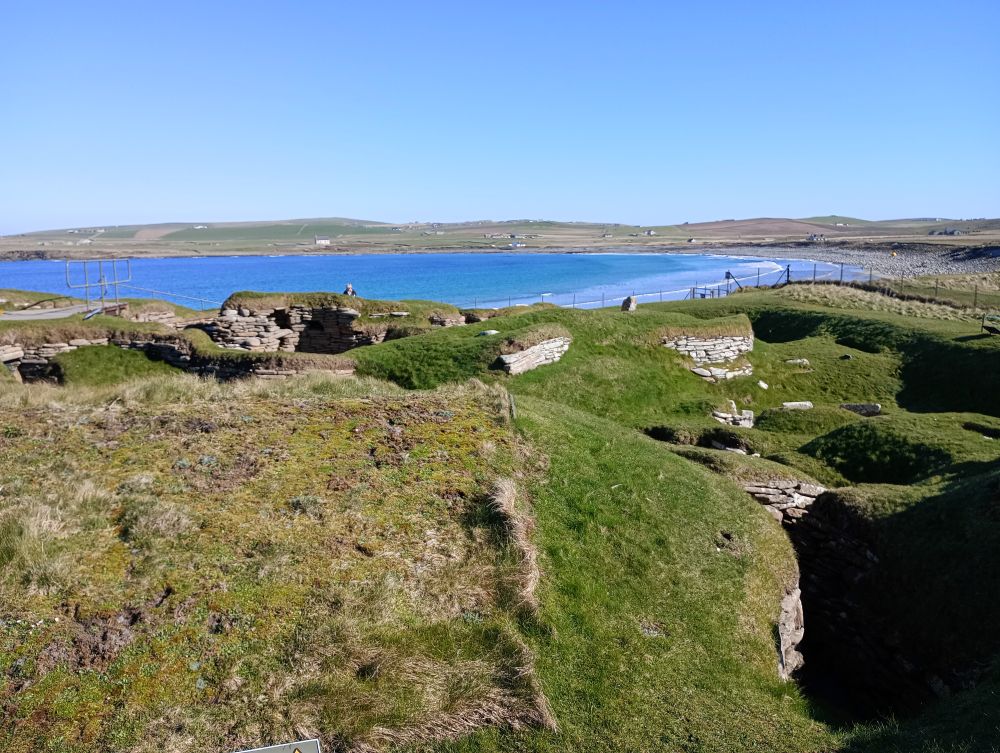
Uncovered in 1850 by a huge winter storm, the village where the early farmers of Orkney once lived, had been buried in sand dunes since it was abandoned as the sea encroached on the settlement. The Neolithic builders of Skara Brae set their stone built houses and workshop some way back from the sea with a small inland loch between the settlement and the coast. Gradually the sea broke through and the people moved from the village leaving it to the wind and sand.
Today, this iconic site is under threat from the sea once again despite the building and reinforcing of a sea wall. In 2019, a risk assessment led by Historic Environment Scotland found that Skara Brae is “extremely vulnerable” to climate change due to rising sea levels, increased rainfall and other factors; it also highlighted the risk that Skara Brae could be partially destroyed by one unusually severe storm in the future.
Climate Change
For the past decade, each year has been hotter than the previous year in the world’s ocean.
The ocean is an important part of the Earth’s climate system – it covers 70% of the planet and absorbs about 90% of the heat from global warming. The ocean helps control the atmosphere – a warmer ocean leads to a warmer and moister atmosphere with wilder weather. The ocean also controls how fast the Earth’s climate changes.
Based on temperature measurements analysed by the IAP (the Institute of Atmospheric Physics), the world ocean heated by 15 zettajoules relative to 2022. Rainfall and evaporation patterns are also changing which alters ocean saltiness (salinity). Salty areas are getting saltier and fresh areas are getting fresher, with consequences for marine life and ocean currents.
A warming ocean supercharges weather. The extra heat and moisture that enter into the atmosphere make storms more severe with heavier rain, stronger winds, and more significant flooding. There is tremendous damage around the world as well as major disruptions and loss of life.
Large and sustained reductions in emissions of carbon dioxide and of other greenhouse gas emissions would limit climate change.
Renewable Power in Orkney
In 2020 Orkney produced 128% of its own energy needs from renewable sources – mostly wind. In addition to wind farms and large turbines it has 700 micro wind turbines, more than any other area in the UK.
Orkney is successful as a testing ground for marine renewables. Orbital Marine Power’s (Orbital) first O2 machine is deployed in the waters off Orkney, and it has been exporting electricity as the world’s most powerful tidal turbine to the UK grid since July 2021. It completed operational financing in 2022 and is expected to offset around 2,000 tonnes of CO2 per year and power 1,700 homes, while creating and sustaining high value jobs within the local economy over the course of its operational life.
Several island groups are part of the Scottish Communities Climate Action Network: Shapinsay Development Trust, Stromness Community Development Trust, Sanday Development Trust, Transition North Ronaldsay, and Westray Development Trust. SCCAN is a volunteer-led network with membership open to any community group across Scotland. Its aim is to support community-led action on the climate crisis.
“We think it’s clear that the interconnected crises facing us at this time require transformational change in our economic, political and social systems. And we believe that transformational change happens as networks of relationships form among people who discover they share a common cause and vision of what is possible.” – SCCRAN

Sharing your views
On 31st January 2024, a consultation was launched by the Scottish Government on how climate change is currently impacting Scotland. The consultation, which closes on 24th April, focuses on a draft Scottish National Adaptation Plan 2024-2029 (SNAP3).
Commenting on the consultation Nicole Paterson, Chief Executive of SEPA (Scottish Environment Protection Agency), said:
“As Scotland’s Environment Protection Agency, we’re on the front line of global action to tackle our climate and nature emergencies. Through innovation and collaboration, we aim to help build a stronger, fairer and more sustainable nation.
“The adaption plan is crucial to future success, and with early engagement, we ensure that our decisions today pave the way for a Scotland that’s not just ready for change, but thrives in the midst of it.”
For Skara Brae, which has been a part of Orkney for over 5,000 years, it may all be too late as with each winter, waves pound away at the crumbling coastline.

Fiona Grahame
You can also read this story on The Scottish Beacon


Leave a Reply to berniebell1955Cancel reply