
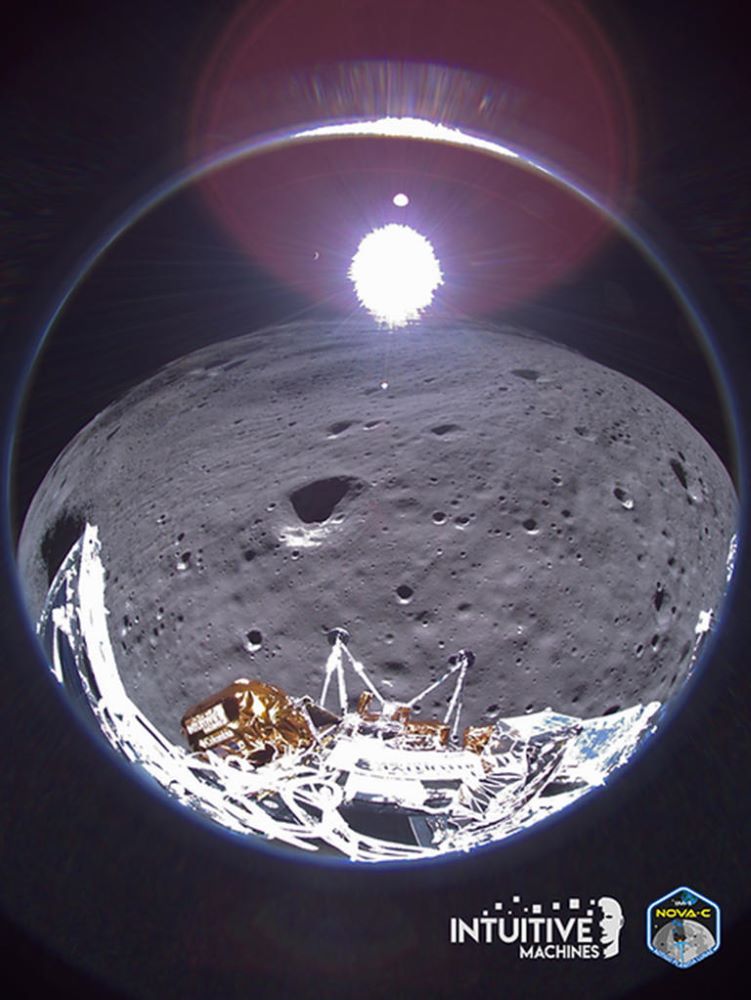
After the Nova-C ‘Odyssey’ lander fell silent on February 29th, the causes of the crash near the lunar south pole became more clear. The much-vaunted fix of replacing the main laser altimeter with an experimental NASA one had almost worked, but the spacecraft computer could not accept the data due to a missing phrase in the software patch. Without it, using only optical data, Nova-C nearly achieved a soft landing, but it touched down at six metres per second vertically, two metres horizontally, broke a landing leg and fell over. The last transmitted image showed the crescent Earth to the left of the Sun (Fig. 1). There were hopes that it might survive the lunar night and resume signals 14 Earth days later, and these were boosted when the Japanese SLIM lander did survive the night, sending more pictures of its landing site, though it wasn’t designed to. Still more remarkably, in late March SLIM reawakened after a second lunar night, and continues to add to its coverage of the landing site, though it remains stuck in its nose-down position.

The SOHO spacecraft, which has been orbiting at the Sun-Earth Lagrange 1 point since 1995, has discovered its 5000th Sun-grazing comet – a remarkable achievement, because it wasn’t intended to do that, and only a few comets passing very close to the Sun had been observed previously. They’re thought to be fragments of much larger comets which broke up in close passes, and many of them don’t survive doing it again. The Parker probe, much closer to the Sun and getting closer on each pass, has encountered multiple Coronal Mass Emissions, high-energy clouds of particles emitted from the Sun during eruptions and causing auroral displays when they enter the atmosphere after overloading the magnetic field, 32 events between August 2018 and October 2022 (Fig. 2).

NASA’s Marshall Space Flight Center has proposed a new mission, Mercury-Scout, which would achieve a close orbit around Mercury and photograph features of interest at 1-metre resolution or better. Mercury-Scout would be propelled by solar sail, reacting to light pressure (Fig. 3).

Although the principle was formulated more than a century ago, and demonstrated with the Mariner probes and Echo satellites of the 1960s, the only interplanetary sail to date has been Japan’s Ikaros, which entered high orbit around Venus in December 2015 (Fig. 4).

Venus will be occulted by the Moon in daylight on April 7th, seen from Central America, Mexico and northern and eastern USA. There’s good news meanwhile about NASA’s VERITAS probe to Venus, which is scheduled for 2031 launch after a pause in funding last year.

In the continuing study of water below the surface of Mars, ESA’s Mars Express continues to play a major role. Its MARSIS penetrating radar booms weren’t deployed until well after its arrival in December 2023 (Fig. 5), and there was concern at the time because one of them wasn’t fully locked. But in operation it’s been a success, and has now discovered that the Medusae Fossae Formation (Fig. 6), believed to have multiple bodies of ice below the surface, apparently has volumes of ice large enough and deep enough to be called an ocean (Fig. 7).


When Mariner 9 reached orbit around Mars in 1971, one of the first features to emerge from the planet-wide dust storm was an elaborate structure of linked chasms named Noctis Labyrinthis, the labyrinth of night (Fig. 8).

It lies east of the Tharsis Ridge which bears three great volcanoes, dwarfed only the still larger Olympus Mons further west (Fig. 9). To appreciate the huge size of these features it helps to visualise them superimposed on the continental USA (Fig. 10).


Its origin has always been obscure, but had to be connected with the downward flow of terrain from the Tharsis Ridge to Valles Marineris, the huge rift valley to the east, whose floor has been scoured by enormous floods in the remote past. Now it turns out, from a study comparing images of the region from Mariner 9 to the present (Fig. 11), that between Noctis Labyrinthis and the head of Valles Marineris the chaotic landforms are the remains of another shield volcano, 200 miles across at the base, which has been erased by a network of outflow channels linking the Ridge to the Valley (Figs. 12 and 13).


The intriguing question is, where did the water come from? We now know that huge amounts of it were deposited below the crust of Mars in its early history – see above. There’s a long-standing idea that the Tharsis Ridge might have been uplifted by shockwaves from the huge impact which formed the Hellas Basin, on the far side of the planet, possibly changing the tilt of its axis (Fig. 14).

Could that also have released enough water to break up the Noctis volcano? That would have been one hell of a spectacle. It’s well known that Ailsa Craig in the Firth of Clyde is the granite plug of an ancient volcano, part of the chain that runs across central Scotland through Dumbarton Rock, Stirling, Edinburgh Castle, Arthur’s Seat and the Bass Rock in the Firth of Forth. The conical mountain which surrounded the Craig has long since been washed away by the sea (though as my sister remarked, they must have used a very strong detergent). But its destruction is nothing to what happened on Mars.

ESA’s Euclid space telescope, launched in July 2023 to search for evidence of dark matter and dark energy (Fig. 15), has been experiencing a build-up of ice on its supercold mirror as individual molecules of water escape from its structure. The problem was anticipated and engineers have successfully heated the mirror and cooled it down, driving off the ice, and expect to do so again during the spacecraft’s life.
The Voyager 1 spacecraft, in interstellar space 45 years after launch, has been sending back garbled data due to a memory fault which has developed in its Flight Data System. Engineers have now managed to command a full download from the FDS, and it’s hoped that the fault can be found within that and remedied, though both Voyagers are expected finally to run out of power around 2030.
Duncan Lunan’s recent books are available through Amazon. For more information see Duncan’s website, www.duncanlunan.com.


Leave a Reply