
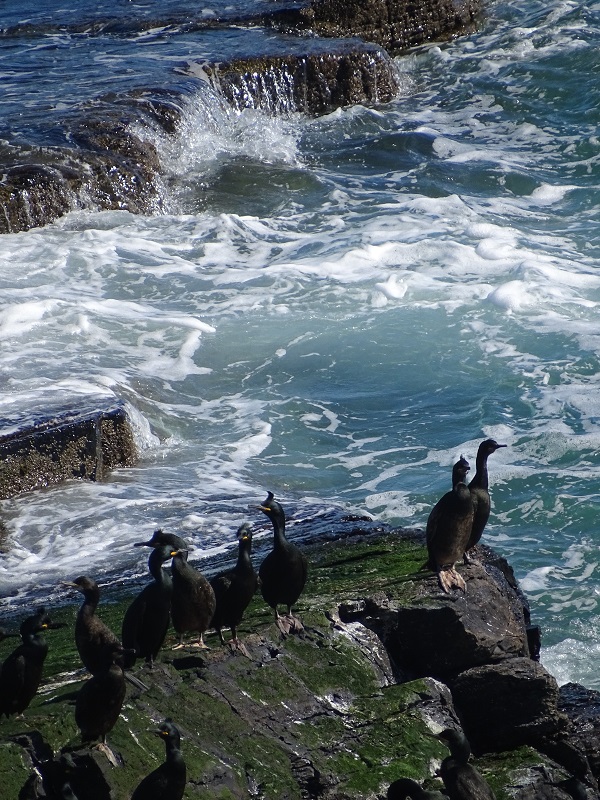
A five year study into sea bird populations will try to predict how wild populations will evolve in response to increasing frequencies of extreme winter storms.
Professor Jane Reid, from Aberdeen University’s School of Biological Sciences, will lead the five-year study when it starts later this year. Commenting on her delight in receiving a €2.5million by the European Research Council (ERC) she said:
“The team are delighted to have been awarded this European Research Council Advanced Grant, which culminates from huge fieldwork efforts across Scottish coasts through recent years.
“This project will greatly increase our ability to predict and manage the fates of wild populations in the face of climate change. Scotland holds numerous internationally important populations of protected species, including our focal species the European shag, where we need to enact successful conservation in the face of turbulent climate changes.”
The project team which includes researchers from Aberdeen, the UK Centre for Ecology & Hydrology (UKCEH), and the Norwegian University for Science and Technology (NTNU), will try to predict how wild populations, and in particular European shags, will evolve in response to increasing frequencies of extreme winter storms.
Professor Francis Daunt, seabird ecologist from UKCEH, said:
“Many seabird species have declined considerably across northern Europe over the last 20 years and extreme climate events are one of the most important causes.
“This project will make a huge advance in our understanding of how species such as the European shag can adapt to such events, a critical question as they are predicted to become more frequent and severe.”
The project, entitled: ‘Spatio-seasonal eco-evolutionary dynamics’, is due to begin in September 2024.
It is the second time Professor Reid has been awarded ERC funding. In 2012, she received an ERC Starting Grant from the European Commission worth over €1.3 million for her project on the evolution of inbreeding in wild animals.



Leave a Reply