
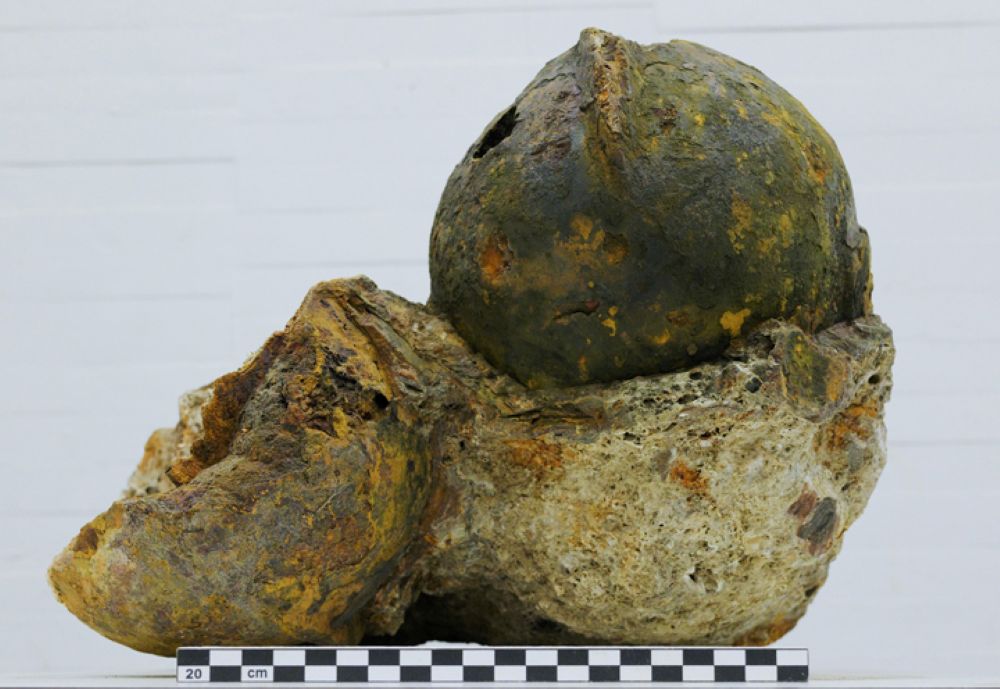
Research led by the University of Alicante (UA) has enabled a reassessment of one of the most remarkable assemblages of weaponry ever discovered in Spanish waters of 43 helmets.
Using new and improved methods, archaeologists are re-visiting sites and artefacts. Recently military equipment thought to be Roman, and found in 1990 at the Piedras de la Barbada underwater archaeological site, off the coast of Benicarló have been re-assessed.

Led by Manuel Frallicciardi, a doctoral student under joint supervision between the University of Alicante and the University of Salerno the scientific results place the manufacture of the weaponry between the late 14th and early 15th centuries, completely dismantling the Roman attribution that had stuck to the find since its recovery.
The helmets were originally discovered by chance when local fishermen accidentally snagged two large metallic blocks, compacted by marine corrosion, in their nets. Inside lay an exceptional haul of iron headpieces. While this concentration of 43 items represents what remains of a potentially much larger shipment, the quantity makes it the largest hoard of medieval helmets discovered to date in the western Mediterranean.
According to Raimon Graells, a UA lecturer, co-director of Frallicciardi’s doctoral project, and co-author of the paper, the sheer scale of the find goes beyond purely archaeological curiosity.
“We are looking at direct evidence of large-scale arms trading. This discovery reveals a network of exchange and communication that was far more complex than previously thought,” he noted.
The research points to a flow of weaponry between the coast of the Valencia Region and the major commercial hubs of northern Italy, such as Genoa, which was one of the dominant mercantile powers of the era. The presence of such a substantial shipment suggests that transporting military equipment was integrated into perfectly structured commercial circuits connecting different Mediterranean territories.

One of the most innovative aspects of the project was the application of an analytical methodology developed at the University of Alicante. Although this system is routinely used in other archaeological contexts, it had never been employed to examine medieval weaponry of these characteristics. Thanks to this approach, combined with radiocarbon dating of textile remnants preserved inside several helmets, the team established a highly precise chronology.
Frallicciardi explained:
“At the beginning, it was difficult to place them in a specific era because they featured traits that recalled both Late Roman models and potential medieval pieces inspired by classical traditions.
“When I started the research, it was incredible to see that practically no known parallels existed.”
His search for references led him to some similar 14th-century iconographic representations in England, though without exact matches. The carbon-14 results ultimately confirmed that this was a poorly documented helmet shape belonging to a technological transition phase that left no later lineage.
Specialists believe that all the pieces formed a single shipment when they hit the seabed. The most probable hypothesis is that the batch was packed and transported by sea when an incident occurred during loading or unloading operations. The cache was found at a depth of just six metres, right next to an area used as a jetty.
Dr Graells suggested that a portion of the cargo became trapped under the sand and could not be recovered at the time. This accidental mishap allowed the package to remain hidden for centuries, safely buried out of sight.
The exceptional preservation of the helmets was achieved through the combined action of marine concretions and sediment. In some specimens, these deposits sealed the fabrics lining the interior, creating stable micro-environments that protected organic materials that would normally decay. These very textile fragments proved fundamental to reconstructing the history of the hoard.
The researchers place the sinking during a particularly turbulent period for the western Mediterranean. The expansion of Islamic piracy along the Valencian coast during the mid-14th century, alongside the growing militarisation of the coastline, generated a high demand for defensive equipment. In this context, the cargo may have been destined for local militias, troops of the Kingdom of Valencia, or armed companies tasked with protecting the maritime frontier.
Click on this link to access, Radiocarbon dating and characterisation of textiles preserved in late medieval helmets from Benicarló (Castellón, Spain), published in in the Cambridge University Press journal Antiquity.



Leave a Reply