
Review by Duncan Lunan

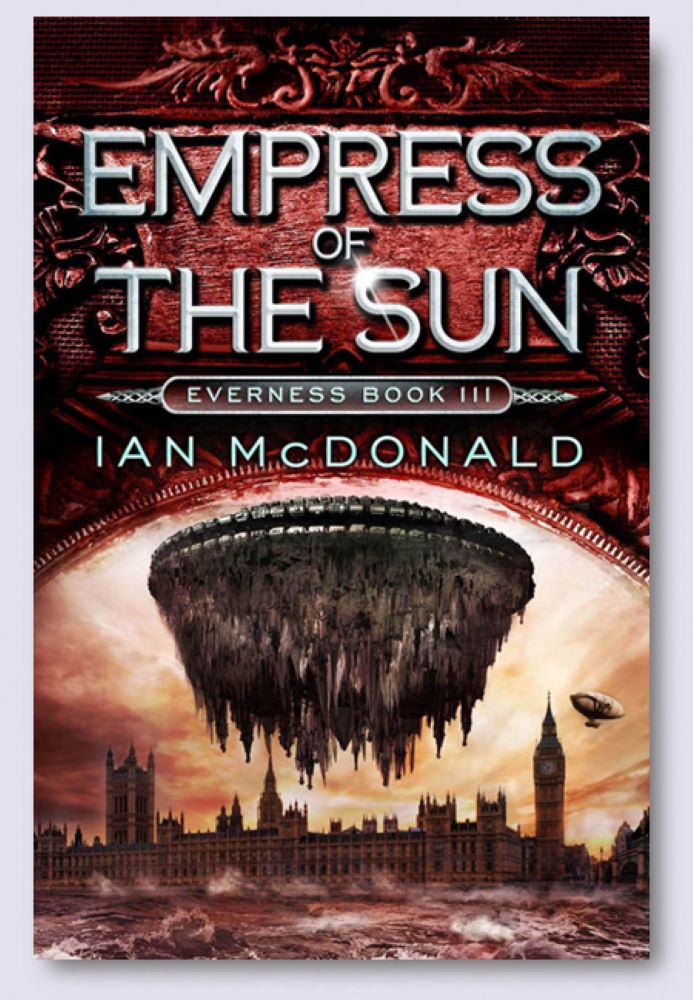
Ian McDonald, “Empress of the Sun, Everness Series Book 3”, Jo Fletcher Books, £20.00, hardcover, 389 pp, 2014.
First published in Interzone 251, Mar-Apr 2014.
Empress of the Sun is the third of a series of young adult novels, set in a series of alternative worlds – which puts the reviewer new to the canon at something of a disadvantage. There are an infinite number of alternative worlds, but hitherto only ten of them have been accessible from ours. The novel begins with the airship Everness emerging over an eleventh, unexpectedly in a nosedive instead of level flight, and not pulling up sufficiently to escape becoming embedded in the treetops, with two engines pulled off and lying somewhere astern on the forest floor.
The teenage navigator who finds himself unpopular as a result is Everett Singh from Earth 10, whose preoccupation is to find his father Tejendra, missing somewhere Out There among the many worlds (not the other father who died on E1). But Everett too has his counterparts on the other worlds, and the one on E10 has to deal with the usual young adult issues of schooldays, the opposite sex, etc, with the additional burden of hidden weaponry to deal with an infestation of the self-replicating nanotech nasties which made E1 uninhabitable. So he has to keep his best mate, his girlfriend and his family from becoming targets without telling any of them what’s happening or why his behaviour has changed so much.
The alternative Earths have major differences between them and there’s no Prime Directive to maintain hands-off policies, indeed there’s an attempt at overall government called the Plenitude of Known Worlds. The technology of the nonhuman Thryn is everywhere, especially on E4, whose people “had not developed a technology or made a scientific discovery of their own in thirty years”; E2 has the fullest grip on what’s happening and the best of everything, E5 has Victoriana and five different varieties of humans, and E3 is a good compromise if you can live where you choose. E7 is a world of twins which has adapted most readily to an expanded reality of multiple worlds. On E2 Britain is apparently merged with Gibraltar, on E4 Michael Portillo is Prime Minister, E3 has no oil and E8 is “an ecological wreck with a runaway greenhouse effect”.
There are a lot of in-references. Terry Pratchett is explicitly cited, but in real life Hugh Everett was the originator of many-worlds theory, and Tejinder P. Singh is a prominent researcher in the field. Here the unique device which gives access to all possible worlds is called the Infundibulum, the word for a space-warp in Kurt Vonnegut’s The Sirens of Titan; Everett’s arch-enemy is Charlotte Villiers, sharing her surname with M’s assistant in the Bond canon, and her sidekick is called Zaitsev, after the real-life chief planetary scientist of the Soviet space programme. Everett’s featured counterpart is Everett M. Singh, not to be confused with Iain M. Banks, either. The all-devouring Nahn have a lot in common with the nanites of Stargate SG-1; and of course E3 has to have airships to go with the steampunk and Tesla’s electricity, but the airship’s Captain is called Anastasia, like Dan Dare’s personal transport. When invasion comes, it focuses on London, not Washington, as if in honour of H.G. Wells. On E7 the land bridge between Europe and Britain still stands, as it does in Stephen Baxter’s ‘Northland’ trilogy. Everett M.’s difficulties are very like the android’s in The Last Starfighter. But the school bullies whom he faces down are Jennings and Derbyshire, inescapably linked in my day to the public school fiction of Anthony Buckeridge; either you loved it or you hated it, and I’m glad to see them parodied at last.
But younger readers may not get these references, or may be amused to catch up with them later, as I remember being when I discovered the original of Percy F. Westerman’s Golden Vanity. The big idea of this novel is that the world of the Empress is the one where the Chicxulub impact never happened, and the dinosaurs’ descendants are in charge, with a culture of six ‘clades’ locked in rivalry and conflict. Yes, there are echoes of Harry Harrison’s Eden trilogy… but their 65-million-year lead on us is in physics, not biotechnology, and they’ve cannibalised the planets of their Solar System to create an Alderson Disc, a filled-in Ringworld like a giant DVD with the sun in the middle (hence the airship crash at the beginning). The sheer scale of the thing, the multiplicity of life it supports and the alienness of rulers who could destroy it for purely personal gain, make the threat that the winners pose to the Earths of the Plenitude truly chilling. For adult readers that may not sit too easily with the in-jokes and the girlfriend problems; but we are not the target audience, who will probably enjoy it all.


Leave a Reply