
By Fiona Grahame
Bishop William, the Old, was in charge of all things ecclesiastical in Orkney for 66 years. That’s quite a length of time to be running affairs that went way beyond that of Church duties and into areas where his considerable skills at diplomacy were all too evident to be seen.
It’s difficult to fully appreciate those who work behind the scenes in any political arrangement as it is an essential element of their skills to make sure someone else is the headliner so that they don’t lose theirs.

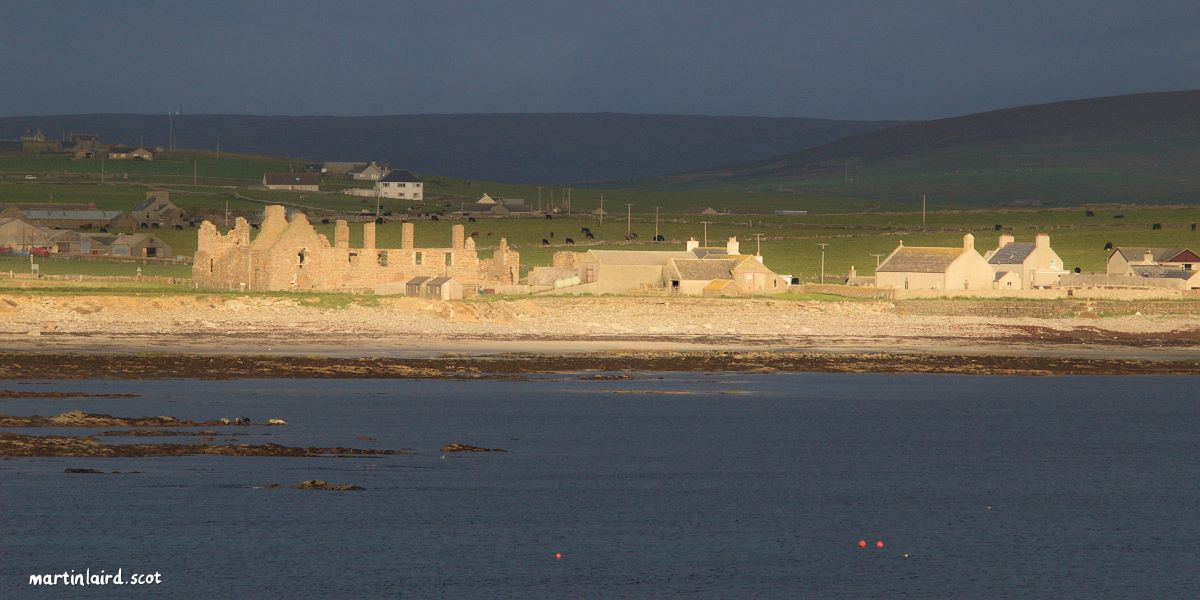
Bishop William, referred to as ‘The Old’, but who must have been young when he started on his rise to power, would have been from a well to do family, educated in Europe, fluent in languages and was a good friend to Svein Asleifsson, Orkney’s last sea wolf. Bishop William intervened on more than one occasion on Svein’s behalf. This included giving Svein a place to stay with him on Egilsay after he killed Svein Breastrope, and ensuring he could get away safely to Tiree.
There were at this time not just two Earls in Orkney sharing the Earldom, the cousins Haakon and Magnus, but also two Bishops. One was Bishop William appointed via the Hamburg-Bremen route and supported by the King of Norway, Magnus Barelegs. The other was Bishop Ralph Novell via the York route with the support of the Rome Papacy and elected, the OrkneyInga Saga states, by ‘the men of Orkney.’
The Bishops fell into the factions of the two Earls who were struggling for outright control of the Earldom. Ralph was in team Earl Magnus and William in team Earl Haakon. William also had connections to the powerful Atholl family in mainland Scotland who themselves had claims to the Earldom. It’s not known if Ralph ever came to Orkney but William was residing in Egilsay and it was there that Magnus and Haakon came together to reach agreement over the Earldom. William would have been involved in that negotiation.
Agreement was never reached and Magnus was dragged from the church where he was at prayer to be slain by order of Haakon.

Magnus’ distraught mother, Thora, asked for his body to be taken from Egilsay to Christ Kirk in Birsay in the West Mainland. Haakon, possibly feeling some remorse, agreed to this and Magnus’ body was taken to Christ Kirk, built by the grandfather both cousins shared. Bishop William would have made this important journey too, accompanying the Earl’s remains.
Bishop Ralph never had any kind of power in Orkney despite letters from the Pope, and his days were spent ‘in remotis’ as an assistant in the Bishopric of York.
The killing of Earl Magnus might have got rid of his immediate rival but his supporters were still there and as time passed miracles were being spoken of. Pressure was put on Bishop William to recognise that the miracles were happening but this would have been deeply unpopular with Earl Paul, Haakon’s son, who ruled from 1122. Bishop William stifled the increasing reports of miracles saying that it would be ‘sheer heresy to spread them around.’
Some years later, and with a cult of St Magnus growing despite efforts to stifle it, Bishop William visited Norway. It is most likely that he met Earl Paul’s rival, Rognvald Kali Kolsson, nephew of the late Earl Magnus, and favoured by the Norwegian King. William then left for Shetland a stronghold of supporters of the Magnus line and many of whom had recounted their own experiences of the miracles associated with him. Delayed by poor weather William vowed to the ship’s captain that should the weather improve and he return to Orkney that he would no longer oppose Magnus becoming a Saint. Local Bishops, such as William, had the power to create saints. The weather did improve, William returned safely to Orkney, but did not honour the vow he had made to the Shetlanders. He was still very much aware of the power and popularity of Earl Paul and would do nothing which would compromise his position with the leadership.
One day William was kneeled in prayer in Christ Kirk, Birsay, but when he stood up he was blind. Weeping profusely and praying over Magnus’ grave, his own personal miracle occurred and his sight returned.

It was also at this time that Rognvald Kali Kolsson had begun his military campaign to take the Earldom from Earl Paul. The first attempt failed, 1135, but the second succeeded, in 1136. The power balance had shifted and so too did William’s views about Magnus becoming a saint. But there was a process to go through.
Bishop William washed Magnus’ bones which shone brightly as he did so. He tested a knuckle bone three times in consecrated fire. It would not burn but took on the colour of gold. Earl Paul had disappeared, captured by Svein Asleifsson, whisked away to the Atholl clan in Scotland, where he was maimed and died. On taking over the Earldom, the victorious Earl Rognvald, made good on the vow he made his father, Kol, in Norway, and the construction of what was to become St Magnus Cathedral was started in 1137.

In a grand procession Bishop William travelled with the relics of St Magnus from Birsay to St Olaf’s Kirk in Kirkwall where they would remain until installed in a pillar of the new Cathedral. The power of the islands had also shifted to Kirkwall and the northern isles with the success of Earl Rognvald. Miracles continued to occur and the cult of St Magnus became widely known, well beyond the shores of Orkney. Many Shetlanders travelled to pay homage to the saint and a pilgrimage route took devotees across Caithness to the islands.
The building of the Cathedral increased the already formidable reputation of Bishop William who received landed estates adding to his personal power and wealth.
‘The alliance between Rognvald and Bishop William is a good example of how the Medieval Church and State could co-operate for their mutual benefit.’ – The New History of Orkney, William P.L. Thomson.
Bishop William travelled with Earl Rognvald to the Holy Land and acted as his interpreter. The pilgrimage to the East involved 2 years of preparation, a fleet of 15 ships, and took them through Europe. In Galicia they attacked a castle and the land was plundered. Off the coast of Sardinia they encountered two dromons (Greek galleys), laden with riches, which were successfully overcome and those who were not killed, but looked wealthy, were taken hostage to Bishop William’s ship. No one would pay a ransom and the hostages were eventually let go, or so the Saga tells us.
The entourage reached Jerusalem and Earl Rognvald bathed in the River Jordan. Onward they travelled to Constantinople where they were welcomed and given the opportunity to become paid mercenaries. Passing the winter there they went by horseback to Rome, an audience with the Pope, finally travelling back home via Denmark and Norway.
Bishop William was ‘the key to unlocking the full potential of the Magnus cult’, Thomson, The New History of Orkney. This allowed Earl Rognvald’s claim to the Earldom a legitimacy which no other claimant could get close to. Bishop William, the ‘cleric of Paris’, was central to the development of the Earldom, its cathedral, and raising the international status of the islands across the Medieval World.

The Orkney News has several stories about the Orkney Earls. You can find them by using the search button.
This article first appeared in iScot Magazine.

Leave a Reply