
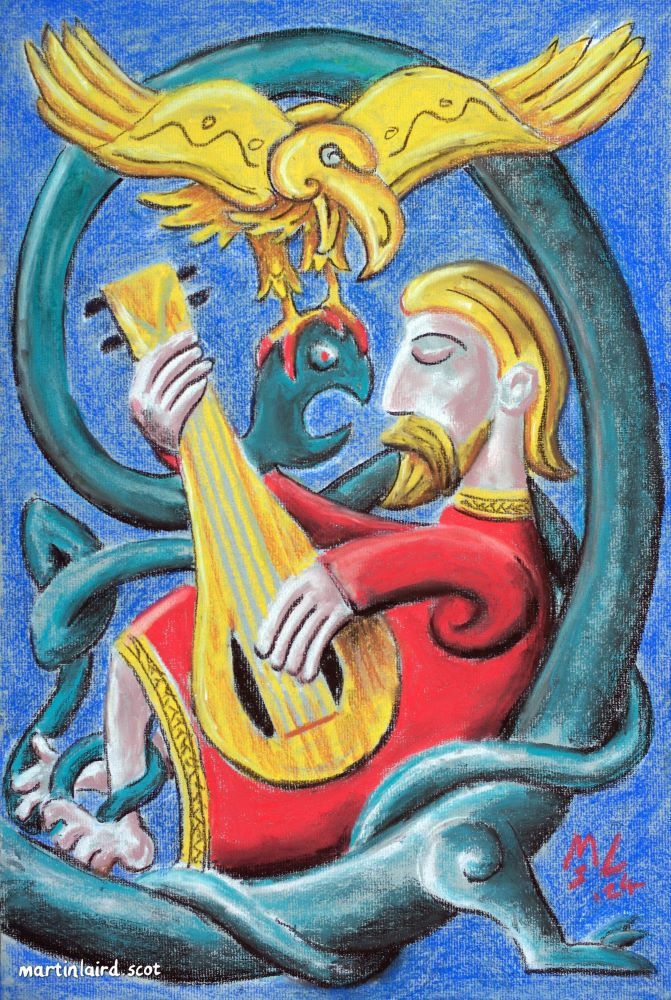
“Who’ll challenge my nine skills?
I’m champion at chess,
canny recalling runes,
well-read, red-hot smith –
some say I shoot and ski
and skull skilfully too.
Best of all, I’ve mastered
harp-play and poetry.” – Rognvald Kali Kolson, translated by Ian Crockatt

It’s all too easy to fall into the portrayal of the Norse Earls of Orkney as savage, blood thirsty piratical rulers who enjoyed nothing better than a good raid south to bring back bountiful booty to their feasting halls in the islands.
And whilst they did all of those things, there is also much more to their rule over Orkney than that image encapsulates. No one is better to illustrate the other facets of the Orkney Earls than Rognvald Kali Kolson.
Earl Rognvald’s time as Earl, first as a joint ruler, sole ruler, and then again jointly, has been described as a time of ‘Renaissance.’ He ruled c1135 – 1158 when disorder and casual violence was still common. To survive it required ‘all his political skills’, Thomson, The New History of Orkney. He had those skills, having been brought up by his parents on their wealthy estate in Norway, but also by keeping close to him advisors that knew how to manage the situation in Orkney, like Bishop William the Old.
Earl Rognvald was not well known when he invaded Orkney to challenge Earl Paul to the Earldom, and his first attempt failed. Support, however, he did have in Shetland and Iceland, through the good name of his Uncle, the martyred Earl Magnus, and his second invasion in 1136 was successful.
The poem at the start of this article was written by Rognvald when he was still a young man. In it he boasts about his many accomplishments, and in amongst his prowess at physical pursuits are his skills in reading and writing. Rognvald was a highly literate man who wrote some of the finest poems ever conceived in the complex form of Skaldic verse. His poems, expertly translated by Ian Crockatt in ‘Crimsoning the Eagle’s Claw’, reveal a man well-travelled, humorous, and passionate.
Twelfth Century Orkney was a literate Christian society. It was Earl Rognvald who ensured that his uncle, the Earl Mangus, was canonised, and who began the construction of St Magnus Cathedral. The runes carved inside the Neolithic Tomb of Maeshowe by Vikings returning from pilgrimage to The Holy Land, demonstrate skills of men and women, in not just writing in runes, but in composing phrases of ribald humour.
Earl Rognvald travelled to the Holy Land to bathe in the waters of the Jordan – all of which he describes in his poetry. His infatuation with the Lady Ermingerd at the court of her father the Count of Narbonne, reveals a man of passion, who could express his feelings in the language of courtly love:
“Who else hoards such yellow
hair, bright lady – fair as
your milk-mild shoulders,
where milled barley-gold falls?”
He gathered around him in Orkney the fine poets of the day, many of whom came from Iceland. His feasting Hall would have been filled with music and poetry, verse which was intended to be performed. Rognvald was also very self aware about his appearance and was a snazzy dresser. The Norse were skilled weavers of cloth but, as great traders, they also had access to fine textiles from across the trading routes which spanned from East to West.
Rognvald was a man brought up in wealth, and who expected that to be maintained, but who was curious about the world further afield. To go on Crusade to the Holy Land was an essential component of his complex character. The Crusade was brutal and ruthless, and included a stay at the court of the Emperor of the Varangians, where the opportunity arose for Earl Rognvald and his retinue to be mercenaries in his employ. Highly cultured Rognvald might be, but a crimson winged eagle’s claw he still was.
Rognvald was gone from his Earldom for over three years and over that time things had changed in the islands. Conflict again had arisen between competing Earls. Earl Rognvald had to agree to share the Earldom with Earl Erlend. They were up against Earl Harald Maddadson. Shifting sides Rognvald and Harald joined forces. It did not end well for Erlend who was found washed ashore on the island of Damsay with a spear sticking in his drowned body.
Every Earl was only as powerful as the support he could count on from among his own people. The ‘godings’ (good men), were landowners, often related in kinship or marriage, who provided the Earls with taxes from their lands, with produce, and with people, as servants, slaves, or from their own ranks, warriors. This was a structured society where the guy at the top was only as secure as the good terms he was on with the godings. The feasting and entertainments at Earl Rognvald’s Hall were part of his insurance policy for keeping the godings on side.
No matter how skilled an Earl was at political manoeuvring, or how popular he thought he might be, there was always the chance of meeting a violent death. Unfortunately, despite all his sophistication and diplomacy, Earl Rognvald was killed. He was in Caithness, part of the Earldom, and it so happened that also there was Earl Harald Maddadson and Thorbjern Clerk. Thorbjern had at one time been Earl Harald’s right hand man but had gone rogue on him. The two Earls went in pursuit of Thorbjern but luck was not on the side of Rognvald that day. In cornering Thorbjern, Rognvald’s foot caught in his stirrup as he dismounted his horse. Thorbjern, never a man to miss a chance, fatally wounded Rognvald. On his arrival on the scene, Earl Harald, ignored Thorbjern’s pleas for mercy and handed him over to be killed by Rognvald’s men.
Earl Rognvald’s body was taken to Orkney and buried in the Cathedral he had created. Eventually he too became a Saint, like his Uncle Magnus before him, and his bones are interred within a pillar in the Cathedral.
“Let the sea’s soused poet/sound his voice.”- Rognvald Kali Kolsson.

By Fiona Grahame
This article was first published in iScot magazine


Leave a Reply