
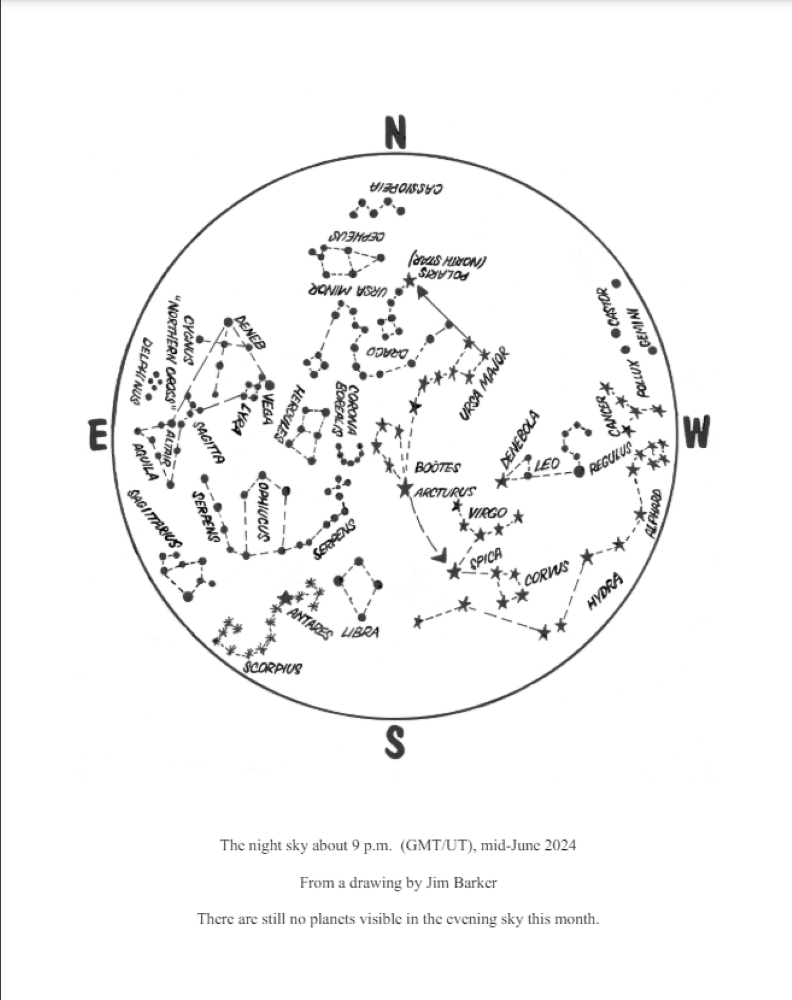

The Moon will be New on June 6th, and Full on June 22nd. The Moon is very near Neptune on June 1st, and a third of a degree from it again on the 28th, The Moon passes Mars on the morning of the 3rd, and Saturn on the mornings of the 27th and 28th, during which it will occult Saturn, passing in front of it as seen from eastern Australia. On May 24th the Chinese space agency announced that the attempt to set down its sample return mission, in Apollo crater within the Farside Aitken Basin, will be made on June 2nd, with the return scheduled for June 25th as previously declared.
The midsummer solstice is on June 20th, not the 24th as some publications are listing as ‘Midsummer’s Day’. Sunspot region AR3697, which was associated with the events causing May’s big aurorae, is now back on this side of the Sun and very much still active, so there may be spectacular events to come.

Some US guides to the sky have been making a big deal of the line-up of planets as they appear from last month’s concealment by the Sun (Fig. 1). They will all be in a 90-degree arc of sky, all visible in theory except Venus, and better seen from further south in the USA, but as detailed below they will not make a spectacular view from here.
I’m often asked if such alignments foreshadow good or bad luck, and the answer is that even if they did, they won’t be in a straight line even as seen from the Sun, let alone close to one another in space. Years ago now, I was asked to help my then landlord in the collection of a motorcycle from Ashby-de-la-Zouch, far down the A1. I was to share the drive down and escort the cycle back. There was a visible line-up of planets in the morning sky that day, and I managed to see it while my friend was buying the bike, After the purchase was concluded, I made my way out to the A1, and Jim wasn’t there. I backtracked to the previous roundabout, then back up to the rendezvous point, but there was no sign of him, and this was long before the days of mobile phones. Having made my own way home in his car, the following day I learned that he’d been unable to start the bike, had to come home to Glasgow by train, and would have to have it shipped up after all. It arrived, he chained it up securely in the front garden, and just a few days later enterprising thieves with bolt cutters sliced through the heavy chain and made off with the bike, presumably in a van unless they blatantly wheeled it away. If the bad luck went with it, maybe they couldn’t start it either; but if I’m asked to do anything similar during the June alignment of the planets, I shall plead age and infirmity without hesitation.
The planet Mercury might be seen after sunset in late June, but probably not in the prolonged Scottish summer twilight. Mercury is at superior conjunction with the Sun on June 14th. Europe’s Bepi-Colombo probe is gearing up for its last three Mercury encounters, ending on January 25th 2025, before it enters orbit around Mercury in December 2025 and separates into two (Fig. 2), to study the planet from different orbits (Fig. 3). However its solar-electric xenon thrusters (Fig. 4) are producing diminished thrust, 90% of the intended value, and the encounters will have to be reprogrammed if the problem can’t be solved.


Venus is still out of sight beyond the Sun, at superior conjunction on June 4th. On May 29th the JAXA space agency announced that it had lost contact with Akatsuki, currently the only spacecraft in orbit around Venus, and efforts to regain contact are ongoing. After 9 years there, and before that 5 years in solar orbit when it failed to achieve Venus capture at the first attempt, it has had a good innings and more US missions to Venus are pending.
Mars will rise about 2.30 a.m. in June, so it’s not likely to be seen in Scotland’s pre-solstice twilight as it passes from Pisces into Aries.
In November 2023, on its way to the Asteroid Belt, NASA’s Lucy spacecraft passed the asteroid Dinkinesh, a ‘target of opportunity’ which had been discovered in 1999. It turned out that despite its small size, Dinkinesh had a satellite, quickly nicknamed ‘Dinkytoy’ – and then, an image taken a day before closest approach revealed Dinkytoy either had a satellite of its own, or was a ‘contact binary’ of two objects joined together, as many asteroids are (Fig. 5). With more images downloaded, it turns out that Dinkytoy is indeed a contact binary (Fig. 6). They all appear to be of the same material, unlike Ida and its companion Dactyl, which were the first binary asteroids to be discovered. Dinkytoy was formally named named ‘Selam’, meaning ‘Peace’, and analysis of its orbit suggests that it has broken off from Dinkinesh no more than 3 million years ago, with 2 million years more likely. If so, remarkably enough, Selam is younger than the 3.2-million-year old human ancestor Australopithecus afarensis, discovered in Ethiopia in the 1970s, after whom the spacecraft is named.


Lucy’s next encounter will be another target of opportunity, the Main Belt asteroid 52246 Donaldjohanson, in 2025, after which will come its main targets, eight asteroids occupying ‘Trojan’ positions at the L4 and L5 Trojan points in the orbit of Jupiter (Fig. 7), which Lucy will encounter in a looping path around the Sun between 2027 and 2033 (Fig. 8). One of Lucy’s circular solar panels has never fully opened (Fig. 9), but after multiple attempts to tug it free have failed, it’s hoped that it will at least stay put for the rocket manoeuvres to come.


The asteroid Bennu, from which the OSIRIS-Rex probe recently returned sample, is described as a Potentially Hazardous Asteroid. Bennu will have a close encounter with the Earth in 2135, but will not hit us the time after unless it passes through a narrow ‘keyhole’ in space (chances are 1 in 2,700). As a result, on Tuesday, Sep 24, 2182, there is a 1 in 2,700 chance of colliding, and between now and 2300 the odds are 1 in 1,750, so the situation needs close watching.
The Psyche space probe, going to the metallic asteroid of the same name, is now under ion thrust to line it up for a Mars flyby in 2026, before rendezvous with the asteroid in 2029..
Jupiter in Taurus rises at 3.30 a.m., briefly visible low in the north-east before sunrise, near the Moon on the 5th. On its 59th close pass of Jupiter (perijove), on March 7th, the Juno orbiter captured two images of the inner satellite Amalthea, silhouetted against the planet (Fig. 10), the first from a spacecraft since the Galileo mission in 1999. Juno’s mission, much extended from 2016, is currently scheduled to end in September 2025. With NASA’s science budget under pressure, and Europe’s Jupiter Icy Moons mission already en route, what happens to Juno may depend on whether the launch of NASA’s own Europa Clipper mission is successful in October this year. Continuing investment in Juno may be unlikely, if the Europa Clipper launch goes well.

Saturn in Aquarius rises about 1 a.m. and is close to the waning Moon on the 27th and 28th as above.
Uranus reappears from behind the Sun in Taurus, rising ahead of Jupiter, but hard to see throughout the month in growing twilight.
Neptune is in Pisces, rising about 1.30 a.m.. The Moon occults Neptune on the 1st, seen from Africa and Asia, and again on the 28th, in daytime from the UK and Europe, as well as from much of South America.
Mission controllers are continuing to make headway with Voyager 1, bypassing the faulty chip which has been garbling its signals since late last year. After obtaining an engineering download, engineers were able to locate the problem and bypass it to send engineering data in real time. allowing for the radio timelag of over 17 hours (over 22 hours according to some reports). On 24th May, Space.com reported that science data from two of the remaining instruments had been received by a similar re-routing within the spacecraft. Due to a shortage of data storage onboard, two more instruments have still to be redirected. One by one Voyager’s suite of instruments have been turned off as the output from the spacecraft’s radioisotope generator continues to fall, and contact will probably be lost around 2030.

It’s also worth noting that TESS, the Transiting Exoplanet Survey Satellite, launched in 2018 on a small Pegasus booster, has completed its primary mission of a 6-year all-sky survey (Fig. 11), looking for planetary systems of other stars. In the process it has validated 32 new planetary candidates, and confirmed the masses of 126 (Fig. 12), with a wide range of masses and orbits, and many more discoveries to come as its result are analysed. What it will do next remains to be seen, but already there are proposals for a 14-metre space telescope called SALTUS (Single Aperture Large Telescope for Universe Studies, Fig. 13), which would work in far-infrared wavelengths far beyond the James Webb’s Space Telescope’s, to study the formation of planetary systems and the evolution of planetary atmospheres (Fig. 14), among many other things.


Meanwhile the JWST has found two red-coloured galaxies composed of massive young stars, JADES-GS-z14-0 and JADES-GS-z14-1. dating respectively from 300 and 400 million years after the Big Bang (Fig. 15). There have been previous claims to have found galaxies as old as that, and none have been borne out, but the JWST team are very sure of their ground and have published redshift spectra to back up their claim (Fig. 16). The big surprise, not really a surprise because indications were already pointing that way, is that both galaxies are so large and so evolved, rather than having been largely devoured by supermassive black holes – showing that star formation began much earlier in the history of the Universe than previously thought.


As I advise every year, astronomical twilight lasts all night in Scotland during June and July, making those the best months to watch for noctilucent clouds, glowing in the northern sky as they’re lit by the Sun from below the horizon (Fig. 17).

They were first noted by Charles Piazzi Smyth, the Astronomer Royal for Scotland in the mid-19th century, and because they reflect sunlight perfectly, their composition is unknown. Some form of ice seems most likely, but ice should not be able to float at those altitudes, around 60 miles up, so the clouds remain doubly mysterious. Why were there no reports before Piazzi Smyth’s?
Stop press news.

On May 30th, news came in that ESA’s Solar Orbiter (Fig. 18) has solved a mystery which has persisted since the existence of the Solar Wind was confirmed by the Mariner 2 probe, on its way to Venus in 1962. The solar telescopes on the Apollo Telescope Mount on the Skylab space station, in 1973, established that the outflow of plasma escapes through large holes in the outer atmosphere, the solar corona; but where on the Sun it originated has literally remained unclear, because the necessary data was too smeared out by the time the wind reached Earth, or even satellites like SOHO (Solar Heliospheric Observer) at the Earth-Sun L1 point, a million miles to sunward of us. But in Solar Orbiter’s ever-closer passes around the Sun (Fig. 19), it has been possible to match up variations of the Solar Wind with events on the surface a day earlier, with variations in chemical composition helping to identify them, and it turns out that the Solar Wind is released by a particular type of ‘closed’ reconnection, where bright loops of plasma, anchored to the surface at both ends, break and rejoin. (Sharmila Kuthunur, ‘Solar Orbiter Traces Solar Wind Back to Its Mysterious Source for 1st Time;’, Space.com, online, 30th May 2024, citing Stephanie L. Yardley et al, ‘Multi-source Connectivity as the Driver of Solar Wind Variability in the Heliosphere’, Nature Astronomy, 28th May 2024.) The result isn’t entirely surprising: only recently the Parker Solar Probe, working in collaboration with SOHO, established that the mysterious Coronal Mass Ejections into the solar wind, responsible for events like the recent nationwide auroral display, are also caused by small-scale events, in the Sun’s outer atmosphere, as Eugene Parker himself had maintained for decades. But both discoveries have greatly improved our understanding of what goes on in the solar atmosphere, and more than justified the effort it took to get those two probes down there.

Duncan Lunan’s recent books are available through Amazon. For more information see Duncan’s website, www.duncanlunan.com.


Leave a Reply