
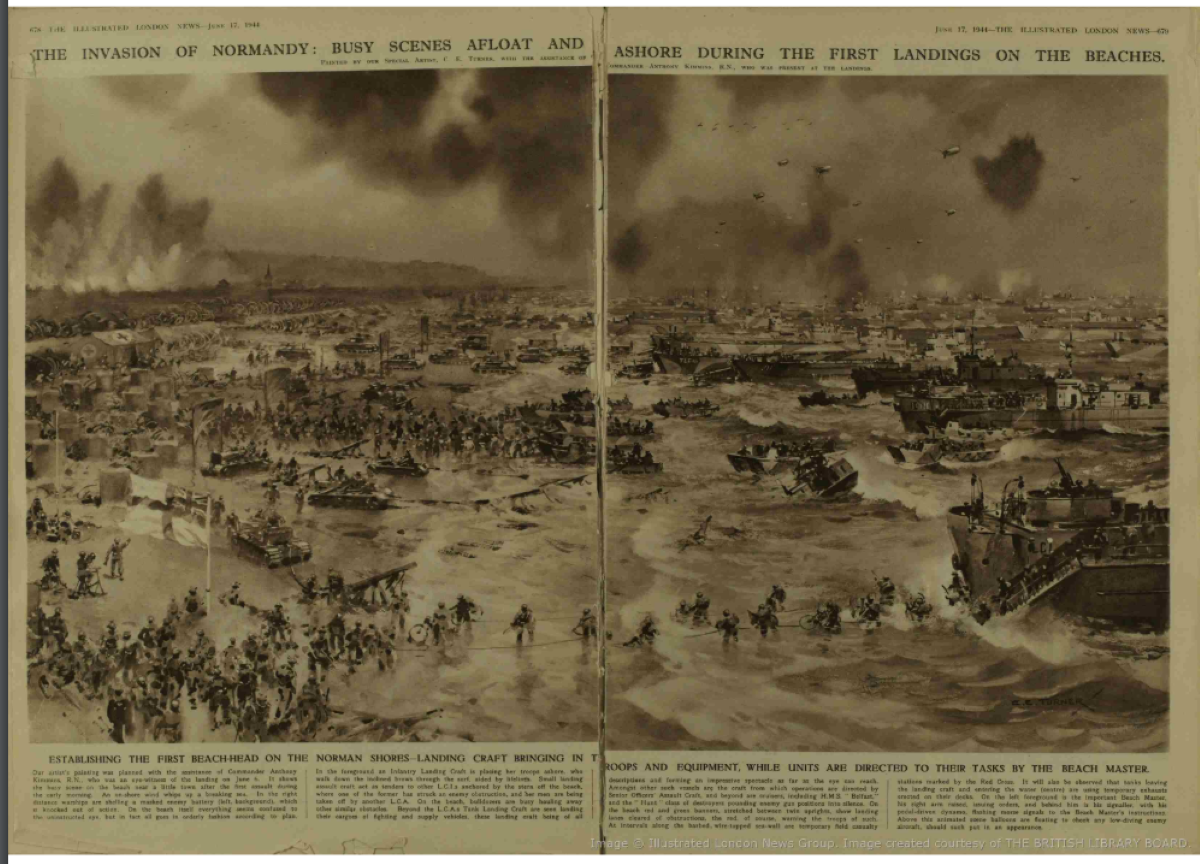
All this week and especially today, 6th June, events are being held to remember D-Day.

D-Day – 6 June 1944 – was the largest amphibious invasion in the history of warfare. The statistics of D-Day, codenamed Operation Overlord, are staggering. The Allies used over 5,000 ships and landing craft to land more than 150,000 troops on five beaches in Normandy. The landings marked the start of a long and costly campaign in north-west Europe, which ultimately convinced the German high command that defeat was inevitable. IWM
But how did people hear about it in June 1944 when coverage was strictly censored and communication so limited ?
Listening in your own home to the Wireless was the most direct way people could hear about what was happening.
Film, at the local cinema meant you could see action images.
Poster design flourished in World War 2. It was an effective way of communicating government schemes and propaganda. Some of those designs are still used today for instance ‘Rosie the Riveter’. Paper was rationed. Newspapers were limited in how many pages they printed, and some didn’t print at all during the war years. In Orkney the Orkney Herald did keep going.
A poster appeared in The Orkney Herald shop window ‘The Merchant Navy Was There’. The report on the 13th June 1944 states:
“Here is the story behind the Merchant Navy poster …as sent to us by the National Appeals Director: ‘At 1015 am on D – Day as the invasion news came through the loud speaker, we telephoned our printers and said the one word “France” . By 11am the first of a 10,000 delivery came through; printed on old newspaper for economy reasons. Today from England, Scotland, Wales and all over the country, are coming orders by wire, telephone and letter. Of course the blue type was set up and printed months ago; only the red word “France” was slipped into position at 1015am on D-Day.”
Men of The Army Film and Photographic Unit (AFPU) went forward on the beaches capturing on film as the assault unfolded.
“On 6 June 1944, Sergeant Ian Grant was among the thousands of men landing on Sword Beach in Normandy on D Day, armed only with a revolver and a cine camera. He was part of the Army Film and Photographic Unit (AFPU) and captured this incredible mute footage of the landings. Fewer than a dozen men filmed the D Day landings and this extraordinary record is now held exclusively by the Imperial War Museum. Film curator Michelle Kirby introduces us to this film. Watch Grant’s short silent footage, and more footage from D Day, on IWM’s Film Archive: https://bit.ly/iwmfilm-swordbeach”
The 6th of June 1944 was the start of the campaign and reports continued to come in from reporters with the troops on the ground about what was happening.
The Dundee Courier and Advertiser of June 8th 1944 reported that ‘ALL BEACHES CLEARED: SOME LINKED UP’, and, ‘REINFROCEMENTS ARE CONSTANTLY BEING LANDED.’

Estimated Battle Casualties During the Normandy Invasion on June 6, 1944

Fiona Grahame
Leave a Reply