
By Eamonn Keyes
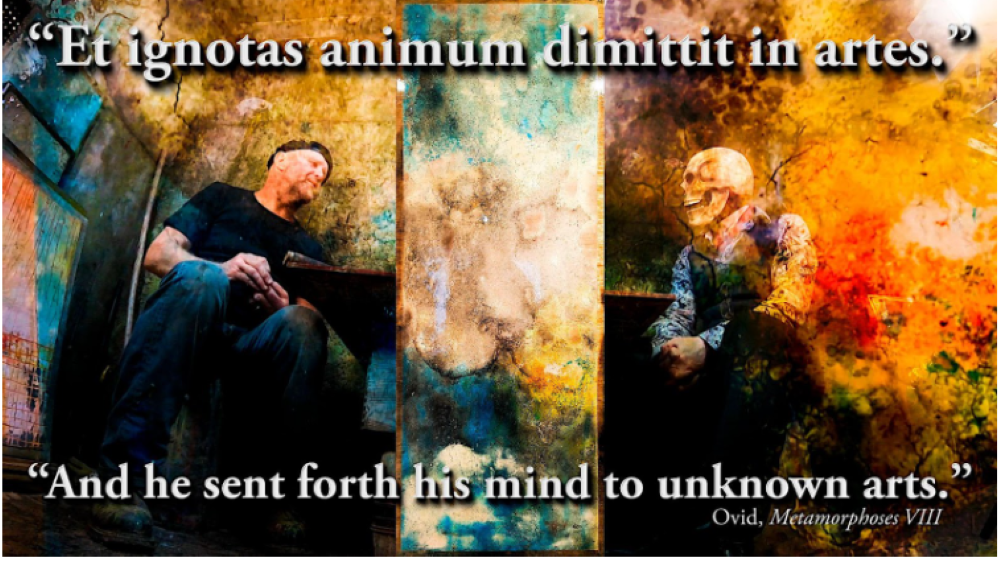
A Film on Vernon Bradley by Martin Laird

Where to start?
I was intrigued when I heard that the award-winning Orcadian filmmaker and artist Martin Laird had made a film in collaboration with artist Vernon Bradley, who has been living in Orkney for some years.
On the surface, the two would appear to be a yin and yang, diametrically opposed personalities, with Bradley’s effusive, abrasive and confrontational style contrasting with Laird’s reserved, contemplative and more laconic presence. However, in conversation Martin Laird revealed that the project resulted in a meeting, rather than a clash, of minds, which might have been more my expectation, and the resulting film is both revealing and informative, whilst having its moments of contradiction and hyperbole, usually deliberate.
The first showing of Martin Laird’s film, which centres around the life and work to date of artist Vernon Bradley, was on Friday June 7th at Stromness Community Centre, with both artists in attendance. It takes the form of Vernon Bradley being interviewed by a skull headed figure, who is revealed to be Magnus Erlendsson, a psychopomp appearing and disappearing finally in a flash of light and highlighting immortality confronting mortality.
Possibly an Orcadian ‘Seventh Seal’ albeit in Bradley’s ‘wet shed’ instead of over a chessboard.
For me, Bradley is like a human neutron star, blasting out intensity like radiation in pulses which result in his work. In person, he can be a force of nature, hurling opinions and thoughts everywhere with an almost desperate abandon.
Shards of rage, frustration and compassion bombard those who will stop to listen to his Rime at time both attracting and repelling like an emotional magnet, but ultimately captivating them.
He is often contradictory and occasionally offensive, but always challenging. He describes himself as a “cultural Christian atheist looking for the light”, and ‘looking for the light’ is frequently mentioned as his ultimate goal. What that light actually is he never clearly defines, but light features heavily and clearly linking him to other artistic figures.
When Dylan Thomas wrote ‘rage, rage against the dying of the light’ he could have been writing about Bradley, who is seemingly living his daily life doing just that, as he is in recovery and remission from cancer, but with his endless cigars and wine accompanying his working he seems to be using a flame thrower to burn both ends of his candle, and I suspect he may parallel Goethe, who cried out ‘more light’ from his deathbed as his final words.

In the meantime, Bradley works like a man possessed, creating works, destroying some he feels fall short of his goal, damaging many in his artistic process, and occasionally even, as he himself says ‘rotavating’ some. Many he simply gives away online but refuses to do so to anyone already possessing his work.
His manner and idiosyncrasies would place him right at home living in an 1870s Parisian garret, drinking absinthe and arguing into the small hours about art and life with famous Impressionists.
Martin Laird revealed that the film they ended up making was different from Bradley’s original concept, and the interview questions developed rather than being planned. Laird intended an exploration of Bradley’s creativity, in order for an audience to get to know him and discover his working methods, and he has definitely succeeded in this aim, as well as challenging Bradley on his work and how he provocatively presents his persona on social media.
Special effects feature from time to time, from the perhaps overly reversed reverb giving Magnus a disembodied voice to the solarisation and colour tinting of some of the film scenes to support the supernatural element of the film whilst giving some contrast to it.
The film goes through Bradley’s childhood and upbringing, from his Gibraltar birth to an idyllic Malta childhood before being ripped away back to the UK, and how his childhood memories affect his work with impressions of the ‘safe refuge’ of the sea, the horizon ‘why look at the horizon if you won’t leave the shore’ and the sun depicting ‘the light’ and ‘hope’ often feature.

He paints in themes such as ‘Caged’ about being trapped and unhappy in modern life, debt, relationships, ‘Rage’, about taking control of the monster and bringing order to chaos, and ‘Out Of the Fire, Into the Sea’, which he says is a ‘feet firmly on the ground response to what appears to be a mad world on fire. One of too much information, misinformation, propaganda, the poorly informed and the uneducated. The sea is my refuge, where I find my order, my paintings are the mark that I leave’.
He mentions other important elements inherent in his work, such as hope and sacrifice -which he features in what he feels was his most important work to date ‘Looking For The Light’, with the sacrifice, three crucifixes which also double as ships masts, unbroken and unbowed in memory of the Arctic convoys, showing hope on the refuge of a blue sea.
“See the storms, see the blood-red visceral endless circles, when you look at my paintings. But see the structure, look for fractals and see the sense of order and how I stay one step ahead of my demons.” Most of my work is a wrestle to avoid conforming to any expectations. I most certainly wrestle with known doctrines, religion, politics and what I think are broken systems. Like so many of us I hear the endless noise of human suffering and I look for rational thought to deal with it. I find the archaic, mediaeval, prehistoric, faith-based practices to be impoverished. Paintings and my piano compositions give me some order from the chaos.”
Ultimately, the film is an immersive look at Vernon Bradley and his work, it is entertaining, revealing and provocative about a man who although he superficially epitomises the ‘tortured artist’ trope and talks about suffering, says he is very comfortable in his own skin.
His viewpoints are sometimes acerbic and often more than flirt with controversial right wing gurus like Jordan Peterson, but then unexpectedly effuse an empathy and compassion that would be anathema to most supporters of that political viewpoint.
The pair have started looking for wider distribution for this film, and it certainly deserves to be seen further afield and will certainly. provide a talking point.
Martin Laird says he feels very much on the same wavelength artistically as Vernon Bradley, and that there are plans for the future, and more work together.
An enticing thought.





Leave a Reply