
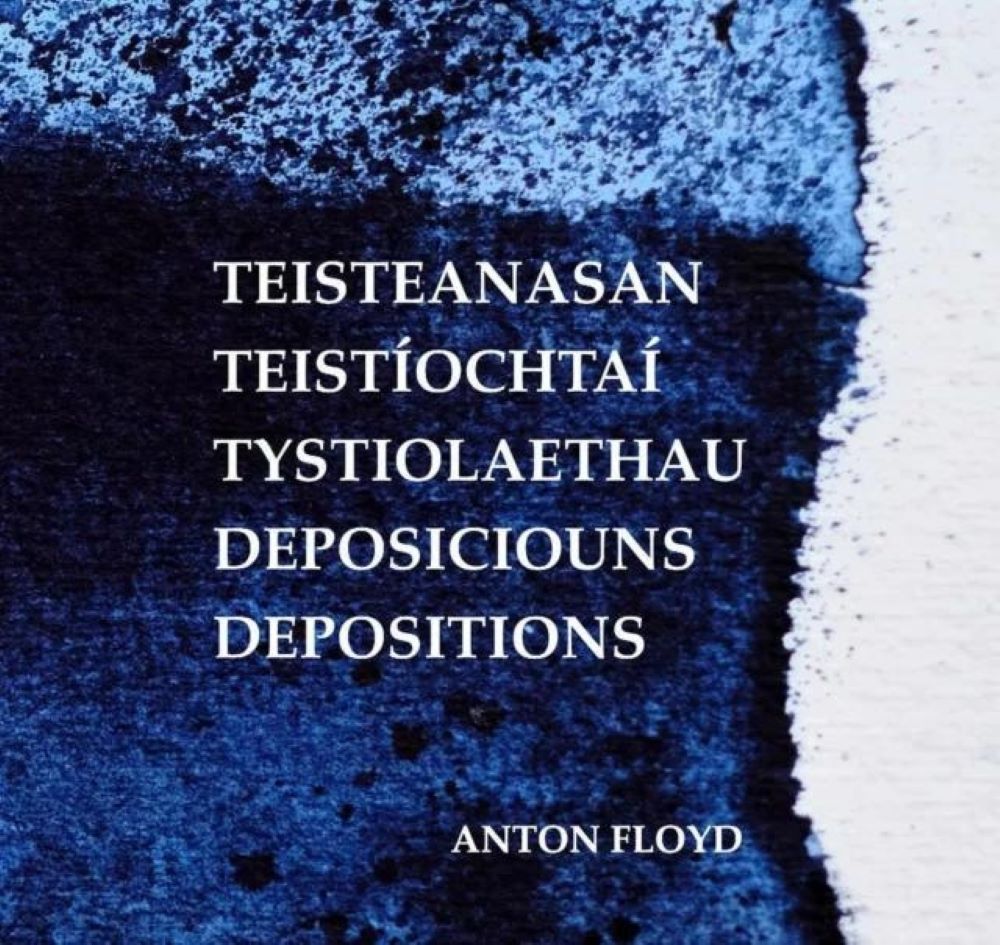
A special commemorative edition of the critically acclaimed collection Depositions, by award-winning poet Anton Floyd, has been published to mark World Refugee Day, 20 June 2024.
With the support of the Gaelic Book Council the Dazzling Spark Foundation is delighted to have sponsored the translation of this ground-breaking work into the minoritised native languages of the North Atlantic Archipelago: Scottish Gaelic, Irish, Welsh, and Scots.

With other translations in progress Depositions is fast becoming recognised as a unique literary resource giving voice to the oppressed throughout the world and in the opinion of many has the potential to become a modern classic.
The first edition of Depositions, with some verses translated into twenty-one languages, was published in Ireland last year. Unusually for poetry, it generated an enthusiastic response far beyond the usual literary and academic circles, engaging with native speakers of many other language groups, especially those who are victims of forced migration and persecution.
Dazzling Spark Foundation director Gordon Kerr explained:
“We wanted to build on this momentum by commissioning a special commemorative edition to promote similar discourse and engagement among different community groups here in the North Atlantic Archipelago.
“We were fortunate to have the services of Celtic language Scholar Professor Seosamh Watson, Emeritus Professor of Modern Irish at University College Dublin, as our consulting editor.
“The Gaelic translation is by Marcas Mac an Tuairneir, one of Scotland’s most celebrated Gaelic poets and singers.
Depositions is a work long in the making. The author, himself a refugee, developed this epic poem of a hundred-and-twenty tercets, which traces seven stages of exile and the search for sanctuary. After volunteering at a direct provision centre for refugees in Cork, Ireland he workshopped the poems with different groups of trauma-experienced asylum seekers and hundreds of hours were then devoted to finding translators, editors and reviewers to make the poems accessible in the mother tongues of major migrant groups.
Their stories echo the despair and tragedy which resonates through our own history in Scotland when so many men, women and children were stripped of their land and possessions and forced into exile, during the Highland Clearances – events which continue to resonate today, as the Scottish Languages Bill moves through Parliament.
Sadly, with Gaza and Ukraine in headline news and so many other ongoing conflicts across the globe, the need for discourse and understanding on the plight of displaced people has never been greater.

Leave a Reply