
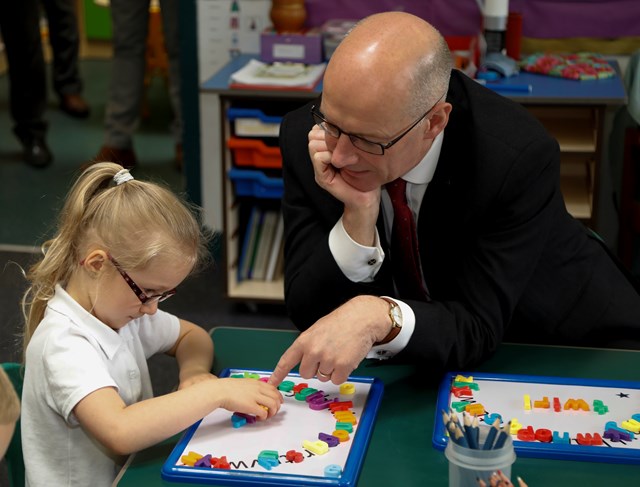
Public authorities in Scotland must protect the rights of children and young people in their policies and decision making. On 16th July, The United Nations Convention on the Rights of the Child (UNCRC) (Incorporation) Act, became part of Scots Law.

For the First Minister of Scotland John Swinney, who first introduced the Bill back on 1 September 2020 when he was the Deputy First Minister and Cabinet Secretary for Education and Skills, it marks a considerable achievement in advancing the rights of children and young people in Scotland.
Minister for Children and Young People in the Scottish Government Natalie Don said:
“This is a milestone for advancing children’s rights in Scotland, delivered by the Scottish Government. We want all young people to grow up loved, safe and respected and the UNCRC Act aims to do just that.
“We all have a responsibility to ensure that children and young people are at the heart of decisions that affect them and that they have the confidence and skills to get involved.
“The Scottish Government is proud that we are the first devolved UK nation to incorporate the UNCRC into law, helping to make Scotland the best place in the world to grow up.”
The United Nations Convention on the Rights of the Child (UNCRC) (Incorporation) Act, first passed unanimously on 16th of March 2021. Despite this, the Bill was referred by the Law Officers to the Supreme Court under Section 33 of the Scotland Act 1998. The Supreme Court then ruled that some of the things the Bill set out to do were not within the powers of the Scottish Parliament due to the limits of Devolution. The Bill as passed at Stage 3 could therefore not become law.
After changes were made, it was then approved by the Scottish Parliament on 7th December 2023, with 117 MSPs voting For, and no one Against, however, 12 MSPs did not vote.
The Bill which incorporates the United Nations Convention of the Rights of the Child (UNCRC) into the law in Scotland finally became enacted on 16 January 2024.
It means that public authorities, including Scottish Ministers, will be legally obliged to respect children’s rights, and that rights-holders will be able to challenge public authorities in the courts for breaches of their rights.
It includes provisions to:
- Incorporate the UNCRC into Scots law so far as possible within the Scottish Parliament’s powers. The incorporated provisions are defined in the schedule of the Bill as the ‘UNCRC requirements’.
- Make it unlawful for public authorities to act in a way which is incompatible with UNCRC requirements.
- Give children, young people, and their representatives the power to go to court to enforce their rights.
- Give the Children’s Commissioner power to take legal action in relation to children’s rights.
- Require Scottish Ministers to make a Children’s Rights Scheme setting out arrangements for them to comply with the UNCRC requirements, to be reviewed and reported on annually.
- Require listed public authorities to report on their compliance with the UNCRC requirements every three years; this replaces an existing duty in the Children and Young People (Scotland) Act 2014.
- Place a legal duty on Scottish Ministers to carry out and publish a child rights and wellbeing impact assessment on an all Scottish Parliament bills, and most secondary legislation.
- Place a legal duty on a member of the Scottish Government in charge of a bill to make a written statement on the bill’s compatibility with UNCRC requirements when the bill is introduced in the Scottish Parliament.
- Require new and old legislation to be read wherever possible in a way that is compatible with the UNCRC requirements; where this is not possible:
- courts will be able to ‘strike down’ old incompatible legislation (being legislation which pre-dates the Bill), meaning that it no longer forms part of Scots law; or,
- make a declaration that new legislation (being legislation which post-dates the Bill) is incompatible with the UNCRC.
- Set up court procedures to address questions about the compatibility of legislation or public bodies’ actions with the UNCRC requirements.
- Enable the Scottish Government to change the law, by regulation, to cure incompatibilities with the UNCRC requirements.
Commenting on 16 July, Ellie Craig MSYP, Chair of the Scottish Youth Parliament said:
“I hope that the UNCRC (Incorporation) (Scotland) Act coming into force today sends a message to children and young people that they live in a country which aims to respect their human rights.
“Today is not an endpoint though, this is just the beginning of the next step of Scotland’s human rights journey. Scotland now moves from incorporation to implementation and this is a chance for decision makers to address the human rights issues impacting children and young people and create a culture where their rights and meaningful participation are put at the forefront of decision making.
“I’m looking forward to supporting and, where needed, challenging decision makers to stand up for the rights of all children and young people in Scotland.”
Fiona Grahame




Leave a Reply