
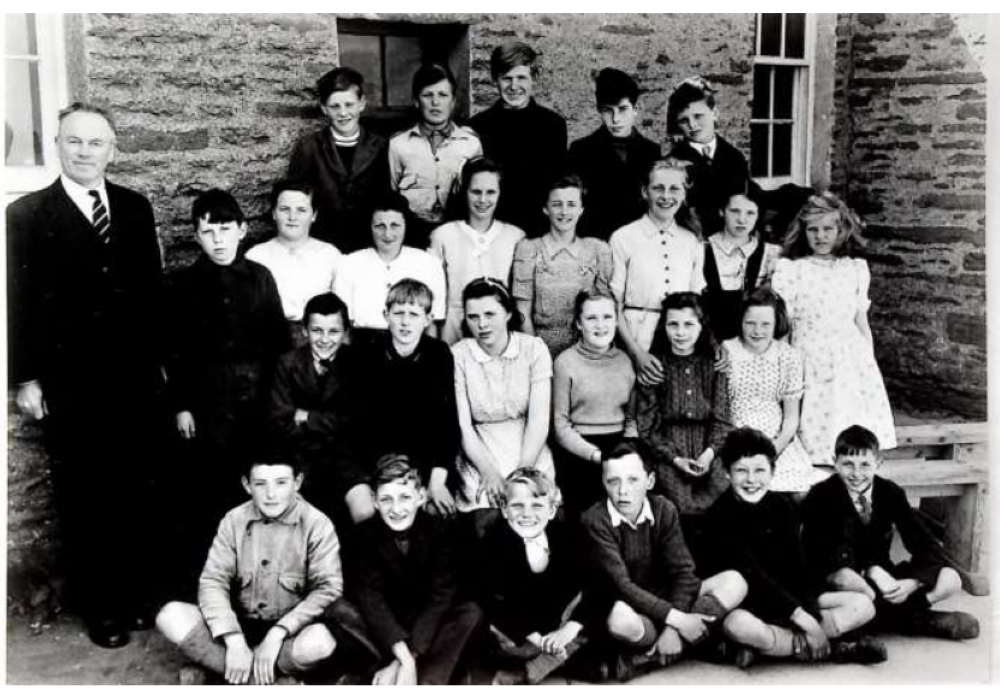
By Ian Cooper from his excellent series, Records of a Bygone Age, and republished here with the kind permission of The Stronsay Limpet.
We left the school in last month’s article just as war had broken out, with the school and the island in a state of apprehension regarding the future.
It was noted in the log dated 25th September 1939 that the Secondary Departments of all country schools were to be closed until Monday 9th October to allow pupils to help with the harvest at home or on neighbouring farms.
Then, at the end of October, it was intimated that from 1st November to 1st February the school would open at 9.45 am and close at 2.45 pm. This was to help make maximum use of daylight and ensure that all the pupils could go to school and return home while there was still adequate light for their journey.
With war in the forefront of everyone’s minds, there was an alarming moment at 1.30 pm on 14th November 1939 when an air raid warning was sounded and, as most of the pupils hadn’t yet been supplied with their gas masks, school was dismissed and the children sent home. Fortunately this was a false alarm.
There was an outbreak of German Measles in March 1940 affecting many of the pupils and also some of the teachers. It was to be 15th June before the last pupil to contract the virus was back in class and the epidemic over.
In December 1941 note was made that the children were practising games and dancing in preparation for the SWRI’s annual children’s party. This same month saw some atrocious weather, described by Mr Drever as ‘hurricane force winds, heavy rain, sleety showers, blizzards, flying storms, spindrift all over the sea and large snowdrifts.’
Teacher James Sinclair joined the Royal Air Force in April 1941, with the teaching of his classes being shared between Mrs Wilson and the headmaster.
The school closed for 4 weeks holidays in the summer and then a further 4 weeks from 13th September until 12th October for the harvest.
On 20th November 1941, 53 pupils were sent to Dr Pyle to be inoculated against diphtheria, with a second inoculation given 2 weeks later. This, Mr Drever recorded, was a war time measure although in actual fact it appears to have been the first of the mass vaccination programme against the disease.
A police officer visited the school in March 1942, noted in the log as ‘’re insulators etc.’ This visit may well have been instigated by some of the pupils being involved in breaking the porcelain insulators carrying the phone wires on the telegraph poles, no doubt quite a tempting target for young boys with stones.
To help the war effort that spring a collection of waste paper was made and sent to Kirkwall. Then, on 28th May 1942 Miss Barnett from the Ministry of Food visited the school to issue the new food and clothing ration books to each pupil.
Ralph Fotheringhame of Boondatoon, who had been chair of the School Management Committee, a member of the County Council, a JP and had been involved in education in the island for more than 50 years, died in December 1942. His funeral was held on 7th December and, as a mark of respect, the headmaster and 9 of the older pupils attended on behalf of the school.
There was another bad flu epidemic in March and April 1943, laying low teachers and pupils alike, quickly followed by an outbreak of German Measles and then whooping cough.
When school reopened in August 1943 it was recorded that the school roll stood at 61 and that Mrs Wilson had been transferred to another school, with probationer Miss Margaret Hay taking over her role. By October Miss Hay had been transferred to Sandwick and Mrs Wilson reinstated!
Whooping cough and chicken pox was still affecting attendance levels in October and then, on 1st November, the school was closed for 2 weeks due to an outbreak of Scarlet Fever. It seems that resistance to bugs and viruses must have been very low at the time, although at least the epidemics would have built up the natural resistance to reinfection for many of the pupils.
In May 1944 Mr McDougall from Kirkwall came out to the school and, in the morning, spoke to the pupils as part of the ‘Salute the Soldiers week’, aimed at raising funds for field hospitals and military equipment. He then gave the children a cinema show in the Public Hall in the afternoon.
Miss Gorie was absent from October to Christmas to look after her father, who was seriously ill, with Mrs Helen Groat (nee Inkster) of Lower Millfield deputising for her.
An outbreak of mumps affected the island early in 1945, with nearly every pupil who hadn’t previously been affected succumbing this time round. With this epidemic only recently past, the school was shut for 2 weeks in April due to an outbreak of measles.
On a much happier note, the school was shut on 8th and 9th May 1945 as Victory in Europe Days and again on 15th and 16th August as Victory over Japan Days, celebrations that would have been greeted with delight and relief by young and old alike. The celebration of the end of the war wasn’t yet complete as the following year, as part of the nationwide Victory Celebrations held on 8th June 1946, each pupil was given a shilling, gifted by the Education Department as ‘sports money’ for Victory day.

In September 1946 Miss Patricia Chalmers of Comely Bank, who was a student at Edinburgh Provincial College, taught at the Central School for 3 weeks as part of her teacher training. She was to be another local lass who was destined to become a long serving and respected member of the school staff.
Magnus Dennison from Ellerslie was appointed as school janitor in May 1947 at a salary of £75 per year. He took over the post from J Price Sinclair who had been holding the fort since Brenda Moodie had given up the post some time previously.
On 7th October 1947 four pupils from the Rothiesholm school started at the central school, driven there by Sydney Swanney of James Swanney (motor hirers). The four were Irene Miller from Millgrip, Jean and Hugh Stevenson from the Bu and Emma Peace from Brigend. This was occasioned by their teacher Miss Mary D Drever going off to Edinburgh to live and work, with the local Education Authority taking the opportunity not to replace her but to close the Rothiesholm School instead. These four additions took the Central School roll up to 76.
A public holiday for another happy occasion took place on 20th November 1947 with the wedding of Princess Elizabeth, the elder daughter of King George VI and Queen Elizabeth, to Philip Mountbatten, who was given the title ‘Duke of Edinburgh’ that same day. Another festive holiday was given on 26th April the following year to celebrate the Silver Wedding Anniversary of King George VI and Queen Elizabeth.
John Shearer took over from Mr Marwick as Orkney’s Director of Education in December 1946. He visited the school in December 1947 and Mr Drever recorded that he kept pupil Douglas Cooper back ‘to talk to him about his behaviour.’ We would be led to the assumption here that this behaviour may have been less than exemplary!
Mrs Jessie Wilson’s last day at the Central was 30th January 1948, moving to Clochan School in Moray to take up a post there. Mrs Peggy Swanney (nee Firth) took over her role as teacher of P4 and P5 soon after. In November of that same year local joiner James Mitchell from Ocean View was appointed as a part-time teacher of woodwork.
In April 1950 Mrs Swanney was absent and her class was taken by Miss Muriel Drever from Westray, a 5th year student from Kirkwall, who was on holiday in Stronsay.
In February 1951 the headmaster was off ill and newly ordained island minister Rev Philip Fox took his classes, something Rev Fox was called on to do voluntarily a number of times over the years.
In August 1951 Miss Gorie retired from the school, with Mrs Pat Sinclair taking over from her. High tribute was paid to Miss Gorie by staff, pupils and the wider community in celebration of her service of over 40 years as teacher in the school. The roll at this time had crept up a little, to stand at 85.
Mr Drever’s log entry of 15th January 1952 records a hurricane that morning, at its height from 4.00 am until 7.00 am and reaching speeds in excess of 120 miles per hour, causing great damage all over Orkney. Part of the roof of the school was torn off by the wind and the school was shut that day and until further notice. With devastation all over the island to be dealt with, it wasn’t until 4th February that workmen were able to complete repairs to the roof and enable the school to be reopened.
In April that year the Education Committee sent retired Post Office worker Robert Wilson out to the school to teach singing. He was in Stronsay for a fortnight, giving lessons at both the South, where Mrs Fiddler was now teaching, and Central School, and it appears that his teaching was very much appreciated by those attending.
The North Isles inter-island sports day was held on 7th June 1952, with the event being held in Eday and the school being shut for the day. This annual event, the only day of the year where North Isles residents were able to meet together and return home the same day, was set to become a permanent fixture in both school and island calendars.
The annual school sports and picnic was held in the Hunton field north of the school on 1st July 1953 with 67 pupils present, together with 16 pre-school children. It was noted that the scholars were all given ‘a poke of good things with a bottle of lemonade.’
When the school reopened on 27th August 1955 it was stated in the log that school hours were to be 9.30 am until 4.00 pm each day, with a lunch break from 1.00 until 2.00pm. School was to be dismissed at 3.30 pm during the winter months, with only a half hour break for lunch.
It was also noted that at that time Mrs Maxwell was teaching 26 primary pupils in classes 1, 2, 3 and 4 with Mrs Groat in charge of 25 pupils in primary 5, 6 and 7. With a further 15 pupils in Secondary under the charge of Mr Drever this gave a total roll of 66.
Moving on to 1956, the school was closed on 31st May for the annual trip day to Kirkwall, organised jointly by the SWRI and the South End Men’s Club. It was closed again on 5th June for the North Isles Sports in Westray, with 50 Stronsay folk making the day trip up to Westray.
The end of an era was recorded at the school on 6th July with the retirement of 65 year old headmaster John Drever who had been in post for 35 years. Local councillor William Work from Holland spoke in appreciative terms of the headmaster’s long and dedicated service to the school, the pupils and the island following which Rev Fox spoke of Mr Drever’s service to the Church as Session Clerk, Organist and Sunday School Superintendent.
Miss Mary Gorie, herself a recently retired teacher and island stalwart, then spoke appreciatively of Mr Drever as a teacher and colleague for so many years before presenting him with a handsome gold watch from the people of the island. Former pupil Miss Emma Peace of Brigend, who was the current dux of Kirkwall Grammar School, then presented Mrs Drever with a beautiful Stafford China tea set.
In what was to be another long association with the school and the island, Mr Walter Forrest was appointed as the new school headmaster and took up his duties on 3rd September 1956. The staff at that time was Elma Maxwell, teaching 32 Primary 1, 2 and 3 pupils, with Helen (Nell) Groat in charge of the 22 pupils in Primary 4 – 7 and Walter Forrest instructing the 21 Secondary pupils. On Tuesday and Thursday afternoon the Secondary girls were instructed in cookery by Mrs Forrest while the boys were taught woodwork by David Fotheringhame.
The log entry for 11th March 1957 noted a welcome new service for school pupils and staff with the introduction of hot meals at lunch time, something which had first been strongly recommended by His Majesty’s Inspectorate some 40 years before. The record stated that ‘Pending the erection of a dining centre, a modified arrangement for school meals was inaugurated today, under the supervision of Miss Firth, County Meals Organiser. The scholars are to receive a one course hot meal at the luncheon interval. Miss Elizabeth Stevenson has been appointed cook and, together with her assistant, Mrs Work, commenced duties today.’ Both these ladies were to become something of an institution at the school, with May Work in the school kitchen until she retired in the mid 1970s and Liz Stevenson serving as a highly regarded cook until her own retirement 37 years and around half a million school lunches later!
Less than two weeks later another new service, probably as essential to pupils but certainly less popular, saw the introduction of the School Dental Service. This first recorded visit of a dentist specifically for scholars was noted on 22nd March 1957, with Mr James Clunas examining and treating scholars from that date until the 28th of the month. This first visit and a number of subsequent annual visits made use of a room in the school for examination and treatment but after a few years a dedicated caravan was fitted up for the purpose and Mr Clunas and his caravan appearing at the school became an annual event.
Heavy snowfalls in the early part of 1958 again caused disruption to the school and the wider community, with roads recorded as being blocked from the 20th to the 30th January and again from the 6th until the 14th of February. The snowfall wasn’t yet over, with heavy snowfalls and the roads blocked once more from the 1st until the 14th of March. A whooping cough epidemic hit the island around the same time, with the last cases being recorded at the end of April.

With a major refurbishment and extension taking place at the school that same year, Mrs Maxwell’s lower primary classes were being taught in the Public Hall while the building works were carried out. With snow and frosty conditions hampering progress on this project this interim measure was to last for quite some time.
Another landmark for education on Stronsay was reached on 1st September 1958. This marked the start of a new term and a new academic year in what was to all intents and purposes a new school with large, light and airy classrooms, dedicated spaces for domestic subjects and woodwork and metalwork. There was also a new kitchen and large dining room which also doubled up as a drill hall, assembly room and, with a stage on one end, also served as a concert hall. This was to be the start of a new era for the Stronsay Central School, its pupils and its teachers and so, although much of its more recent history is yet to tell, this seems an appropriate place to bring this account of the history of education in Stronsay and the Central School to an end.



Leave a Reply