
By Ian Cooper, from his excellent series, ‘Records of a Bygone Age’, published in The Stronsay Limpet, and republished here with their kind permission.
In last month’s article we left the Central School under the headship of recently appointed Papa Westray man and war veteran John Drever, a role he was to hold until he retired. Although he was apparently quite a forceful character and one who undoubtedly left a lasting impression on all his pupils, Mr Drever seemed to bring some badly needed stability to the school. This opinion has been formed mainly by reading through what was a fairly mundane school logbook of the time which was, of course, written by Mr Drever so may not always be a full and fair representation.
The school again acknowledged the importance of agriculture to the island by closing at 1.00 pm on 13th February 1924 to allow pupils to attend the ploughing match at the nearby farms of Errigarth and the Bay. This was the first ploughing match to be held in Stronsay since 1891, although ‘helping’ matches had been held in 1922 and 1923.
For some unknown reason the school had been downgraded from a four to a three teacher establishment in September 1923 but in December 1924 its four teacher status was reinstated and the additional post soon filled with the appointment of Miss F D Windwick from Kirkwall.
On 12th February 1925 the school was closed all day to allow staff and pupils to attend the induction of Rev Milne to the Established Church. This was the church which is now part of the Linkshouse steading and Rev Milne’s Manse would have been the Old Manse, recently renovated by Steve and Yvonne Weaver.
After just over 2 years in post, Miss Windwick resigned in February 1927, with Miss Maggie Jessie Banks from Stromness being appointed in her place and taking up her duties that same month. Miss Banks, later Mrs Fiddler, was destined to become another stalwart of the school in Stronsay.
The school reopened on 29th August 1927 without the services of Fair Isle man Walter Munro, who had died the previous week at the age of 31. Mr Munro, who was lodging at Hazelbank and had been less than a year in post, had developed appendicitis and had undergone an operation for this at the Balfour Hospital but failed to recover after the operation.
Miss M A Sutherland was soon to be appointed in his place while Miss C L Manson was appointed as temporary teacher in place of Miss Banks who was off under medical certificate for 3 months. Miss Manson left upon the return of Miss Banks in October.
The school closed at 1.30 on 6th February 1929 for the induction of Rev Millar to the Established Church, the post vacated by Rev Milne in March the previous year. It appears that his appointment would have been very much on an interim basis as the Established Church, with their church at Linkshouse, and the United Free Church, who worshipped where the Church is today, united later that year to form the Church of Scotland as is today.
On 29th April 1929 it was recorded in the log that there was a great deal of illness in the island, with some being very ill. Dr Bannerman had visited by motorboat from Kirkwall the day before and Dr Matheson had come across from Sanday to visit the Glebe, where some of this sickness prevailed, around the same time. Why these doctors visited is unclear but it is possible there may have been no resident doctor in Stronsay at the time. Dr Robert Rosie, who had served the island faithfully for 30 years, had died in March the previous year and his daughter Irene, herself a qualified GP, had acted as locum for a time. New appointee Dr R H Mackay was certainly in place by June 1929 although he may not have taken up his duties by that time or possibly, as a young doctor, he may have been seeking a second opinion on this illness.
In the school log entry of 1st May Mr Drever recorded that there was still much illness in the island and that there had been another death that morning. (This was of 26 year old James F Miller of the Glebe whose brother Peter had died a week earlier aged 21.)
With only 19 pupils out of a roll of 94 turning up to school on 2nd May and one less the following day, Mr Drever recorded that
‘The people seem frightened to send their children to school on account of the disease “not peculiar to Orkney” which has broken out. But many of the children are down with the flu and other are excluded. It is to be hoped that this cloud will soon pass over, for it has been trying to teach in school this week’, adding ‘(The disease is cerebro-spinal meningitis – “Spotted Fever”.)’
Attendance on 8th May was still very poor, with Mr Drever noting that ‘Perhaps some parents are frightened to send their children because of the spotted fever.’
Following a telegram from the local Sanitary Inspector, to try to break the hold of this highly contagious disease all Stronsay schools were instructed to close on 14th May, only reopening on the 27th. It later transpired that the disease was in fact Poliomyelitis and had taken the lives of 3 people on the island while leaving a number of others with disabilities of varying degrees of severity.
Mr Drever was a keen singer and apparently expected all his pupils to be prepared to sing, recite poetry and otherwise perform regardless of their talent. He was also the instigator and organiser of many concerts in the island, with school pupils and older residents all taking part. One such Christmas Concert, open to all on the island, was recorded as being held in the Drill Hall (now the Community Centre) on 20th December 1929.
In what was now an annual event, the 1930 ploughing match was held in a Whitehall field just above the North School and school was once more dismissed at 1.30 pm to allow pupils to attend.

When the school reopened after the summer break on 25th August 1930 Miss Banks had transferred to Kirkwall Burgh School and Miss Lena Stout, who was later to marry local man James Fotheringhame, had transferred from Papa Stronsay to the Central School with uncertificated teacher Miss Cathie Swanney taking over as teacher in Papay.
In January 1932 Miss M A Sutherland left the Central to take up the post of head teacher in Hoy, with her place being filled by Miss Anna F Baird. Around the same time Miss Stout was transferred to Flotta, to be replaced by Miss Jean Gunn from Caithness.
The ploughing match that year was held at Errigarth on 10th February and, as this was quite near to the school, the teachers took the pupils down to the field to view the event.
In what was a most unusual and welcome event at the time the school was shut on 7th June 1932 to allow Stronsay residents a day return trip day to Kirkwall by steamer. This was a venture organised by the Stronsay branch of the SWRI, who arranged the charter of the SS Earl Thorfinn to leave Stronsay for Kirkwall at 7.00 am, with the SS Earl Sigurd similarly chartered to leave Kirkwall at 7.00 pm to convey the weary trippers back home. 135 passengers availed themselves of the opportunity, with return fares set at 5/- (25p) for adults, with children travelling at half price. This may well have been the only trip to Kirkwall many folk would have had in that year, and was one of only two days each year (the other being the County Show day) where it was possible for islanders to go to Kirkwall and return on the same day, This was the first of what was to become an annual event right up until the coming of new ferries and a daily roll-on roll-off service between Kirkwall and Stronsay in 1991.
With the SWRI by now having a strong presence in Stronsay it was noted that on 2nd June 1933 WRI stalwarts Miss Gorie and Miss Baird both went off to Kirkwall with the Stronsay SWRI to take part in the annual Drama Festival.
Another HMI inspection took place on 13th June 1933 where it was noted that
‘The infant classes are well taught; the children act right and interested, while their progress and proficiency are good. Their reading, writing, arithmetic, oral answering and handwork are very creditable for this stage. The junior classes are taught by a probationer. The general nature of the work is very satisfactory. Good features are the oral and written composition, spelling and neat penmanship. In the senior classes the work is not all that could be desired at this stage. In arithmetic mental calculations were slowly performed, while in a written test the accuracy was only fair, and the work was very carelessly arranged, which in itself leads to faulty reasoning and error. In written composition the matter was meagre and the expression often incorrect and uncouth. The sentence conventions, punctuation, grammar and idiom requires more attention. The standard of penmanship and weakness is also low. Exercise books, however, showed some signs of greater care in the work of the last two months. Brisker and fuller oral answering is a desideratum, and regular practice in oral composition should be given to secure greater freedom and correctness of speech. A period of history was well known and with considerable detail, geography too was satisfactory. The advanced division continues to do good work, and the profession is overtaken in a very satisfactory manner. The walls and ceilings are discoloured and grimy: all four rooms should this year be repainted in some more suitable colours.’
Miss Baird transferred to Finstown in August 1933 while Miss M A Firth, who came from Finstown herself, took up duties for the start of the 1933/34 session.
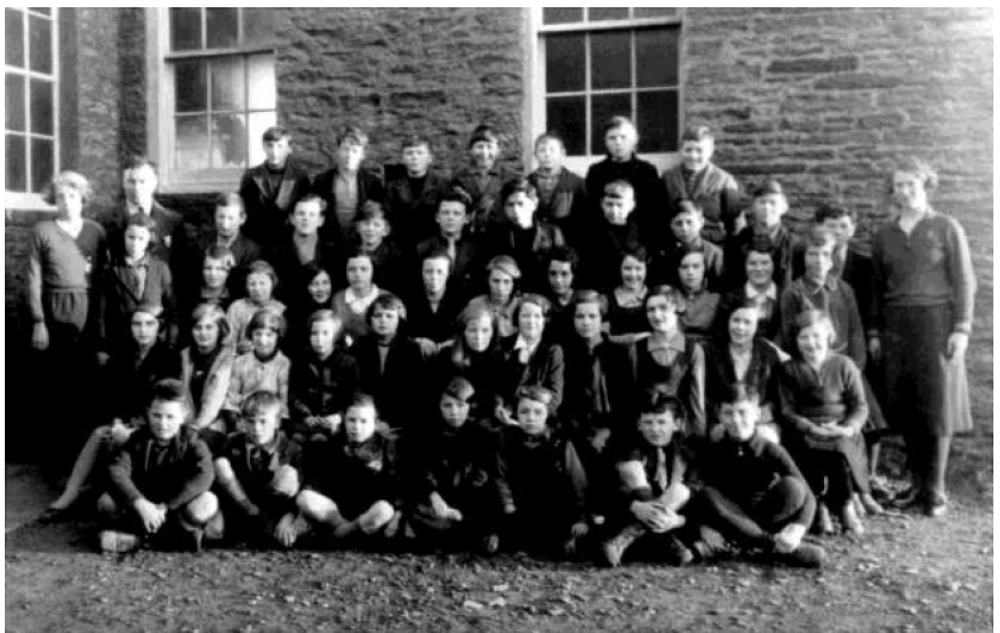
Photographer Mr Gray came out from Kirkwall on 10th January 1934, taking photos of pupils at all four schools.


Praise was given to pupils by Mr Drever when, on 17th January 1934, he recorded in the log
‘This is a terrific morning, the rain is pouring and many of the pupils almost drenched when they come to the school and their clothes must be dried. 67 are present out of 92 – an excellent attendance for such weather and the long distance of some.’
On 29th November 1934 the school was shut for the day by the wish of HM King George V to celebrate the marriage of his son Prince William to Princess Marina of Greece. Pupils would have been delighted the following year when, on 6th May 1935, they were given another day’s holiday, this time to celebrate the Silver Jubilee of King George V and Queen Mary’s accession to the throne.
The log entry of 20th December 1934 records that all teachers, pupils and friends from the four island schools were invited to the biennial social and to see the Christmas tree in the school. Tea was served at 12 noon, with proceedings being finished at 2.00 pm.
In August 1935, after 3½ years in post, Jean Gunn moved on to pastures new and Miss Helen Inkster from Egilsay took over. Helen (Nell) Inkster was later to become Mrs Groat and was to be another teacher of long standing in Stronsay.
King George V decreed another public holiday on 6th November, this time in celebration of the marriage of his third son, Prince Henry the Duke of Gloucester, and Lady Alice Montagu Douglas Scott and the school was shut again for Parliamentary Election on the 14th. Sadly there was to be yet another day off school for pupils on 28th January 1936, this time for the funeral of King George V who had died on 20th January.
Miss Gorie was absent on 13th November 1935 to enable her to attend the farm dispersal sale at Clestrain, which had been tenanted by her family for many years and later bought by them from the Balfour estate.
Pupils were again released from school early to allow them to attend a ploughing match at the Bay on 19th February 1936.
Allen Kent Smith, originally from Waterside and a prospective student at Edinburgh Training College, began a 3 week teacher training post in Miss Firth’s room on 10th September 1936. He was to go on to graduate MA from Edinburgh University and then at the outbreak of war volunteered to join the Royal Navy’s Fleet Air Arm. There he became a pilot but sadly was lost when his plane crashed on 15th November 1942.
Weather was again the main topic in the log book in January 1937, with Mr Drever reporting gale after gale, one of which saw the loss of the Finnish cargo vessel Johanna Thorden and 25 of her crew. Due to these incessant gales less than half of the pupils were in attendance for much of that time. This poor attendance carried on through February and March due to an outbreak of whooping cough in the island.
Another public holiday was announced for 12th May 1937, this time to celebrate the coronation of King George VI and Queen Elizabeth.
In January 1938 the National Bible Society of Scotland presented all the pupils over 9 years of age – 56 in all – with a New Testament.
In March 1938 the number on the roll had fallen to 71, with Mr Drever noting this as ‘surely the lowest it has ever been’. That same month Miss Inkster left the island, with her place being taken by John D Mackay. The following month Dr Bannerman from Kirkwall visited the school and, along with Stronsay’s recently appointed Nurse Slorach, examined 26 pupils, with Nurse Slorach to make monthly visits thereafter. Nurse Slorach was later to marry Alfie Meil from Samson’s Lane and, known as Nurse Meil, became a highly respected island nurse until she emigrated to Australia in 1958.
28th June 1938 was again a very poor day with a gale and driving rain from the north-west, with only 30 pupils attending school. Mr Drever recorded that these stalwarts must have been drenched going home in afternoon, and that six pupils who were studying French came down to the Schoolhouse at 3.35 to hear the last of a series of talks in elementary French on the wireless.
A school inspection in August 1938 was quite scathing about the school premises which, it said, were in great part antiquated and congested. Better heating arrangements were needed in two classrooms, with one of the smaller rooms having too little floorspace for the number of pupils being taught there. It was recommended that these classrooms and the offices should be modernised and a staffroom added.
Pupils were congratulated on their attendance record and teachers commended for their work. The probationer teacher of Junior 1 and Senior 3 was singled out for special praise where it was noted that her teaching showed originality and promise of success.
This probationer teacher who, it seems, may have been Miss Firth, transferred to Shapinsay in August 1938 and was replaced by Mrs Jessie Wilson, who was put in charge of Junior 1 and Senior 3. It was noted at that time that Miss Gorie was teaching the infants and Junior 2 class, Seniors 1 and 2 were being taught by John McKay and the Post Qualifying classes were in the charge of John Drever.
The school was closed on 6th December 1938 as it was to be in use as the polling station for the County Council election to be held that day. This election saw Ralph Fotheringhame of Boondatoon receiving 57 votes while the successful candidate, Duncan J Macrae of the Hotel, secured 180 votes.
The 1939 session opened on 28th August with a note in the log recording which classes each teacher was in charge of, this time in what was to become the more familiar Primary and Secondary designations. Miss Gorie was still in her familiar role in charge of the infants and Primary 1, Mrs Jessie Ann Wilson was teaching P2 and 3 and James Sinclair was in charge of P4 and 5. (John D Mackay had been transferred to Kirkwall to carry on correspondence work.) The Secondary division remained under the care of Mr Drever.
The school had just opened with classes assembling on the morning of Monday 4th September 1939 when a wire came through to the Clerk of the School Management Committee to say that all schools must remain shut that week due to war having been declared the previous day.
It reopened at the usual time the following week with one boy, an evacuee from Edinburgh, being admitted to the school. This was James Fotheringhame from Edinburgh, a son of former teacher Lena Stout and James Fotheringhame, who came to stay with his grandparents at Hescombe.
Part 9 next month.


Leave a Reply