
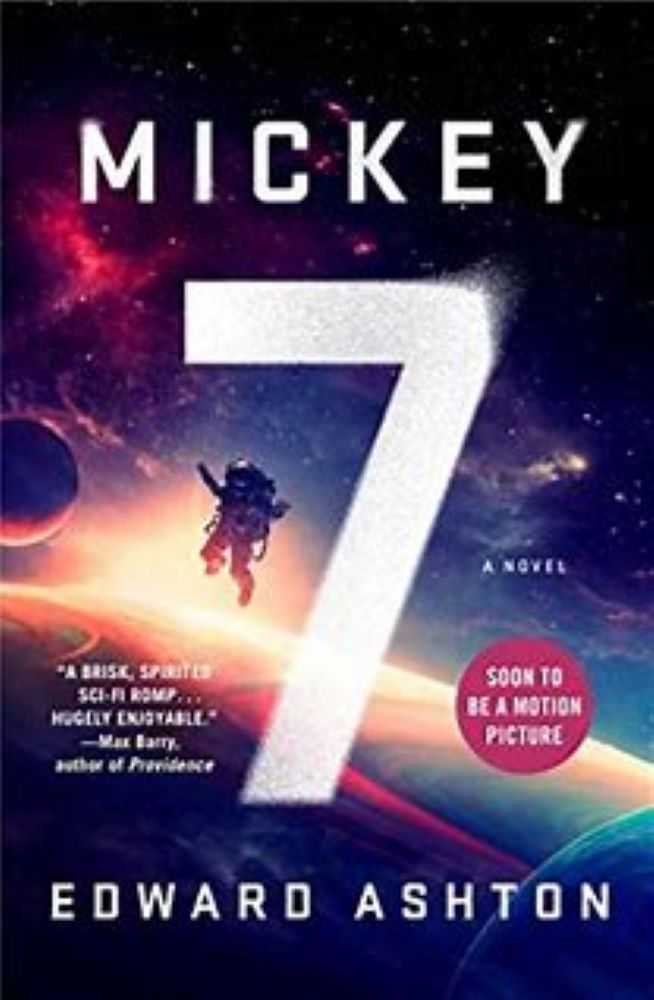

Edward Ashton, “Mickey7”, pbk, 368 pp., £13.59, Solaris (Rebellion Publishing), 2021.
First published in different form in ParSec #3, April 2022.
After a lengthy review of Stephen Baxter’s Galaxias (reprinted ON, 30th August 2022) which involved explaining and discussing much of his 10-billion-year plot, it was different and refreshing to tackle a novel who protagonist’s main problem is where his next meal is coming from – though there’s a lot more to it than that.
Preceding Gary Gibson’s Echogenesis (ON 28th January, 2024) and following Eric Brown’s On Arcturus VII (2021), it was also interesting to find another novel with issues which were looked at in the late 1960s by the discussion group behind my first nonfiction book, Man and the Stars (1973, Fig. 2). The first half of that book considered the first wave of human interstellar colonisation, out to 12 light-years, and although it rapidly went out of date in many respects, particularly in discussing conventional starships and not concepts like mobile O’Neill habitats, the reasoning mostly remains valid.

One of the questions we discussed was what would motivate a near-future society to attempt interstellar colonisation, and the answer was the threats to survival on Earth, starting with weapons of mass destruction. In Edward Ashton’s future, what trips the balance is the technology to make cheap and simple antimatter bombs. When any malcontent group or even individual can do it, nothing can stop it, and as in Nevil Shute’s On the Beach, civilisation breaks down in a wave of fresh attacks and tit-for-tat reprisals. The only hope seems to be to establish off-planet settlements and have them promise not to make the bombs, even though they can. Human nature being what it is, you can guess how well that turns out. Not all of them succumb to that, but earthlike worlds have their own dangers.
At the outset of our discussions, the late Prof. Archie Roy assured us that space telescopes could detect planets of other stars, and probably even tell if they had earthlike worlds, so colony missions could set off with confidence that they were habitable. From the ones that have been discovered so far, we know now that such confidence would be seriously misplaced. Being of a philosophical disposition, the central character, Mickey7, contemplates the fates of the missions that have failed, comparing their problems to his own predicament. Overconfidence has been the biggest mistake. On the desperate fling second-generation mission that he’s on, they have reached an earth-sized planet, but it’s in snowball mode, like the Earth of 700 million years ago (Fig. 3), and the atmosphere is unbreathable. They’ve set down and are trying to make the best of it, but the odds are not good. At least two of the previous colonies have failed because there’s already sentient life on their target planet. On Niflheim, as they name it, the only life-form visible appears to be a sort of giant centipede they call ‘creepers’. They can move at will through snow, tunnel through rock (or starship hull), and are very hungry for the assets humans are or represent. They don’t appear to be sentient, but Mickey7 has been saved from death by one which is bigger, differently marked, and empathic if not telepathic. He can’t tell anyone about it, and wouldn’t be believed anyway, for reasons which soon become plain.


In his artwork for Man and the Stars, the late Ed Buckley portrayed a colony site which could be evacuated by sea, to get away from volcanic activity or other dangers on land, or the colonists could move inland, and upland, if menaced by tropical storms or tsunamis. He chose a sheltered sea-loch on the coast of an island the size of Britain (Fig. 4), so that any dangerous life-forms could be contained and controlled (as the Martians do in The War of the Worlds). Even so it might not work, as the Niven/Pournelle/Barnes Legacy of Heorot pointed out, and the late John W. Macvey’s lecture, on life on other worlds, convinced us that integrating a terrestrial settlement into the biosphere of another earth would be so difficult that the the ‘foreseeable’ mission, using possible propulsion methods outlined by the late Prof. T.R.F. Nonweiler, would never survive. The ‘acceptable’ mission, big enough to have a decent chance of survival, would require faster-than-light links to Earth at the very least, and going on to consider it brought us a lot of flak – as one critic wrote, ‘whenever Mr. Lunan encounters a difficulty, he simply wishes it away’. And as the late John Braithwaite said in reply, ‘This is to say that you can’t discuss the ethics of the voyage unless you have a blueprint for the engines’.
For the foreseeable mission, we had postulated a colony group of 100 people – just what Elon Musk proposes to send on a one-way trip to Mars, with the ‘Starship’ he’s now testing in orbit. Patrick McNally, a medical student who went on to become a distinguished surgeon, outlined the problem with that. As recessive genes surfaced in subsequent generations, fewer and fewer of them could be allowed to breed, and by the fifth or sixth generation, the number who could be allowed to have children would be down to single figures. For the mission to succeed and the colony to survive, those individuals and their ancestors must live long enough to have children, even though we don’t know which of the crew those ancestors are. The social tensions and frustrations would be immense, and the chances that those last few would make it, in the rough-and-tumble of a settlement on a new world, seem vanishingly small. A recent NASA study has come to exactly the same conclusions; I don’t know what that cost them, but it’s nice to have the confirmation.
Edward Ashton’s colonists have two solutions: most of the colonists are carried in suspended animation as embryos, but among those awake is a single supernumerary individual who takes all the risks, being regenerated, each time he gets killed, as a clone with a full set of memories up to the last scan before he met his end. Mickey7 is indeed the seventh of his kind (Fig. 5), whose original volunteered for it, to escape from moneylenders on the home world who wanted to make an example of him – and as he remembers the experiences of the previous six, including several of their deaths, he has a lot to think about in his current incarnation.

Given how essential they are to the survival of the rest and the success of the mission, you might expect that nothing would be too good for the Mickeys, like the sacrificial kings of Frazer’s The Golden Bough and Mary Renault’s The King Must Die. But not a bit of it. Many of the crew are ‘Natalists’, believing in ‘the sanctity regarding the unity of the unitary soul’, and regarding the regenerated as soulless monsters at best, if not abominations in the sight of God. Despite their value to the expedition and the heavy commitment of resources for each recreation, the Captain regards the Mickeys as literally Expendable, taking exception to each one in turn and finding creative ways to dispose of each as he becomes unable to stand the sight of them. Most of the crew, though not all, share his beliefs or at least find it convenient to go along with them. The one thing worse than being Expendable is to be a Multiple – and because Mickey8 has already been created before Mickey7 gets back, one or both of them can expect a summary trip to the Replicator if they’re found out.
One issue on which the 1960s discussion group disagreed with John Macvey was his insistence, in his book Journey to Alpha Centauri (Macmillan, 1965), that the interstellar journey would require strict military discipline throughout. We all know how effective that sort of thing is in prisons, and it’s not how things are done on space missions or in Antarctic bases, nowadays – it comes as a shock to learn that Captain Scott insisted on strict separation of officers and Other Ranks in his one. Even on nuclear submarines, one is led to believe that there’s a different ethic nowadays. In his recent book Under Pressure, Living and Avoiding Death on a Nuclear Submarine (Mudlark, HarperCollins, 2019), about his time on a Polaris sub in the 1980s, Richard Humphreys considers that a lot of the discipline was irrelevant, a hangover from previous bad practise on surface ships, and when he visited US submarines he found the whole atmosphere to be more relaxed.

(I bought Under Pressure partly to look for parallels with the Niflheim colony, but also because it was the original title of The Dragon in the Sea, the 1956 novel of future submarine warfare which made Frank Herbert’s name when it was serialised in Astounding.)
Marshall, the Captain of the starship in Mickey7, is so inept that I’m tempted to slip in the word ‘Mouse’. He has no support team of officers like the ‘Polaris Submarine Hierarchy’ charted as a frontispiece to Under Pressure, where one of the chapter titles is ‘Captain Is God’, whereas Marshall relies on a ‘goon squad’ of security officers to enforce his orders. They’re ostensibly there to protect the colony against outside threats, but spend most of their time repressing the crew in response to Marshall’s edicts. One of his many mistakes is to enforce his will by the sanction of cutting general or individual food rations. Mickey7 and Mickey8 have to get by on a single ration, which has been cut several times as punishment, on top of the constantly reducing allocations for the crew as a whole. In all of the high-pressure situations above, dissatisfaction with the quantity or quality of food is the most frequent cause of individual breakdown or group dissent. The Royal Navy was well aware of that even in the 1980s, and despite the privations, discomforts and dangers of 80 days submerged, the one saving grace in the situation was the “rich, plentiful and varied” meals to which Humphreys devotes another whole chapter. On the grounded starship, the food is rubbish and Marshall appears to see no problem, though if the replicators can produce near-perfect copies of people, surely the difficulty with the food could be overcome.
The copies are near-perfect, but not exact. Mickey8 comes across from the outset as more selfish, lazier and generally less ethical than Mickey7. There are people in the crew who don’t care about that – ‘ghost chasers’, women who find the absence of commitment in an Expendable affair to be a turn-on, and don’t mind which Expendable is which. Even Nasha, the security officer who tried to save Mickey7 at the outset, isn’t immune to it – but he’s better off with her than with Cat, the other candidate for his affection. And in the end, in a refreshing turnaround from most books of this kind, it’s the security ‘goons’ who start to see sense, querying Marshall’s absurd orders and listening to what Mickey7 has to say.
There’s a lot here to think about here, as there is in Baxter’s Galaxias, but whereas the latter’s ideas play out on a 10 billion-year timescale, Edward Ashton’s are all set in the context of Mickey7’s uncertainty about his next meal – a remarkable accomplishment. The book doesn’t quite obey the classical unities – the action moves away from the ship a couple of times, though never far – but it all takes place in just a few days, which again is quite remarkable. If Racine had written science fiction, he might well have approved.




Leave a Reply