
Reviewed by Duncan Lunan

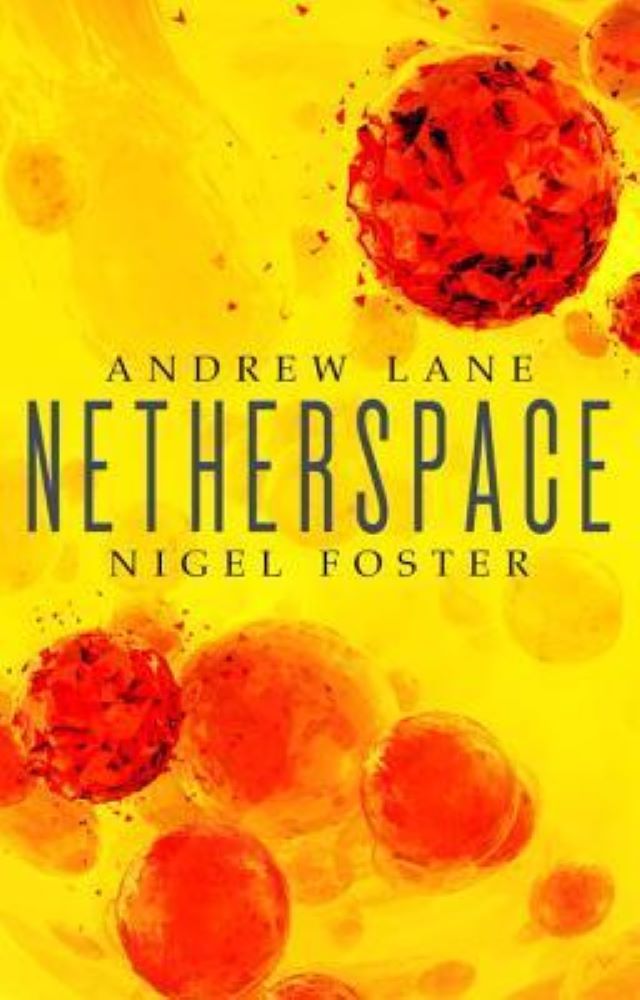
“Netherspace”, Andrew Lane and Nigel Foster, £7.99, trade paperback, 379 pp. inc. 12-page glossary and more, 2017.
First published in Interzone # 270, May 2017.
The two authors have interesting backgrounds. Andrew Lane has written 29 books plus short stories, including one for Interzone in 1994, and radio and TV scripts. While he is best known for the Young Sherlock Holmes series, his credits online include spinoffs from Blake’s 7, Doctor Who and Conan Doyle’s Professor Challenger novels. Nigel Foster comes to writing from an advertising background and his credits include developing and launching OK! Magazine, on one hand, and The Making of a Royal Marine Commando, on another.
It’s a combination from which one might expect something a bit unusual, and Netherspace explores a situation in which two normal SF situations are overturned. The various extraterrestrials who contact humanity seem to have no qualms about sharing their technology, including access to interstellar travel, and helping to set up our own colonies on earthlike worlds; but everything happens by barter, because we cannot make sense of their languages. Naomi Mitchison pointed out some of the possible difficulties in Memoirs of a Spacewoman (1962), and in this case, just one of the problems is that the E-Ts we call ‘Cancri’ are symbiotic pairs, and we don’t know which species is sentient, or whether they both are.
In my own Man and the Stars (1974) I suggested that the language issue might be over-rated because we use language for so many things which we couldn’t or wouldn’t want to communicate to extraterrestrials. I thought Contact could proceed to quite advanced levels through games such as ‘technology snap’, but I was examining situations where we already had interstellar travel and met the E-Ts on nearly equal or even superior terms. In Netherspace they find us, and they call the shots. The impact on our culture is drastic (countries break up into city-states), and while we don’t understand why they want what they ask for in the exchanges, our leaders have agreed to or allowed the price to be paid all too often in human lives, especially in exchange for interstellar drive units. One of the lesser instances, though bad enough, is that starships fail in transit and fall out of ‘netherspace’ with quite a high frequency. There’s a well-organised interstellar breakdown service, but it requires payment in human beings, and that risk is taken by professional or involuntary ‘call-outs’. I’ve argued elsewhere that things like this should never be permitted, because it would set extremely dangerous precedents. The Netherspace situation is not that bad, tough as it is for the victims; the E-Ts have a good reason for their fascination with humans, which I won’t spoil by revealing.
Human reactions to our disadvantaged position are varied. Like some UFO believers today, some believe that the Netherspace E-Ts are divine and nothing they do can be wrong. One such group, setting off to found a colony, is attacked and made hostage in a classic hijacking situation. I wasn’t sure whether the Cancri had learned how to do that from us, but it did strike me as a long shot, given the disregard for human life which our leaders seem to be showing. At any rate, our response to it is to put together a rescue team. Of course it’s full of misfits, including the only artist whose work has sold to E-Ts, a female commando who’s the only person who’s killed an E-T, and a pre-cog whose Delphic utterances are of very little help – at least till we glimpse the bigger picture at the end. The team sets off in pursuit, break down, sacrifice their incompetent commander as the call-out fee, and from then on start to make headway. Meanwhile, having no idea whether anyone will come for them or not, the ex-partner of the murdered religious leader is trying to persuade the abductees to rescue themselves.
Altogether it’s an interesting situation, and although the big revelation at the end makes sense of much of it, there are big loose ends at the end. There’s a glimpse of a starship from some still more advanced culture, and there are repeated hints that netherspace itself is sentient, or hosts some kind of intelligence which gets into people’s heads and tries physically to get into ships. “We have unfinished business,” says the artist at the end, agreeing to go back Up for further exploration, and his GalDiv handler confirms, “You’ve a society to save. Maybe a master race to find. Possibly a snark to hunt. And a netherspace mystery to solve.” So there are definitely more books to look forward to.
So I wrote in 2017, and indeed there are now two more books, Originators (2018) and Revelation (2019). Interzone was off the stands for a while and hasn’t renewed contact with me since, so I may have missed opportunities to review those two, which I would have liked to do. Life has had ups and downs for me since 2017, but I must ‘open a hailing channel’ and get back on the reviewers’ list if possible.




Leave a Reply