
By Eamonn Keyes
September 5th, The Orkney Club, Kirkwall

The 2024 Orkney International Science Festival (OISF) is back again, bringing an absolute wealth of fascinating and entertaining talks to Orkney The opening Sponsors Event featured two very different talks, with the first presented by Adam Wilcox , Senior Demonstrator in the School of Forensic Applied Sciences at the University of Central Lancashire, who teaches a range of subjects including crime scene examination, forensic testing and analysis.
This talk centred around the physics of forensics, where the application of scientific methods helps to find evidence in criminal cases. This is based on Edmund Locard’s Exchange Principle, which states that ‘every contact leaves a trace’. These methods involve examination for evidence of many everyday things, such as glass, DNA, hair, fibres, soil, pollen, paint and footwear marks for things that may link to an ongoing case.


Adam showed where oblique light, where a light source placed at a low angle will reveal the presence of footprints that were not visible in normal light, and with careful work this can reveal shoe size, the type of shoe based on identification of the tread patterns, and even whether had been worn by a male or female based on shoe style. A positive identification can be made on as little as a square centimetre of shoe sole, as there is a database of shoe sole types which lists type of shoe and manufacturers and this can be accessed for comparison.
Fluorescent powders can stick to residual traces left on surfaces such as glass, stainless steel or polyethylene by skin, fingerprints, fibres, hair etc. The powders adhere to these and fluoresce under ultra violet light and can give detailed information when examined closely.
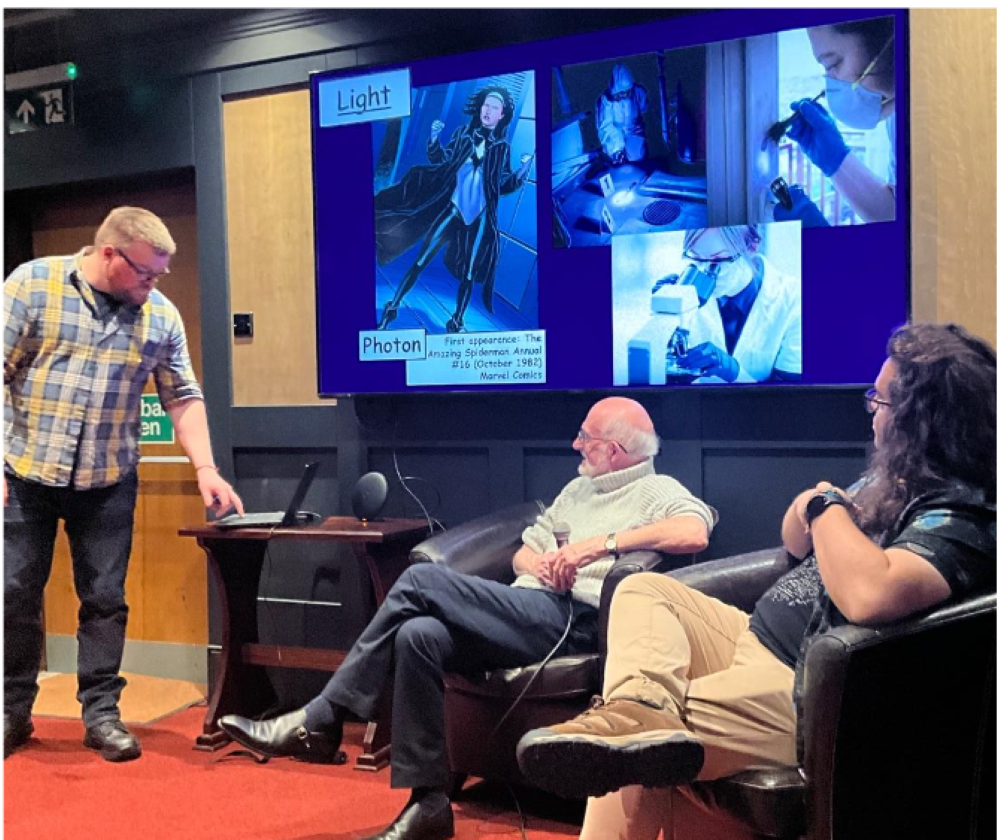
These photos show how fluorescent powders can help detect prints under UV light.
In our everyday lives we encounter static electricity in encounters with many things, and again this can help to detect the residual static left on contact with many surfaces, footprints again, for example. If a black vinyl sheet is spread over the area upon which a footprint is thought to be, and on top of this sheet aluminium foil is placed, then this serves as an electrode, along with a metal earthing plate.. When a high voltage is applied to this electrode the image of any footprints will appear on the surface of the vinyl sheet and can again be used to access the shoe sole database.

Birefringence uses the refractive properties in materials to identify them and can be used in many ways. It is very important in the analysis of fibres found at crime scenes to identify them. In addition , it can be used to find cars that have been involved in hit and run incidents, as birefringence patterns can be used on paint chips to identify vehicle make/model, to detecting latent fingerprints on the vehicle’s surface, or identify types of road dust collected during an incident. It is separate from but supplementary to the use of polarised light in identification.

Polarised light can also be used to identify fibres, revealing structural detail and properties not otherwise visible. This is particularly the case for man-made fibres and hair from both humans and animals.

Specific wavelengths of light or coloured filters can also help to show previously invisible fibres that may pertain to crime and have been found at crime scenes. Infra-red light, for example, can clearly show the presence of blood that is invisible on dark clothing under normal light.


One of the most interesting forensic methods is Electrostatic Detection Analysis (ESDA). ESDA works by applying an electrostatic charge to a document containing suspected indented writing. The indented writing is visualized through the application of charge sensitive toner. Indented writing (i.e., disturbed fibres) created from previously written documents on overlying pages can then be seen. This has also recently been used to detect the individual markings left on documents by printers and photocopiers as the result of the passage of paper through the mechanism.
This was used to free the Birmingham Six and Guildford Four, all serving life sentences for murder. In 1989, detectives from Avon and Somerset Constabulary, investigating the handling of the case, found significant pieces of evidence in relation to Surrey Police’s handling of the Guildford Four and their statements. Typed notes from police interviews had been extensively edited. Deletions and additions had been made and the notes had been rearranged. The notes and their amendments were consistent with hand-written and typed notes presented at the trial, which suggested that the hand-written notes were made after the interviews had been conducted. The notes presented had been described in court as contemporaneous records.
Additionally, following a raid on a London bank, police used ESDA to examine a note handed by the robber to the bank official demanding cash which was left behind. ESDA revealed the indentations of a previous telex message to someone in Canada pleading for money to be sent to an address in Surrey. Police called to the address and arrested a man .


For Adam, this is clearly a subject close to his heart as in his spare time, he is an avid reader, loves solving puzzles (the harder the puzzle, the better the challenge!) and designing new puzzles.






Leave a Reply