
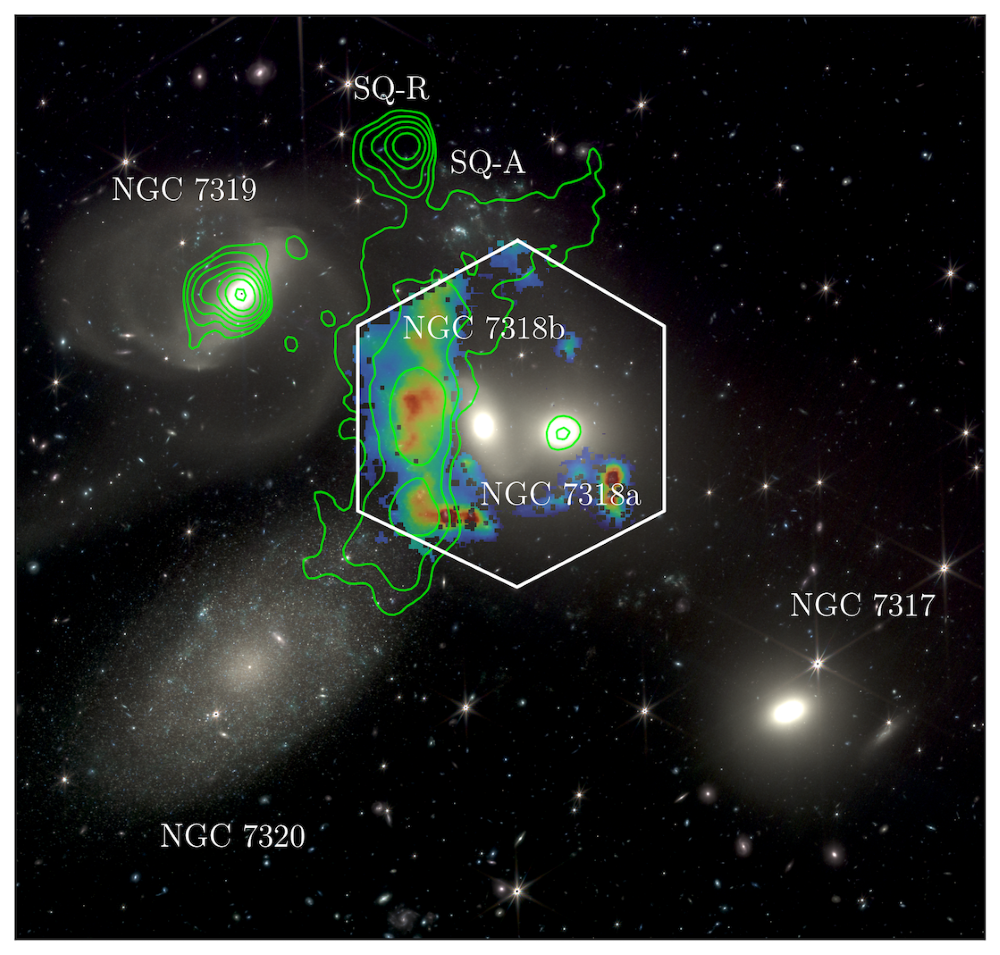
A massive collision of galaxies has been spotted by a team of scientists using the first observations from the new 20-million Euro (£16.7million) William Herschel Telescope Enhanced Area Velocity Explorer (WEAVE) wide-field spectrograph in La Palma, Spain.

The dramatic impact was observed in Stephan’s Quintet, a nearby galaxy group made up of five galaxies first sighted almost 150 years ago.
Opposite: The WEAVE prime-focus corrector and positioner at the William Herschel telescope in La Palma, Spain. Image credit ING
This cutting-edge, next generation science facility will not only reveal how our Milky Way galaxy was built up over billions of years, but also offer new insights into millions of other galaxies across the Universe.
The discovery of NGC 7318b smashing through Stephan’s Quintet was observed by a team of more than 60 astronomers and has been published in Monthly Notices of the Royal Astronomical Society.
Lead researcher Dr Marina Arnaudova, of the University of Hertfordshire, said:
“Since its discovery in 1877, Stephan’s Quintet has captivated astronomers, because it represents a galactic crossroad where past collisions between galaxies have left behind a complex field of debris.
“Dynamical activity in this galaxy group has now been reawakened by a galaxy smashing through it at an incredible speed of over 2 million mph (3.2 million km/h), leading to an immensely powerful shock, much like a sonic boom from a jet fighter.
“As the shock moves through pockets of cold gas, it travels at hypersonic speeds – several times the speed of sound in the intergalactic medium of Stephan’s Quintet – powerful enough to rip apart electrons from atoms, leaving behind a glowing trail of charged gas, as seen with WEAVE.”
When the shock passes through the surrounding hot gas, it becomes much weaker.
PhD student Soumyadeep Das, of the University of Hertfordshire added:
“Instead of causing significant disruption, the weak shock compresses the hot gas, resulting in radio waves that are picked up by radio telescopes like the Low Frequency Array (LOFAR).”
WEAVE is a state-of-the-art super-fast mapping device that has been connected to the William Herschel Telescope to analyse the composition of stars and gas both in the Milky Way and in distant galaxies.

The scientists combined WEAVE’s LIFU, data with other cutting-edge instruments such as the LOFAR, the Very Large Array (VLA), and the James Webb Space Telescope (JWST).
This is done with the help of a spectroscope, which reveals the elements that stars are made of by generating a bar code-style pattern within a prism of colours that make up a source of light.
It was designed and built following a multi-lateral agreement by France, Italy and the countries of the Isaac Newton Group of Telescopes partnership (the UK, Spain and the Netherlands).
Astronomers hope that WEAVE will help reveal how our galaxy formed in unprecedented detail and revolutionise our understanding of the Universe.
Dr Daniel Smith, of the University of Hertfordshire, said:
“It’s really neat work that Marina has put together with this large team, but this first WEAVE science paper also represents just a taste of what is to come over the next five years now that WEAVE is becoming fully operational.”

Professor Gavin Dalton, WEAVE principal investigator at RAL Space and the University of Oxford, added:
“It’s fantastic to see the level of detail uncovered here by WEAVE.
“As well as the details of the shock and the unfolding collision that we see in Stephan’s Quintet, these observations provide a remarkable perspective on what may be happening in the formation and evolution of the barely resolved faint galaxies that we see at the limits of our current capabilities.”

Dr Marc Balcells, director of the Isaac Newton Group of Telescopes, commented:
“I’m excited to see that the data gathered at the WEAVE first light already provide a high-impact result, and I’m sure this is just an early example of the types of discoveries that will be made possible with WEAVE on the William Herschel Telescope in the coming years.”

Click on this link to access, WEAVE First Light observations: Origin and Dynamics of the Shock Front in Stephan’s Quintet, published in Monthly Notices of the Royal Astronomical Society.
In 2016, a multi-lateral agreement to design and build WEAVE was signed by the countries of the Isaac Newton Group of Telescopes (ING) partnership (the UK, Spain and the Netherlands), joined by France and Italy, with each country contributing major components as listed below, and with the ING providing auxiliary systems and overall project management.
The consortium is led by Gavin Dalton from the University of Oxford and RALSpace as Principal Investigator, Scott Trager from University of Groningen as Project Scientist, Don Carlos Abrams from ING as Project Manager, and Chris Benn from ING as Instrument Scientist.
The main components of WEAVE are:
- Fibre positioner, developed by the University of Oxford in the UK, with support from the Instituto de Astrofísica de Canarias (IAC) in Spain.
- Prime-focus system, designed by ING, IAC and SENER, provided by the IAC and manufactured by SENER. Support from Konkoly Observatory (HU). Lenses were polished by KiwiStar in New Zealand, funded from STFC, NOVA, INAF, IAC and ING, and mounted at SENER Aeroespacial (ES) by SENER and ING.
- Spectrograph, built by NOVA in the Netherlands with optical design by RAL Space in the UK, optics manufactured at INAOE (MX) and with support from INAF (IT) and the IAC.
- Field rotator, provided by IAC and manufactured by IDOM (ES). Optical fibres, provided by the Observatoire de Paris in France, manufactured in France, Canada and USA.
- LIFU, built by NOVA (NL).
- CCD detectors system, provided by Liverpool John Moores University in the UK. Data processing, analysis and archiving led by the University of Cambridge (UK), IAC (ES) and FGG-INAF (IT) respectively.
- Observatory control system, built by the ING.


Leave a Reply