
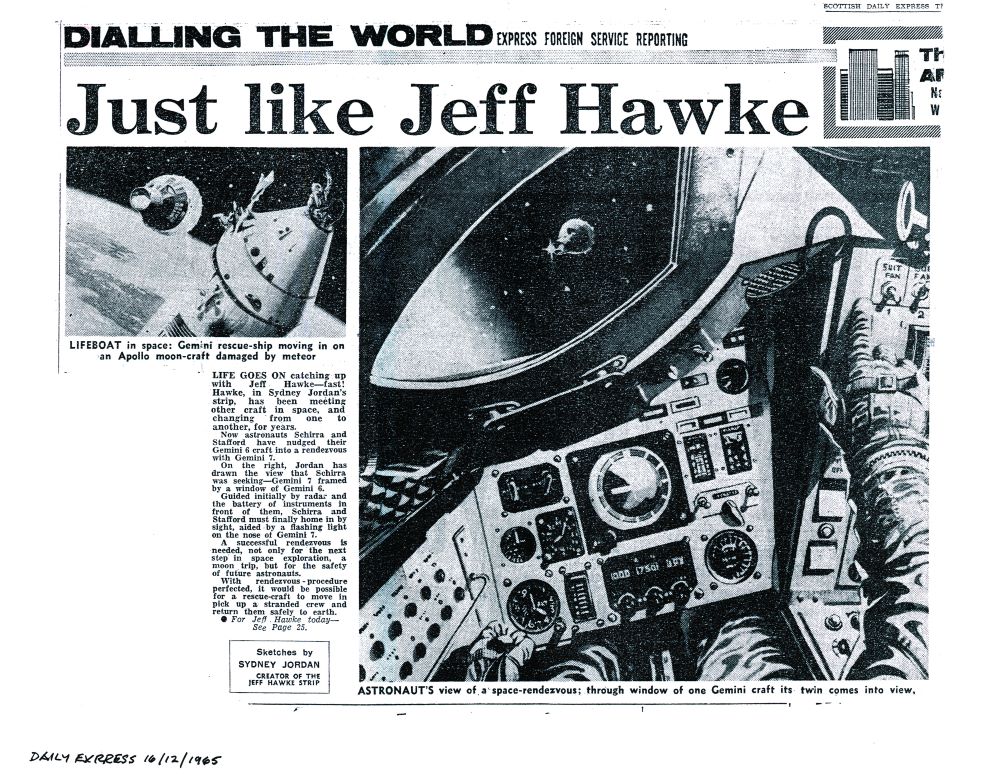
In 1965 the Gemini programme of 2-man space flights established many of the techniques afterwards used in Project Apollo. Gemini 6 was to have attempted rendezvous and docking with an uncrewed Agena target vehicle (subsequently achieved by Neil Armstrong and Dave Scott on Gemini 8). However the Agena exploded after launch, and after Gemini 6 experienced a launch abort, the decision was taken to rendezvous with Gemini 7, which was to undertake a 14-day endurance mission, to test life-support and other systems for Apollo. Gemini 7 launched first and Gemini 6A followed on December 15th, achieving the rendezvous although no docking was possible (Figs. 1-3).


The day before re-entry on December 15th, Walter Schirra (pic with DL, Fig. 4), surprised Mission Control by announcing a sighting of a UFO in polar orbit, apparently preparing for atmosphere entry. He described it as having one suited occupant in a red suit, and eight smaller modules at the front. He then produced a harmonica which he had smuggled aboard and proceeded to play Jingle Bells, accompanied by Thomas Stafford on a small set of bells, as a result of which he was later awarded honorary membership of the US association of harmonica players.


In December 1968, when the Russians were preparing to send a cosmonaut crew round the Moon (cancelled due to electrical problems), NASA took the bold and some would say reckless decision to send the Apollo 8 astronauts (Fig. 5) into orbit round the Moon on the first crewed launch of the Saturn V booster (Fig. 6).


The trans-lunar injection sending them on their way to the Moon (Fig. 7) was captured by a time-life photographer on the edge of dusk in Hawaii (Fig. 8), and although little known until recently, that sequence alone is enough to prove that they didn’t remain in Low Earth Orbit for the duration of the mission. (It’s necessary to emphasise these points because I have been assured by sceptics, with great vehemence, that such images do not exist. See ‘Yes, We Did Go to the Moon, Part 1’, ON, October 23rd, 2022.)

In lunar orbit they took the famous ‘Earthrise’ photo (Fig. 9), which made a much bigger impression than similar ones taken previously by unmanned probes; and they gave the equally famous Christmas Eve reading from the Book of Genesis, which drew criticism for supposedly over-emphasising Christianity. But the text, which is actually from the Old Testament, had been recommended by the United States Information Service because it is used by more religions than any other.

Be all that as it may, the next hurdle was the Service Module burn which would set Apollo 8 on return trajectory to Earth (Fig. 10). For astrodynamical reasons it had to be conducted over the lunar Farside, out of touch with Earth. As the Apollo was in orbit at an altitude of only 60 miles, if the burn went wrong it would take very little to cause an unobserved crash on the Farside. If the Service Module had exploded, as Apollo 13’s did subsequently, with no Lunar Module to use as a lifeboat, again they might never have been heard from again. And if they came round the Moon too early, they would miss the Earth entirely, or bounce off the atmosphere at best, and would not have lived more than a month longer at most. Tension in Mission Control rose to a high pitch as they waited for AOS (Acquisition of Signal), and when it came, precisely on time, James Lovell (Figs. 11 and 12) announced it with the words, ‘Please be advised, there is a Santa Claus’. That was immediately leaped on by UFO believers as proof that ‘Santa Claus’ was a NASA code for UFOs. and continues to be cited as such, though the fact that both incidents occurred at Christmas is seldom mentioned, and to the best of my knowledge no astronaut has used the words in space since.


Nevertheless, there have been some images since of Santa Claus with other spacecraft. A nice one sent to me by Tiziano Agnelli of the Italian Jeff Hawke Club (see below) shows Santa passing the International Space Station (Fig. 13), and another by Malcom Mayes shows him about to be run down by a Star Destroyer (Fig. 14).


After the astrophotographer Thierry Legault had captured the ISS crossing the face of the Sun with the Space Shuttle (Figs. 15 & 16) and the Moon (Figs. 17 & 18), and other photographers followed suit (Fig. 19), it didn’t take long for images of Santa doing the same to be produced (Figs. 20-21).


You might need to blow up Fig. 20 to see him better, but this year I’ve received a card from a member of the former Astronomers of the Future Club in which he’s unmistakable (Fig. 22). In all cases he’s seen outbound, and the Star Wars artist Chris Trevas has pictured him delivering presents on Mars (Fig. 23), and in Galaxy, January 1956, the late Ed Emshwiller portrayed him facing up to the issues of going interstellar.


Just distinguishing who’s been bad or good in the Solar System (in the container behind him) is giving him a headache, let alone the Alpha Centauri one next to it and the many more in the distance. The titles of the books he’s consulting are worth noting, as are the number of arms he needs to cope with it all (Fig. 24).

(‘Emsh’. as he usually signed himself, was a big-name SF and fantasy artist of the 1950s and 60s, in the same league as John Schoenherr, Jack Gaughan and Kelly Freas, for example – see ‘My SF’, ON, 10th September, 2023.) In an article in Fantasy & Science Fiction (August 1968, Fig. 25), on the release of 2001, A Space Odyssey, he revealed that Stanley Kubrick had asked him to create the closing sequence, and although he declined, parts of it were recognisably based on his short film Relativity, which had been shown at the British Easter SF convention in Bristol the year before. At another extreme, there’s also some significant influence from it in Roger Vadim’s Barbarella.)

Santa Claus’s flying reindeer, and dress of red and white, may have been inspired by fly agaric mushrooms used by Lapp shamans (James Le Fanu, Auslan Cramb, ‘Doctor’s Diary’, ‘Is Santa Flying High on Magic Mushrooms?’, The Daily Telegraph, 27th July 1999 and 14th December, 2001), though the costume as we know it was popularised by Coca-Cola in the 1930s. While on that subject, it’s worth mentioning Arthur C. Clarke’s story ‘Watch This Space’. It’s one of a series called ‘Venture to the Moon’ which Arthur wrote for the London Evening Standard in 1956, imagining British participation in a crewed lunar mission, reprinted in his story collection The Other Side of the Sky in 1958 (Fig. 26).

One of the expedition’s tasks was an experiment to be performed after lunar sunset, firing a cloud of sodium vapour up to a height where it would fluoresce in sunlight, so that its movements could trace electric fields and possibly magnetic fields around the Moon. It would be visible from Earth and all over the hemisphere facing the Moon, people in darkness were waiting for it. Experiments like this have been routinely performed using ‘sounding rockets’, particularly from high-latitude sites like South Uist, Andoya in Sweden, Poker Flat in Alaska, and Canada. Britain’s Skylark and Petrel rocket were used extensively up to 1995 (Fig. 27), particularly by the Royal Observatory Edinburgh, and Canada’s Black Brant has now taken over. Sodium and barium were often used to make such ‘artificial comets’, and one from South Uist, which I saw from Troon in 1971, caused such a ‘UFO flap’ (Fig. 28) that I’m still sometimes asked about it today, by people who never heard the explanation.


The lunar experiment doesn’t need a rocket launch: because the Moon has no atmosphere, a simple mortar will do. But as the glowing cloud forms, it becomes clear that a template has been fitted into the neck of it, causing the cloud to form letters and the letters to form words, spelling out the name of “a certain soft drink too well known to need any further publicity from me… The O’s and A’s had given them a bit of trouble, but the C’s and L’s were perfect… It did not take long to find, and fire, the engineer who had carried out the substitution. He couldn’t have cared less, since his financial needs had been taken care of for a good many years to come.”

Coming back to Santa, in 1998 Sydney Jordan issued a Christmas card relating to the ongoing controversy about the ‘Face on Mars’ in Cydonia, and suggesting that a previous Martian civilisation or interstellar visitors had spread the Santa myth at least that far (Fig. 29). The Mars aircraft appeared in Sydney’s Lance McLane strip several times, particularly ‘Home Is the Sailor’, Daily Record, 1982, and was reproduced in ‘Beginners’ Astronomy: Sailplanes on Mars’, ON, July 5th, 2022 (Fig. 30).

That was one of a number of short strips which Sydney produced, featuring visits to Earth by alien characters from Jeff Hawke (see ‘Jeff Hawke, Part 4 – Not As We Know It’, ON, October 29th, 2023). Many of them were for comic conventions in Italy, where graphic art is taken much more seriously and Sydney’s status is correspondingly higher than it is here, and most of them also had Christmas themes (Fig. 31).


Almost all of them featured Kolvorok, the cunning but craven assistant to the Galactic Federation’s chief of police (Figs. 32 & 33), including a sighting of Santa Claus (Fig. 34), and some like the ‘Face on Mars’ one included the arch-villain Chalcedon (see ‘Jeff Hawke, Part 3 – The Extraterrestrials’, ON, October 22nd, 2023) – usually in benevolent mood, but in one where he was dressed as Santa, he had captured Kolvorok and made him the butt of the joke, ‘How did the fairy get on top of the Christmas tree?’, which is perhaps too well known and a bit too coarse to repeat here.


A similar but less painful fate befell the Mekon in a Dan Dare/Jeff Hawke medley published by Spaceship Away in August 2012. But my favourite Santa joke is that the Civil Aviation Authority realise that Santa has been flying all these years without a license. They don’t have a sleigh simulator, so the test has to be for real. As the elves are wrapping a blanket round the examiner, they feel something hard beside his leg which turns out to be a shotgun. “What’s this?” they say, and the examiner replies, “Not a word! Santa doesn’t know it, but he’s going to lose an engine on takeoff.”
On which note, Merry Christmas to all,
Duncan.




Leave a Reply to Nigel JenningsCancel reply