
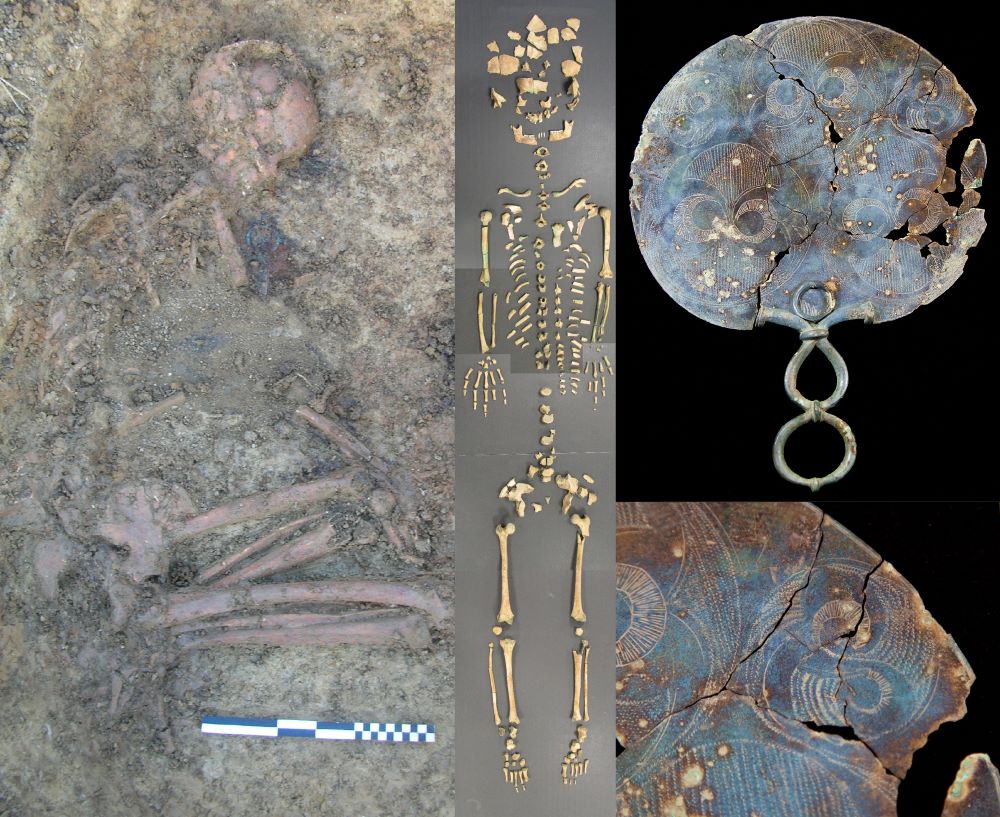
Leading geneticists and archaeologists have teamed up to explore Iron Age Society in southern England by sequencing DNA from many members of a single community in Dorset.

The geneticists retrieved over 50 ancient genomes from a set of burial grounds in use before and after the Roman Conquest of AD 43.
Dr Lara Cassidy, Assistant Professor in Trinity College Dublin’s Department of Genetics, led the study. She explained:
“This was the cemetery of a large kin group. We reconstructed a family tree with many different branches and found most members traced their maternal lineage back to a single woman, who would have lived centuries before. In contrast, relationships through the father’s line were almost absent.
“This tells us that husbands moved to join their wives’ communities upon marriage, with land potentially passed down through the female line. This is the first time this type of system has been documented in European prehistory and it predicts female social and political empowerment.
“It’s relatively rare in modern societies, but this might not always have been the case.”
Matrilocality means new families are established in proximity to the brides’ extended family of origin, not that of the groom. The researchers believe this form of societal organisation was not limited to Dorset.
Dan Bradley, Professor of Population Genetics in Trinity’s Department of Genetics, added:
“In Yorkshire, for example, one dominant matriline had been established before 400 BC.”
Bournemouth University have been excavating the site near the village of Winterborne Kingston, nicknamed “Duropolis”, since 2009. More richly furnished Durotrigan burials were those of women.

Dr Miles Russell, the excavation’s director commented:
“Beyond archaeology, knowledge of Iron Age Britain has come primarily from the Greek and Roman writers, but they are not always considered the most trustworthy. That said, their commentary on British women is remarkable in light of these findings.
“It’s been suggested that the Romans exaggerated the liberties of British women to paint a picture of an untamed society. But archaeology, and now genetics, implies women were influential in many spheres of Iron Age life. Indeed, it is possible that maternal ancestry was the primary shaper of group identities.”
When the Romans arrived, they were astonished to find women occupying positions of power. Two of the earliest recorded rulers were queens – Boudica and Cartimandua – who commanded armies.
Click on this link to access, Continental influx and pervasive matrilocality in Iron Age Britain, published in Nature.
The research also revealed a footprint of Iron Age cross channel migration into coastal southern England during the later Bronze Age.


Leave a Reply