
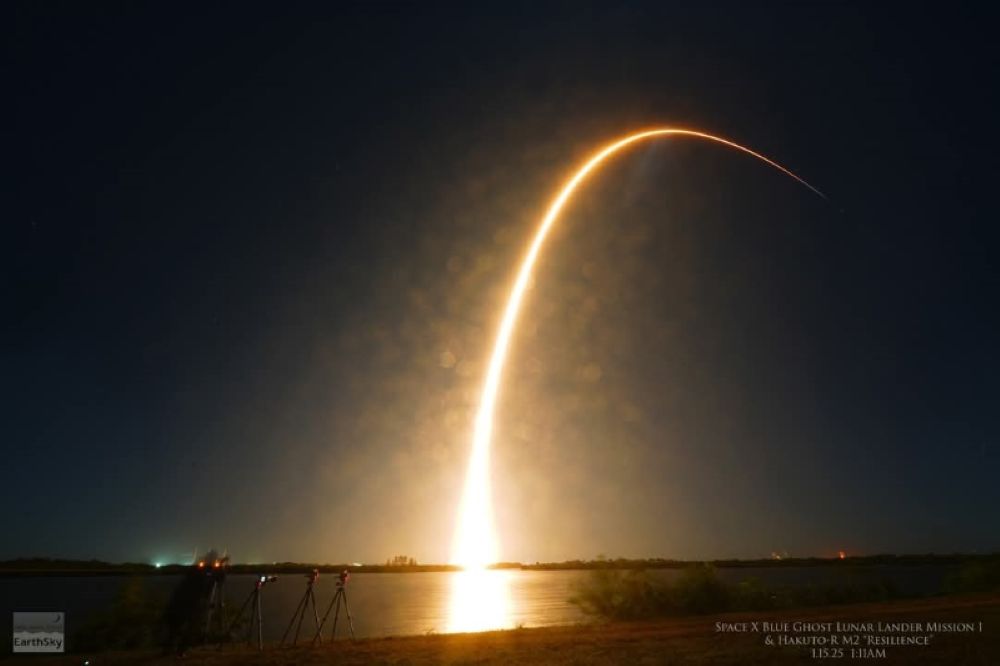
On January 15th 2025, almost unnoticed in the build-up to the launches of Starship Flight Test 7 and the maiden flight of the Blue Origin’s New Glenn booster, a SpaceX Falcon 9 launched two new probes towards the Moon (Figs. 1 & 2).


The double payload (Fig. 3) consisted of the Firefly Aerospace Blue Ghost (Fig. 4), part of NASA’s CLIPS programme (Commercial Lunar Payload Services), and the latest of Japan’s Hakuto-R moonprobe series, named ‘Resilience’ (Fig. 5).


Of the two, Blue Ghost will reach the Moon much sooner. Firefly has named their Mission 1 ‘Ghost Riders in the Sky’ (Fig. 6), which strikes me as pushing their luck when we all know what happened to them – but unless it fails on the way to the Moon, it’s not going to end up riding endlessly ‘across that endless sky’.

Blue Ghost is scheduled to land at a feature called Mons Latreille in Mare Crisium on March 2nd (Figs. 7 & 8). The Russians may not be best pleased about that, because Mare Crisium has been the focus of their lunar landing attempts thus far, including two successful sample returns in the 1970s, and the crash of their Luna-25 attempt to resume the programme in August 2023.


After orbiting the Earth for 25 days, Blue Ghost will head for the Moon about February 8th, meanwhile raising its orbit as the spacecraft systems are tested. Two such engine burns had been completed by January 24th, taking it far enough away to capture a ‘Blue Marble’ image of the full Earth (Fig. 9), first achieved by Apollo 17 in December 1972 (see ‘The Earth from Space’, ON, May 7th, 2023), and a timelapse video of the Earth’s phases changing (Brett Tingley, ‘Blue Ghost moon lander sees Earth as a ‘blue marble’ from orbit (photo)’, Space.com, January 24th 2025).

Having previously filmed an eclipse of the Sun by the Moon, on January 27th Blue Ghost obtained its first distant image of the Moon itself (Figs. 10 & 11, Mike Wall, ‘Firefly Aerospace’s Blue Ghost lunar lander snaps its 1st photos of the moon (images)’, Space.com, January 29th, 2025).


Resilience is expected to make its translunar burn around February 15th, and to spend four months in elongated orbit waiting for the Moon to come into the right configuration for the landing. It too has taken a Blue Marble image, on January 25th, showing Point Nemo, ‘the most remote place on Earth’, into which defunct spacecraft like Russia’s former Mir space station are deorbited (Figs. 12 & 13).


Meanwhile Intuitive Machines’ IM-2 probe, Athena, has arrived at Kennedy Space Centre for the company’s second lunar attempt, launching no sooner than February 26th, but still before either Blue Ghost or Resilience reach the Moon. Japan’s iSpace, the makers of Hakuto-R and Resilience, are planning a third larger mission called Apex 1.0 for launch in ‘around 2026’.
Blue Ghost is carrying a record 10 payloads for NASA, too many to describe in detail here (see for example Joe Hindy, ‘The Blue Ghost Lunar Lander Is Now Headed to the Moon: Here’s What to Know’, CNET, January 16th 2025), but among them is a Lunar GNSS Receiver Experiment to continue plans to extend GPS to cover the lunar surface, currently being checked out by NASA’s CAPSTONE orbiter. Plans for a second Blue Ghost mission are already advanced (Fig. 14), and one of the future payloads will be an optical telescope to check out the possibilities for a lunar observatory (Fig. 15). Although this one is intended to survive for just one lunar day, photographing the sunset before its batteries die, there’s a lot to look forward to if this mission comes off.


SpaceX’s seventh flight of its Starship/Superheavy combination took place on January 16th, and once again the launch, climbout and separation were successful, followed by a second successful capture of the first stage by the Mechazilla arms on the launch tower, while the Starship continued towards orbit (Figs. 16-20).


This Starship model was extended to increase fuel capacity by 25%; it was intended to conduct an engine restart in orbit, and launch 10 demonstration models of Starlink satellites, before testing new heat shield components including active cooling during re-entry. But shortly before reaching orbit one engine shut down prematurely, followed by loss of communication and an explosion visible from the Gulf of Mexico. A still from the video of it showed a large piece travelling away (Fig. 21), and remaining intact, possibly under power, for a long distance.


It looked remarkably like images of the Apollo 8 trans-lunar injection, captured by a Time-Life photographer in December 1968 (Fig. 22), and might suggest that at least one engine kept running and the fuselage kept intact, at least for a time, though the vehicle broke up and entered the atmosphere over Puerto Rico (Fig. 23), generating a spectacular display of multicoloured trails (Fig. 24).


The cause of the explosion apparently was a fuel or oxidiser leak in the engine bay, which the present valves failed to cope with, and Elon Musk has promised that it won’t happen again. Nevertheless the Federal Aviation Authority has frozen further flights and initiated yet another investigation into Starship safety, so it remains to be seen how that will play out when Musk has announced that Ship FT-8 is nearly ready to go, and he hopes to launch at least 24 more this year.


Also on January 16th we had the long awaited launch of Blue Origin’s New Glenn booster, using the same Be-4 engines which have already proved successful on the United Launch Alliance’s new Vulcan booster. NG-1 had been waiting since November (Fig. 25) on the former Atlas Pad 36, unused for 40 years (Fig. 26), and the usual milestones of launch, climbout, Max Q (maximum aerodynamic pressure, just beyond the speed of sound) and stage separation were all passed successfully (Figs. 27 & 28), but without the video coverage we’ve come to expect from Elon Musk and others.


As one commentator put it, ‘Jeff Bezos likes to play his cards close to his chest’. The vehicle reached orbit successfully and deployed its payload, a simulator for the planned Blue Ring orbital transfer vehicle, which was said to be performing well, but again with no video coverage. Nor was there any for the attempted recovery for reuse of the vehicle’s first stage, which was intended to touch down on the ship Jacklyn off the coast (Fig. 29). It was optimistic to try that first time, when it had taken SpaceX so many attempts to get right – the most recent being the first stage for the two January moonprobes (Fig. 30).


It’s instructive to look at the new comparison of New Glenn with other rockets (Fig. 31).

Antares, on the far left, is the vehicle which delivers larger cargo capsules to the International Space Station – currently awaiting replacements for its Russian rocket engines. Soyuz, next to it, has been the Russian workhorse booster since the 1950s, but is getting much less work since the withdrawal of international cooperation following the invasion of Ukraine. Europe’s Ariane V has been withdrawn from service, with Ariane VI soon to replace it. Atlas V is the United Launch Alliance’s booster developed from the 1950s ICBM, again dependent on Russian engines in this form and due to be withdrawn when the last of those is used up. Its replacement, Vulcan, is powerful enough also to replace the Delta IV Heavy, whose final launch was in April last year. Falcon 9 is SpaceX’s standard booster at present, and for heavier payloads three of them are stacked as Falcon Heavy, which still has a greater ‘throw weight’ than Vulcan. And then we come to New Glenn, whose three-stage version is pushing into the size range of Saturn V, which put men on the Moon in 1969-72. It shows just how much capacity has still to be made up – with its Exploration Upper Stage NASA’s Artemis booster will be able to match Saturn V, but only at incredible cost.


At the other end of the scale, Rocket Factory Ausburg (Figs. 32 & 33) now has clearance for its first vertical launch to orbit from the SaxaVord spaceport, on the site of a former RAF station on the island of Unst (Fig. 34), in the extreme north of Shetland, having dropped plans to launch from Sutherland. Other companies such as Orbex (Fig. 35) are pressing for early launch dates from SaxaVord, and competition will be keen. This story is likely to move so fast that it’s best to leave it there for now.






Leave a Reply