

In a typically graceless press conference shortly after the Washington air crash (Fig. 1), President Donald Trump sought to lay the blame on diversity within Air Traffic (Air Traffic Control, as we call it), and/or a deliberately staged event by his political opponents. As one commentator remarked, “It shows that he feels compelled to view everything through his own personal lens”. Among the prejudices, it has to be said that a couple of his points have some relevance – but with the shotgun approach he’s adopted, he’s almost bound to get something right. I’m aware that by venturing into a field so far from my own, I’m sticking my neck out. But I do so from a viewpoint of personal experience, because in 1990 I lived through a near-miss over the same stretch of the Potomac.
I was travelling with a colleague to a NASA conference at the University of Maryland. We landed at Boston and transferred to a Boeing 737 for the flight to Washington. We were seated at the extreme rear of the aircraft, on the starboard side. As we flew up the river towards the airport, we became aware of another aircraft approaching from the far right. At first we took it to be heading for one of the military airfields, either side of the river on the airline map, but as it drew nearer my colleague identified it as civilian, a Fokker light airliner like our own. Then it became apparent that it was on a converging course with ours, with no sign of turning aside. As it was approaching from the rear, we might be the only people on our aircraft who could see it. There was nothing to be done: we were strapped in, coming in to land, with the cabin crew in their seats far up ahead of us. A number of thoughts crossed my mind in the next few seconds, mainly that whatever happened next, it was going to be interesting.
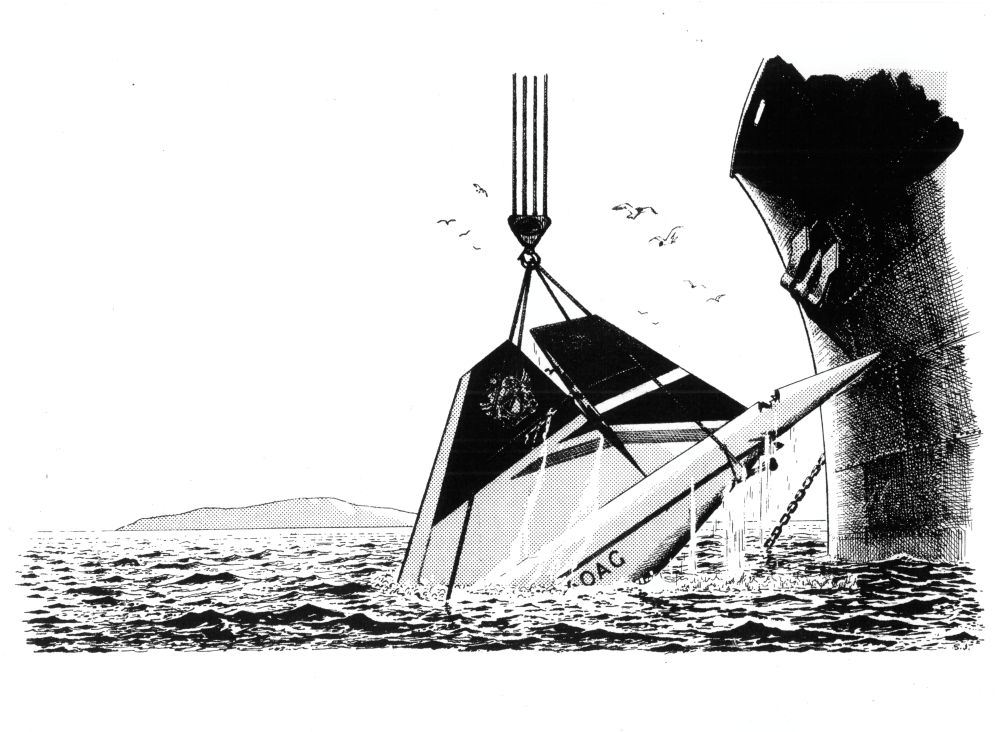
Both aircraft touched down simultaneously, and at that moment a wordless shout came over the tannoy. My colleague, himself a pilot, insists that it was the traditional “Oh, shit”, reserved for such occasions. Our brakes went full on, our engines went to full reverse thrust, and in a sight I hope never to see again, the wing ahead of us dissolved, every surface turning upwards and downwards as an airbrake, leaving only the skeleton of the wing in place. Our tyres lost traction and the 737 went into a 270-degree ground loop, accompanied by screams from the passengers, and came to a halt going backwards, while the Fokker passed unseen behind us. There was nothing said over the tannoy, not a word of apology or explanation. Our engines restarted in normal mode, we taxied to the terminal and were hurried off with none of the usual ‘Thank you for flying with us’ or ‘Have a nice day’. The flight crew, who would normally have been there in uniform to see us off, could be seen through the open cockpit door, still in shirtsleeves and with their heads closely together. In the terminal we were left to our own devices, and there was nothing on the national news that night. The incident revived my previous interest in air accident investigation, and prompted me to write a story called ‘With Time Comes Concord’, which had been hanging fire since the late 1960s (Fig. 2).

What that incident demonstrates is that when two aircraft are on collision course and remain there, neither pilot is playing ‘chicken’ – neither can see the other. There was nothing staged about that cry of alarm just after we touched down. Conceivably the Fokker pilot might have had an onboard emergency and held his course because he had to get down, but that would surely have made the news. It’s far more probable that our pilots couldn’t see the Fokker because he was so far back, until the last seconds, and since he was in descent mode, perhaps we were hidden from the Fokker pilot in a blind spot under his nose, though that doesn’t really fit with the long straight approach. Maybe we were masked by a freak condition over the river. I can’t believe that he could see us and was assuming that Air Traffic would order us to sheer off or pull out; even if he were so arrogant as to try it, when it failed he would have to do the same to avoid the coming impact. But both aircraft should have been plainly visible from the control tower and on radar, long before the near miss, so there seems to have been a serious lapse in traffic control. Innocently, I imagined that the problems with Air Traffic would be long gone, nine years after Ronald Reagan fired 11,359 of them when they went on strike, replacing them with new applicants. His supporters claimed he was proven right because subsequent fatalities were fewer than expected; my colleague Jim Oberg at at Johnson Space Centre was tallying some of the worst cases, and in the one which sticks in my mind, a twin-engined light aircraft was approaching an airport with its starboard engine out. Unaware of the precept, ‘Never turn into a compromised engine’, the inexperienced controller told the pilot to turn right and go round again; the aircraft rolled around the dead engine and fell out of the sky. Nine years later, I imagined that all such problems would be in the past, but when I looked into it after the near-miss, the Air Traffic service was still far from recovery, and allegedly still is, more than 3000 below the intended national strength and with the same issues of overworking hours, outdated equipment, and overloaded controllers still having to handle too many aircraft. The death of rocket pilot Scott Crossfield in 2006 (see ‘The M.52 and the Douglas Skyrocket’ and ‘Review, Paul Beaver, Winkle, The Extraordinary Life of Book Review: ‘Winkle, The Extraordinary Life of Britain’s Greatest Pilot’ Britain’s Greatest Pilot, ON, 30th July and 6th August 2023), came about when he was flying his own Cessna back from an Air Force dinner, and Air Traffic failed to inform him of bad weather ahead.
What strikes me is that in the same location as the 1990 near-miss, the Black Hawk helicopter pilots held their course in just the same way. They were on a training exercise, at night, and I think the President may reasonably ask why they were doing that, flying against the traffic in the approach lane of a busy civilian airport – especially as it now turns out to be standard practise. He also asks why they couldn’t see the American Airlines Bombardier 700 approaching ‘with lights blazing’, but I think that may be explicable because they were on the same level (400 feet, just before landing, 200 feet above the safe limit for helicopter training in the area). Aircraft landing lights point downwards, and when training flights (mostly Ryanair’s) are turning in on Prestwick from the sea, viewed from Troon beach they only appear bright as the aircraft points straight towards you – and the airliner was approaching on a diagonal, striking the helicopter on its port side. Film of the impact shows that the helicopter was showing a landing light, but again that would be pointing downward – and military helicopters are not supposed to be easily visible at night.
Since the helicopter was on a training exercise, another possibility is that its crew was distracted. In the development of the Harrier jump-jet, in one case investigated by the Royal Aircraft Establishment, the pilot had become distracted during descent by a Jubilee clip which came off his air-hose.


During development of the Blue Steel missile (Fig. 3), the crew of a Victor bomber (Fig. 4) was so keen to spot the splash, off the RAE rocket range at Aberporth in Wales, that they didn’t realise until almost too late that their autopilot was set for descent – at 2000 feet, descending at 5000 feet per minute. (Jeff Morgan, ‘Flying with the V-Force, Part 2’, Jeff Hawke’s Cosmos, Vol. 4 No. 3, June 2008.)

And in the 1972 Eastern Airlines Tristar crash in the Florida Everglades (Fig. 5), the flight crew were so preoccupied by a faulty indicator light that they didn’t realise they had turned off the autopilot altogether. Allegedly, their ghosts still haunt similar aircraft urging greater vigilance, for which who could blame them. (John G. Fuller, The Ghost of Flight 401, Souvenir Press, 1996 – Fig. 6.)

But after possible Pilot Error, we come back to Air Traffic, and again President Trump has a point. There should have been a warning to the airliner on the lines of ‘Traffic, traffic, pull up immediately’. Instead Air Traffic issued an ineffectual query to the helicopter, ‘PAT 25, do you have a CRJ in sight?’, when there was no reply, and the answer was obviously no, it was followed by ‘PAT 25, pass behind the CRJ’. Unless there had been previous communication that we don’t know about, had the helicopter crew replied it, would probably have been with, ‘Can we see whom? Pass behind what?’, followed, if time allowed, by the traditional ‘Oh, shit’. The lapse seems to have been as severe as the one in 1990, and it would be nice to think the investigators will look long and hard at that.
That assumes, however, that they will be free to do so. It’s a common trope in air accident movies that the investigators are fired or at least come under pressure from the airline, the manufacturers, or local and national politicians, and from relatives of the deceased and their lawyers on the other hand. None of that is permitted in the UK, whose regulations protecting the integrity of the Air Accident Investigation Branch are the strictest in the world. Once an investigator is assigned to a case, he or she can only be removed by Act of Parliament. I made that point in ‘With Time Comes Concord’, where a newly appointed investigator was assigned to what turned out to be an extremely controversial case. If the investigators of the Washington crash insist on similar independence, they may find themselves replaced by the FBI under Presidential order to ‘find the gays and Democrats responsible’ – and the way the USA is going at the moment, if that’s what they’re told to do, they will, innocent or otherwise.
Duncan’s story ‘With Time Comes Concord’ is reprinted in his book The Elements of Time (Shoreline of Infinity, 2016), and is available from the publishers and through Amazon. Details of all Duncan’s books are his website, http://www.duncanlunan.com.





Leave a Reply