
In January 2025 I had a very pleasant and surprising letter from Elaine Henderson, an Orkney News reader, who had figured out that there was a big idea underlying almost all my published work – all the nonfiction and almost all the fiction has been compatible with it, if not generated or influenced by it. Having found it on my website under ‘The Politics of Survival’, she wrote to tell me she liked it – and what made that such a pleasant surprise was that it’s the first time anyone ever has.
The bedrock of the Politics of Survival was thrashed out between myself and John Braithwaite over the winter of 1968-69, with some input from Charlie Muir and others, and I pulled it together into almost its present form during February of 1969.


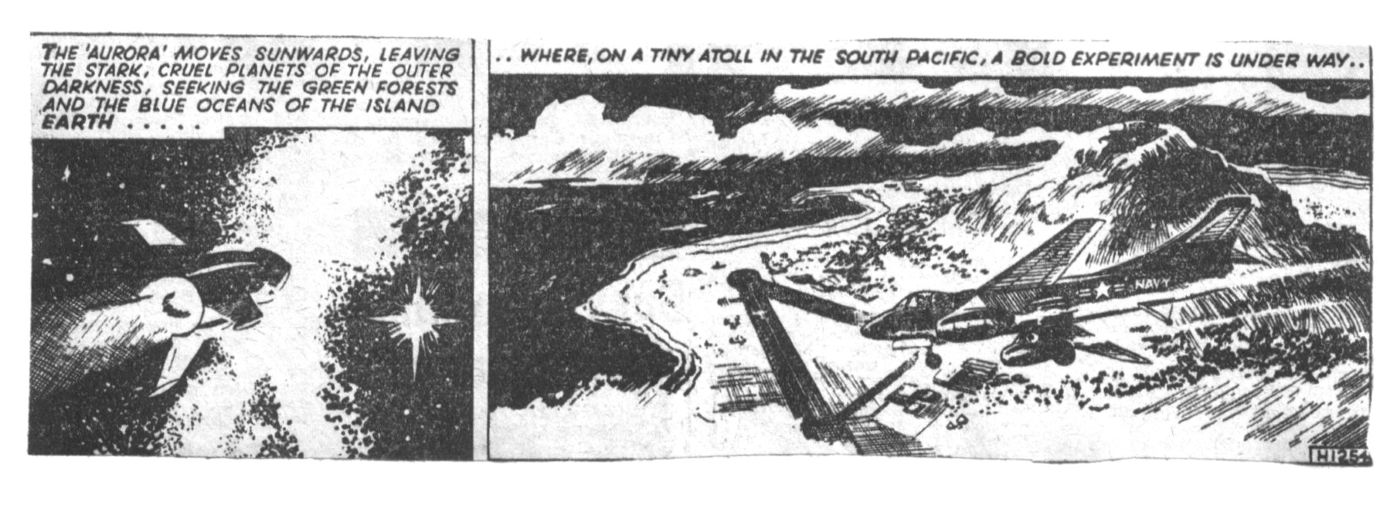
One early influence on it was Sydney Jordan’s proposal, put forward in the Jeff Hawke strip in The Daily Express, in 1958, at the beginning of a story called ‘The Dream Peddlars’ (Figs. 1 & 2). The proposal was to form an élite UN task force to put an end to warfare. Even at the age of twelve, as I then was, it struck me as a very good idea. What happened in the story was that the task force was flattened by a waterspout during a Pacific storm, so the project wasn’t mentioned again – rather a pity, I thought. It had a lot of influence on the formation of the ‘IRL’ concept which was one of the PoS starting points.
It’s customary now to think of ‘The Swinging Sixties’: the Moon Race, the Beatles, The Avengers, the Mini-skirt, Carnaby Street, Flower Power etc., as if it was all unbridled fun. What that leaves out is that most of the fun was taking place in central London, Greenwich Village and San Francisco, and in ultra-conservative Troon and Prestwick, where Andy Nimmo and I lived, much smaller revolutions had to be fought for. It was considered the height of rebellion when I grew a beard in 1965 to hide the scars of a motor-cycle accident, and I didn’t grow my hair long or stop routinely wearing collar and tie until the early1970s.
Other aspects of the ‘60s were not fun at all. The Berlin Wall, the Cuban missile crisis and a whole series of lesser events confronted us with the constant and imminent threat of nuclear war. At school, the question was not whether or not there was going to be another nuclear war, but whether or not there was going to be one before the Highers – with the corollary, was it worth the time and effort to study? A friend of mine, set to write an essay on ‘Myself in ten years’ time’, got six of the belt for handing in the simple phrase, ‘Blown to buggery by the Russians’. Many people dropped out altogether.
Then there was the matter of the environment. Rachel Carson began it, for many of us, with Silent Spring. The answer, for our parents’ generation, was perfectly simple: “You don’t know that you’re born. Who gives a damn for birds or frogs? The only point is that we need industry to beat the Soviets, and anybody who says there’s anything wrong with industry is either a communist or insane.” Oddly enough, when you talked to extreme left-wingers the same attitude came back the other way: the line I lastingly treasure was “You only get waste heat when industry is run on capitalist lines”, because Marxist-Leninist socialism had supposedly repealed the Second Law of Thermodynamics on the grounds that it wasn’t politically correct.
Another thing which particularly annoyed us was the constant ‘two choice’ scenario. ‘Better dead than Red’ – make your choice. Pollution or poverty – CHOOSE! Or as the French humorist Pierre Daninos satirically said, “Il faut décider”, whether or not you wish to do so.
And then, on an entirely different level, for those of us who were aware of it, there was the growing realisation that comet or asteroidal impacts could wipe out the human race – an idea so controversial that only science-fiction magazines like Analog were featuring it in their non-fiction sections, publishing ground-breaking articles by Dietz and Enever that nobody would have entertained elsewhere. Now that Jay Tate and Spaceguard have made the concept respectable, you may hardly find it believable that for most people back then, the first proof that the Politics of Survival was rubbish was that it began with a discussion about impacts.
In the winter of 1968, I was sharing a house in Somerset with the late John Braithwaite and Charlie Muir. We were planning to form a company called Crystal Optics – a long-ago precursor of John’s Braithwaite Telescopes, which became the last telescope maker in Scotland until John’s untimely death in 2012. John was already wheeling and dealing in optics and he sold a 4” reflector to a student at the Art School in Taunton, name of Dave. John and I delivered it to Dave’s flat and somehow the conversation turned to major impacts. “It would be like a nuclear war, wouldn’t it?” said Dave. John had been in Civil Defence and I could back him up from my own knowledge, so we told him how it would be different. “And when this happens…” said Dave, and then he paused. “It is going to happen, isn’t it?” And John and I looked at each other and said, “Yes”.
The only way to put it is that at that moment, we both felt that the lie we had been living throughout the ‘60’s had been exposed. The mode in which you went on with life as if it wasn’t going to happen and would somehow be all right, had been ripped away. We ‘made our excuses and left’, and we drove back out to Oake village, where we stayed, in virtual silence. John made coffee, we sat down with it facing each other across the kitchen table, and John gave voice to what both of us knew the other was thinking. “Okay, what do we do about it?”
One major thing we agreed on, at the outset, was that we not allow the dreaded ‘two-alternative thinking’, as above. There were many other things we agreed on, including a common terminology which we would use to avoid confusion. Nevertheless, it is probably fair to say that the kitchen table discussion was the last time we found ourselves in agreement for the next two months. Almost from the outset we found ourselves in disagreement not about aims, but about methods. It can be summed up in our attitudes to the international task force, which we both agreed was needed and to which John assigned the letters ‘IRL’. John envisaged it as the International Retaliatory League, a covert organisation which would take down the individuals who threatened the survival of humanity and civilisation. The Civil Rights movement in the USA was still a big issue (how ironic that ‘still’ seems now!), Czechoslovakia had just been invaded, Vietnam was getting worse by the week and the Civil Rights movement in Northern Ireland was having a very hard time, two years before the IRA re-emerged as a credible force. There was no lack of targets for John’s IRL. But I maintained that violence would invariably beget more violence, and my IRL stood for International Resources Liaison, an organisation at the opposite pole from John’s: completely open, utterly credible, non-violent and an arm of the United Nations.
The arguments continued through to the end of January 1969, when financial difficulties forced John and me to return to Scotland. Charlie had met his future wife and he stayed put, which meant that we had to send him down the money to settle the remaining bills by the end of February. John took a job but I couldn’t find one, so for the whole of that month I was sending virtually all of my Unemployment Benefit down to Charlie, and I spent a lot of time walking on the beach between Troon and Prestwick because I had little else to do. Over the course of that month, the full shape of the Politics of Survival took form in my head.
After years of innate belief that there was no hope, I can’t adequately express the relief that came with the realisation that humanity, and terrestrial life with it, could in fact be preserved. For the best part of ten years, dating from the erection of the Berlin Wall, I had gone through the motions of life against the constant assurance from my parents’ generation that it would all soon be over, And A Good Thing Too. It had appeared to be true, even though I railed against it; and now I could demonstrate that it didn’t have to be true. Even better, because of the rule against ‘two-alternative thinking’, the set had to include itself: the choice was not between the Politics of Survival and extinction, because if I could figure out one way to avoid extinction, that meant, under the rules of the PoS itself, that there had to be other ways to achieve the same object.
The lift that it gave me was enormous, and it took several months for me to realise that there was a problem. The problem was that everyone I spoke to about it, was convinced either that doom was inevitable, or that there were no problems at all. Either way, talking about solutions proved I was mad, so there was no need to listen to what I said; but that generated every opportunity to misrepresent what I said. The PoS swiftly became known among my friends as ‘Duncan’s insane plan to rule the world’, despite the fact that it didn’t require the creation of a world government and the action plan I then had in mind specifically excluded all the advocates of the plan from political office. If we became politically active for the plan, that would automatically generate opposition to it on party lines, whereas what we wanted was a programme which would be universally acceptable, in the way that all politicians have to be ‘in favour of motherhood and against the man-eating shark’.
Nobody was more fierce in the attack than the late Prof. Oscar Schwiglhofer, the founder of ASTRA, Scotland’s national spaceflight society. He had never read it (because at that time there was only one handwritten copy), and never had it explained to him, because he didn’t need to. “It can never be done without a world government, and you never get that because it takes no account of human nature.” Actually it doesn’t require a world government and it relies on less noble aspects of human nature, such as the desires for safety, profit and good reputation.


So I gave up on talking about it, and simply got on with it, within ASTRA. All of the discussions that became Part 1(b) and Part 2 of my first book Man and the Stars (1974 – Fig. 3), and all of the ones that became New Worlds for Old (1979 – Fig. 4) and Man and the Planets (1983 – Fig. 5), were run on Politics of Survival guidelines: I simply never mentioned it and everyone supposed I had forgotten it, even as they were helping me think it through in more and more detail. The issue remained closed until regular weekly ASTRA meetings resumed in 1977, once we had new meeting rooms in Almada Street, Hamilton. The meeting was scheduled for October 1st, which made ‘October the First Is Not Too Late’ the obvious title, misquoting Sir Fred Hoyle. Bill Ramsay (until recently head of the Educational Institute of Scotand) and Gavin Roberts (until recently Principal Teacher of Art at Airdrie Academy), backed up by Oscar, demanded that I come clean about the PoS – and to their amazement, they found that they knew it all already.
In the first two books, I had stated the PoS concept on a low-key basis, but in Man and the Planets I put it in the first chapter and I wanted to make it more explicitly part of the underlying theory. The battle I then had with our editor, Paul Barnett, was one of the ones that revealed to me that in my own way, albeit less conspicuously, I too was doing tricks with typography like the late Chris Boyce in his fiction. This time, I wanted the eight headings of the Politics of Survival to appear below one another, line by line. And the reason, which I didn’t realise until challenged, is that each of them is the end of the line and should be followed by a full stop.
I lost the battle: nothing would do except that Paul could economise on eight lines of type by putting the eight headings into one paragraph in lower case, as they had appeared in the two previous books. In 1983, Ewan MacVicar invited me to take part in an exhibition of ‘Writers and Writing’, which he was organising for the Open Circle Group in the west end of Glasgow. Each writer was to be represented by a single large-format panel featuring some aspect of his work. After discussion with me Ewan decided to feature the Politics of Survival, as the core of my written work, displaying the way I had wanted it to appear as typed out in the first draft of Man and the Planets in 1975, and the multiple changes it had been through at the behest of successive editors before appearing in what I can only describe as its economy format in the published text of 1983. It was an interesting exhibition, launched during a lunar eclipse (and anyone who’s read Milton’s Lycidas knows how unlucky that is). Author Michael Cobley, who visited the exhibition at an early stage of his own writing career, said that he had “never seen so much concentrated pain gathered in one place”.
For interest, in the late 1970s I had submitted a thesis on the PoS to an essay contest on The Limits to Growth, held by New Internationalist. From the competition guidelines I knew what to expect, and wasn’t at all surprised when the entry was rejected without even acknowledgement, much less discussion. Essays based on The Limits to Growth were supposed to assume that ther crash of civilisation was inevitable. But after another ten years of keeping it low-key, while everybody knew of its existence and those who’d read the books or were ASTRA regulars knew what it was, the late George Hay approached me with a challenge to write it up for the journal Science and Public Policy, edited by his colleague Dr. Morris Goldsmith, where it appeared in February 1987. As word got out, there was a wave of interest which at first looked most encouraging. My Slovenian friend, the editor Samo Resnik, arranged for it to be published in translation in a student journal called Katedra and actually beat Science and Public Policy into print by a month, so enabling me, as John Braithwaite pointed out, to say that when it did appear in English I was speaking ex cathedra. I was then asked to launch the concept publicly, in advance of publication, at the Environmental Sciences Society of the University of Stirling. It was a very pleasant evening, some of the students present were extremely impressed, but nobody was entirely sure who had invited me or why. If something bigger was supposed to happen, it didn’t. I was invited to speak shortly afterwards at a discussion group in Edinburgh, and I was also asked to outline it (unusually) to the Glasgow SF Writers’ Circle, which very rarely has talks. Mike Cobley was particularly interested and asked for a copy of the action diagram (see the thesis, beginning next week) because, as he said, at every arrowhead there’s a potential for conflict and therefore for a story – not quite what I’d had in mind. As all that happened there was a feeling, briefly, of ‘something in the air’, but then it all went quiet again, even though Science and Public Policy very kindly mailed out 20 copies, at their invitation, to people who I thought should be interested, with no result. Dr. Goldsmith had highlighted a throwaway sentence where I had suggested that as an option the PoS could lead to the abolition of warfare, and an article on that was to appear in a sister journal, but never did. However, in that year I gave a talk on ‘The Fermi Paradox’ to the IBM Heathrow Conference, and that paper appeared in Speculations in Science & Technology, January 1988. There’s an updated version in ON, April 24th, May 1st and May 8th 2022, and several other papers spun off from the ASTRA discussions have been updated here (see ‘Project Starseed’, ON, November 20th 2022, ‘Waverider, Parts 1 & 2’, ON, November 27th and December 4th, 2022; ‘The Ownership of the Moon, Parts 1 & 2’, ON, June 11th & 18th, 2023).
Those papers subsequently had updates in amateur publications, but otherwise, there matters remained until shortly before September 11th 2001 (as it happened), when the late Andy Nimmo proposed that we do a special issue of ASTRA’s journal Asgard on the Politics of Survival. At a meeting with the editor Jamie McLean in February 2002, that turned into a plan for an ASTRA discussion project on the PoS, to be reported on in four issues of Asgard.

The first meeting, in March 2002, updated ASTRA’s work on mitigating asteroid and cometary impacts (Fig. 6), and led to a spin-off discussion project suggested by Bill Ramsay, by then Past President.


Issues on population, warfare, the Sahara and meritocracy followed in August and November 2002 (Figs. 7 & 8), with a final general one in April 2003 (Fig. 9), by which time we had a major project, for the next 10 years, culminating in the book Incoming Asteroid! What could we do about it?, published by Springer in 2013 (Fig. 10; see ‘Asteroids and Impacts, Part 2’, ON, 10th October, 2021).

I printed a shorter version of this article in the Preface, and the 2002 version of the PoS thesis as an Appendix. But inspired by Elaine’s letter, and concerned by recent world events. maybe it’s time to update that.
(To be continued).

Leave a Reply