
By Fiona Grahame
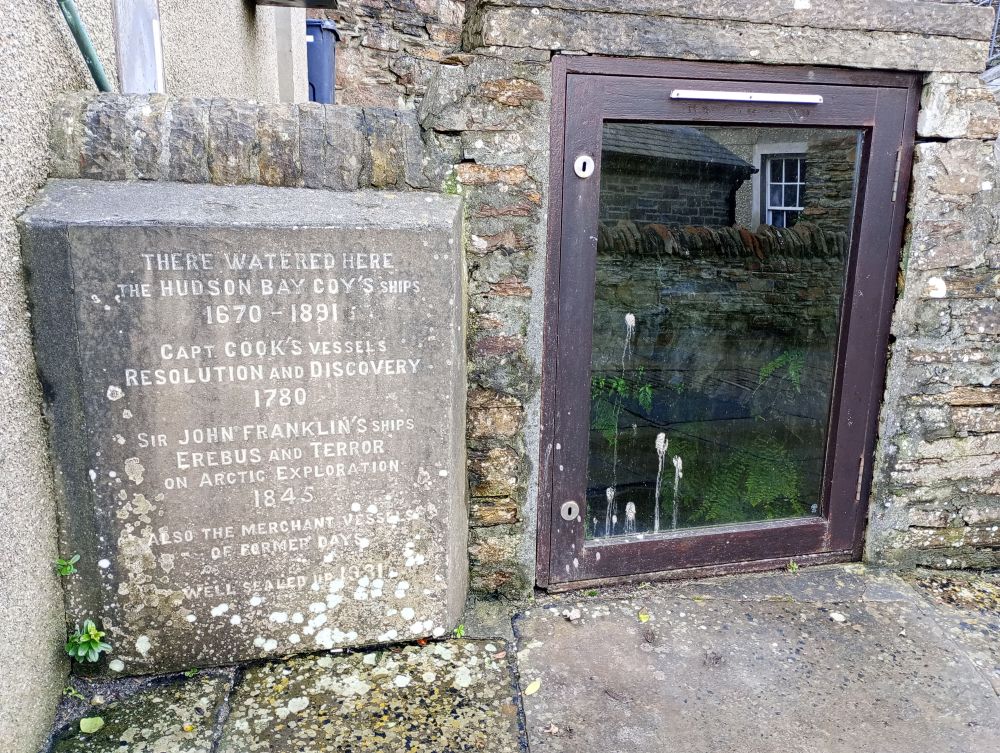
At the south end of the old town of Stromness, Orkney, is a sealed up well, Login’s Well. It is very easy to pass this by, but take a moment to look into its glass covered window and think about the inscription beside it: which bears the following words:
“There watered here The Hudson Bay Coys Ships 1670 – 1891. Captain Cooks’ vessels Resolution and Discovery 1780. Sir John Franklin’s ships Erebus and Terror on Arctic Exploration 1845. Also the merchant vessels of former days. Well sealed up 1931”

The well was a source of fresh water for the many vessels which called into Stromness during the great age of exploration and discovery when the town became a major port on the Atlantic sea route.
From early on in the 17th century The Hudson’s Bay Company (HBC) called in at Stromness to sign on men and buy up supplies for the voyage to Canada’s northwest. Orcadians were favoured because of their hardiness being so used to the sparse and harsh conditions at home and which they would have to endure employed by the Hudson’s Bay Company. By 1779 three quarters of HBC servants were from Orkney, 416 out of 530. The company had an office in Stromness and dealt directly with the town’s merchants until 1913.


Ships arrived in June to sign on men as servants for the company for the return journey. Traders in Stromness would supply them with clothing, tools and other goods which they would need when working in the outposts. Compared to the hard life at home, wages were what attracted the men. A labourer for HBC could earn £6 to £18 a year, depending on the work they were doing and their levels of experience, in contrast to the wages of a farm servant of £2.10 shillings.
Men would sign on for five or ten years leaving behind the women of the family to run the farms. It created a labour shortage and an imbalance in the population as many did not return home. Some would die in Canada but others settled to make lives in the new country. Money was sent home to the women left behind in the islands and some men would eventually return home. A few made enough money to set up businesses or to endow their home islands with legacies.
Those who became successful included Joseph Isbister, son of a Stromness trader, who signed on as a sailor with The HBC in 1726 and became the Chief Factor at Albany Fort.

William Tomison, born in South Ronaldsay, signed on as a labourer in 1760 and rose to become the Chief Factor at York Fort. He endowed a financial legacy for the building of the Tomison school in South Ronaldsay.
In 1876 Adam Flett returned from service with the company and opened a butcher’s shop in Stromness. It is still there today.

Dr John Rae from Orphir was the surgeon on a HBC ship and in 1833 signed on for a short term with the Hudson Bay Company in Canada. Captivated by the landscape and lifestyle in the Nor Wast, Rae stayed with the company until 1856, working on several major mapping and charting projects. His work in Arctic exploration, adopting survival techniques from the indigenous population included how to use snow shoes and sleds. He was known to the First Nation and Metis people as Long Strider Rae and learned a great deal from them.


In 1854 Rae sent a report to The Admiralty about the fate of the Franklin expedition which had set sail from Kent in May 1845 with 134 men aboard. In it, Rae wrote:
“…from the mutilated state of many of the corpses and the contents of the kettles, it is evident that our wretched countrymen had been driven to the last resource—cannibalism—as a means of prolonging existence” (Rae, 1854).
This report shocked Victorian society and a campaign by Franklin’s widow and the author Charles Dickens successfully refuted the claims made by Rae.
Stromness had been the last port of call for Sir John Franklin’s ships, Erebus and Terror. The Admiralty wished to find the Northwest passage, a sea route which would allow vessels to navigate from the Atlantic through to the Pacific without the long treacherous voyage round either the Cape of Good Hope or Cape Horn. This was to be a fatal voyage for Franklin and all his men. In April of 1848, 105 survivors out of an original crew of 129, abandoned their ice-trapped ships in a desperate escape attempt.


Since the mid-19th century, skeletal remains of dozens of crew members have been found on King William Island. Recent research by the University of Waterloo, Lakehead University, and Trent University has managed to identify two of them: Warrant Officer John Gregory, engineer aboard HMS Erebus, and Captain of HMS Erebus James Fitzjames. In 1997 Dr. Anne Keenleyside found cut marks on nearly one-quarter of the human bones which had been recovered proving that the bodies of at least four of the men who died there had been subject to cannibalism. Dr John Rae’s report to The Admiralty in 1854 had been correct. (See previous articles by The Orkney News).

Discovery of the Northwest passage was also the covert mission of Captain James Cook’s third world voyage for The Admiralty with his two ships, Discovery and Resolution. Cook set sail on 12th July 1776 from Plymouth in command of Resolution with Charles Clerke in command of Discovery. He was to return the captive native Omai to his home Raiatea, in the Society Islands, Polynesia, which James Cook had been the first European to discover on his first voyage for the Admiralty in July 20, 1769.
Having left Omai at Raiatea, on 18 January 1778 Cook became the first European to visit the Hawaiian Islands. His main mission, however, was to find the Northwest Passage. He sailed north. Cook explored and mapped the coast of North America all the way to the Bering Strait, and what came to be known as Cook Inlet in Alaska. He continued sailing up round the Bering Strait, the Alaskan and Siberian coasts until ice forced him to sail south again. It was whilst moored at Kealakekua Bay, in the Hawaiian islands that he was killed during a violent encounter with the Hawaiians on 14 February 1779. Charles Clerke, then took overall command of the expedition but he died of tuberculosis on 22 August 1779 at Petropavlovsk, Russia, still trying to complete the mission to find the Northwest Passage.
On the return voyage under the command of John Gore and James King, Resolution and Discovery were blown off course and into the sheltered haven of Stromness. The men had not been paid and with no money to buy essential supplies for themselves and the vessels, articles of Cook’s were sold off to men of substance in Orkney. George Low, a naturalist, bought many of Cook’s rare specimens from the south seas. Cook’s dinner service, from which he would have eaten his meals on the voyage, is now on view in Skaill House, Sandwick. Stromness Museum eventually received as donations his tea set and various other artefacts including spears from the south seas.

Stromness was the last port of call for ships sailing for Greenland and the Davis Straits. These were whaling vessels. Hunting and processing whales was a lucrative industry for the owners but dangerous and unpleasant work for the crew. In the year 1841 292 men in Orkney signed up for work on the whaling vessels adding to the labour shortage created by the Hudson Bay Company recruiters. The whales were killed for their oil used in lighting. Other products included soap and whalebone for ladies corsets. In addition to whales, seals were also hunted for their pelts. Stromness Museum has many exhibits related to whaling and the tools that were used.

Also calling in at Stromness would be ships of the Royal Navy when she was the largest and most powerful in the world. It is estimated that 2,000 Orkney men served in the Navy during the wars with America and then with France. Admiral Alexander Graeme, landowner of Graemeshall, Holm, when not at sea lived at his fine house at 87 Princes Street, Edinburgh. Graeme had an extensive naval career losing an arm in the Battle of Doggerbank on 5th August 1781.
Many men, however, were press ganged into the navy. When the navy was in the islands men went into hiding to avoid the forced recruitment of islanders to serve on board her ships.
Login’s Well and the stories it could tell.



Leave a Reply to Isobel Gunn #OnThisDay – The Orkney NewsCancel reply