
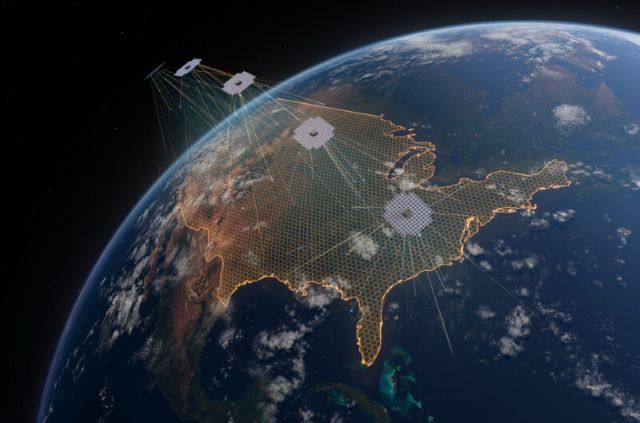
“More satellites have been launched in the last five years than in the preceding 60 years combined. One of key things we’re trying to understand is whether the path we’re on today is sustainable.” – William Parker.
Greenhouse gas emissions are changing the environment of near-Earth space in ways that, over time, will reduce the number of satellites that can sustainably operate there, according to new research by MIT aerospace engineers.
The researchers report that carbon dioxide and other greenhouse gases can cause the upper atmosphere to shrink. An atmospheric layer of special interest is the thermosphere, where the International Space Station and most satellites orbit today. When the thermosphere contracts, the decreasing density reduces atmospheric drag— a force that pulls old satellites and other debris down to altitudes where they will encounter air molecules and burn up.
Less drag therefore means extended lifetimes for space junk, which will litter sought-after regions for decades and increase the potential for collisions in orbit.
As of March 5th, 2025, the satellite tracking website “Orbiting Now” lists 11,833 active satellites in various Earth orbits. A deeper dive into numbers of satellite that are in space reveals how small satellites have come to dominate low Earth orbit. – How Many Satellites are in Space?
The MIT team carried out simulations of how carbon emissions affect the upper atmosphere and orbital dynamics, in order to estimate the “satellite carrying capacity” of low-Earth orbit. These simulations predict that by the year 2100, the carrying capacity of the most popular regions could be reduced by 50-66% due to the effects of greenhouse gases.
Richard Linares, associate professor in MIT’s Department of Aeronautics and Astronautics (AeroAstro) explained:
“Our behaviour with greenhouse gases here on Earth over the past 100 years is having an effect on how we operate satellites over the next 100 years.”

“The upper atmosphere is in a fragile state as climate change disrupts the status quo,” added William Parker, a graduate student in AeroAstro.
“At the same time, there’s been a massive increase in the number of satellites launched, especially for delivering broadband internet from space. If we don’t manage this activity carefully and work to reduce our emissions, space could become too crowded, leading to more collisions and debris.”
Matthew Brown of the University of Birmingham from the SERENE research group, who was also involved in the research said:
“Often we think only about the ground-, or sea-level impacts of climate change, but this research demonstrates that the impacts will reach as high as space.
“The numbers of satellites in low Earth orbit is rapidly expanding and we rely heavily on them for communications, Earth observation, weather forecasting and navigation. For this reason, we need to take the long-term sustainability of space very seriously.
“Discussions are already underway about how many satellites can be put into space at any one time, as more and more instruments are being launched into low Earth orbit. Without checking this proliferation, we are in danger of entering a ‘Kessler syndrome’, where a chain reaction of collisions causes space to become unusable.
“While technology can help these objects avoid collision, recognising the influence that the Earth’s natural environment has on our ability to operate in space is becoming increasingly important. A coordinated approach to reducing greenhouse gas emissions would ensure we can prevent the exploitation of the thermosphere and protect it for future generations.”
The thermosphere naturally contracts and expands every 11 years in response to the sun’s regular activity cycle. When the sun’s activity is low, the Earth receives less radiation, and its outermost atmosphere temporarily cools and contracts before expanding again during solar maximum.
In the 1990s, scientists wondered what response the thermosphere might have to greenhouse gases. Their preliminary modeling showed that, while the gases trap heat in the lower atmosphere, where we experience global warming and weather, the same gases radiate heat at much higher altitudes, effectively cooling the thermosphere. With this cooling, the researchers predicted that the thermosphere should shrink, reducing atmospheric density at high altitudes.
In the last decade, scientists have been able to measure changes in drag on satellites, which has provided some evidence that the thermosphere is contracting in response to something more than the sun’s natural, 11-year cycle.
“The sky is quite literally falling — just at a rate that’s on the scale of decades,” William Parker said.
“And we can see this by how the drag on our satellites is changing.”
The MIT team wondered how that response will affect the number of satellites that can safely operate in Earth’s orbit. Today, there are over 10,000 satellites drifting through low-Earth orbit, which describes the region of space up to 1,200 miles, or 2,000 kilometres, from Earth’s surface. These satellites deliver essential services, including internet, communications, navigation, weather forecasting, and banking.
The satellite population has ballooned in recent years, requiring operators to perform regular collision-avoidance manoeuvres to keep safe. Any collisions that do occur can generate debris that remains in orbit for decades or centuries, increasing the chance for follow-on collisions with satellites, both old and new.
In their new study, the researchers simulated different greenhouse gas emissions scenarios over the next century to investigate impacts on atmospheric density and drag. For each “shell,” or altitude range of interest, they then modeled the orbital dynamics and the risk of satellite collisions based on the number of objects within the shell. They used this approach to identify each shell’s “carrying capacity” — a term that is typically used in studies of ecology to describe the number of individuals that an ecosystem can support.
“We’re taking that carrying capacity idea and translating it to this space sustainability problem, to understand how many satellites low-Earth orbit can sustain,” William Parker explained.
The team compared several scenarios: one in which greenhouse gas concentrations remain at their level from the year 2000 and others where emissions change according to the Intergovernmental Panel on Climate Change (IPCC) Shared Socioeconomic Pathways (SSPs). They found that scenarios with continuing increases in emissions would lead to a significantly reduced carrying capacity throughout low-Earth orbit.
In particular, the team estimates that by the end of this century, the number of satellites safely accommodated within the altitudes of 200 and 1,000 kilometres could be reduced by 50 to 66% compared with a scenario in which emissions remain at year-2000 levels. If satellite capacity is exceeded, even in a local region, the researchers predict that the region will experience a “runaway instability,” or a cascade of collisions that would create so much debris that satellites could no longer safely operate there.
Their predictions forecast out to the year 2100, but the team says that certain shells in the atmosphere today are already crowding up with satellites, particularly from recent “megaconstellations” such as SpaceX’s Starlink, which comprises fleets of thousands of small internet satellites.
“The megaconstellation is a new trend, and we’re showing, because of climate change, we’re going to have a reduced capacity in orbit,” Richard Linares commented.
“And in local regions, we’re close to approaching this capacity value today.”

“We rely on the atmosphere to clean up our debris. And if the atmosphere is changing, then the debris environment will change too,” William Parker added. “We show the long-term outlook on orbital debris is critically dependent on curbing our greenhouse gas emissions.”
This research is supported in part by the U.S. National Science Foundation, the U.S. Air Force, and the U.K. Natural Environment Research Council.
Click on this link to access, ‘Greenhouse gases reduce the satellite carrying capacity of low Earth orbit’, published in Nature Sustainability





Leave a Reply