
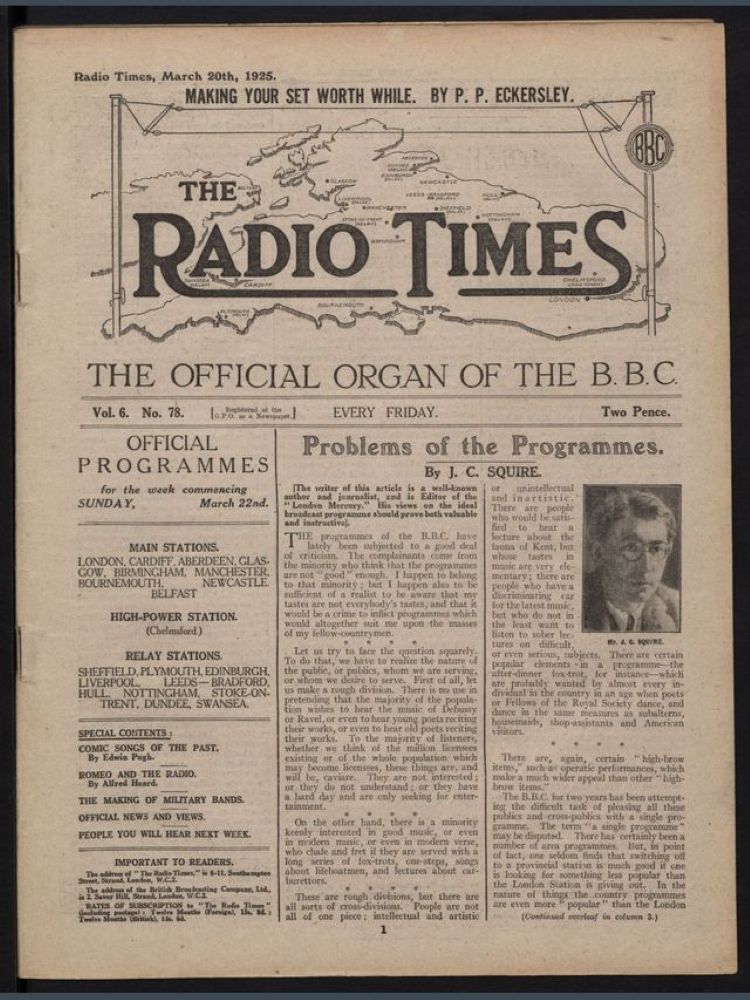
The first wireless licence was issued in November 1923 for ten shillings (50p). At the end of 1923 200,000 licences had been issued and by 1928 this had risen to 2,500,000.
The Post Office retained 12.5% of the fee to cover administration. Of the balance, the Treasury took 10% of the first million licences, 20% of the second million and 30% from the third million in excise duty.
So in 1928, the amount raised by the licence fee was £1,250,000: the Post Office took £156,250 and the Government a further £196,875. The BBC therefore received 71.75% of the fee at that time. – House of Commons Select Committee on Culture, Media and Sport First Report.

On 18 March 1925, The Orkney Herald published a report on the issue of Free Broadcasting.
” It has been suggested that broadcasting should be made a national service free to all who choose to avail themselves of it. The idea is that from a purely educational point of view it would be to the national interest to make it free, but past experience of State control of public services and supplies is sufficient to condemn any such proposal.
” The British Broadcasting Company’s licence from the Post Office will expire at the end of next year, and many think that if the company had a competitor the country would get better programmes, but it would surely not if the Service was a state monopoly.
“The one thing to be said for free broadcasting is that it would get over the difficulty arising from non-payment by owners of receiving-sets of the yearly licence fee, which is leading to two bad results.
“It has brought hundreds of thousands of otherwise good citizens to the slippery slope of law breaking and it has inspired the drafting of the new Wireless Bill, which imposes hard labour penalties on defaulters and gives the police wide powers to search private houses for unlicensed installations.
“The public would neither tolerate any general use of such powers or the filling of the prisons with broadcast defaulters, and if these evils are inseparable from broadcasting they would be a strong argument for its abolition.”
Mentioned in the report is the WIRELESS TELEGRAPHY (EXPLANATION) BILL of 1925: “to explain the meaning of the expressions ‘transmission’ and ‘rent or royalty’ where used in certain provisions of the Wireless Telegraphy Act, 1904.”
In the 1920s the Government took the decision not to allow commercial advertising on air to fund the fledgling BBC but to require the purchase of an annual licence in order to own and operate sound-receiving apparatus. In the early years the system was operated by the Post Office under the combined authority of Wireless and Telegraphy Acts 1904-1929 (later consolidated in the 1949 Act). House of Commons Select Committee on Culture, Media and Sport First Report.
At the instigation of the Post Office, the British Broadcasting Company was established in October 1922 by a group of radio manufacturers to produce radio programmes for the users of their products. Initially the broadcasts were funded by the sale of radio receiving sets, and carried sponsored programmes.
As part of the agreement with the Post Office, the Postmaster General started to apply a condition to broadcast receiving licences that the equipment used be “Type Approved by Postmaster General” and marked with the BBC logo.
Initially, the fee for receiving licences was 10 shillings, and remained at that rate until after the Second World War.
With the forming of the public British Broadcasting Corporation in 1927, the Post Office dedicated nearly the entirety of licence fee income to the funding of the BBC – Wikipedia
UK Prime Minister Stanley Baldwin, informed the House of Commons on 21 December 1925
The Australian Wireless Company applied for a licence to operate a wireless station in Great Britain for communication with Australia, and they have been informed that, in conformity with the policy adopted by the late Government and confirmed by His Majesty‘s present Ministers, the operation of all the Imperial services in this country will be concentrated in the hands of the Post Office. A contract for the erection of wireless stations for communication with Canada, South Africa, India, and Australia was made by the Post Office on the 28th July, 1924, and approved by Resolution of the House of Commons. These stations are approaching completion, and, when they and the corresponding Dominion stations are available, direct wireless services will be opened between this country and the Dominions.




Leave a Reply