
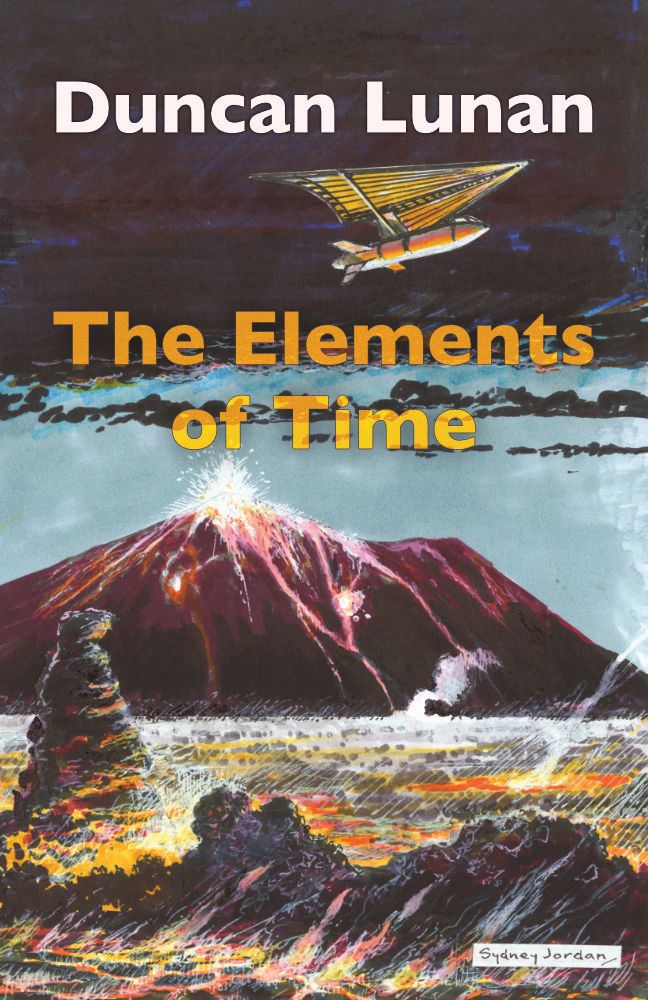

First published in different form in The Elements of Time, Shoreline of Infinity, 2016 (Fig. 1).


In last week’s column I mentioned that some ideas for my science fiction or fantasy stories have come from dreams. Examples include ‘Liaison Assignment’, Galaxy, April 1971 (Fig. 2); ‘Last Days in the Nanotech War’, Shoreline of Infinity No. 2, December 2015 (Fig. 3), ‘Demon’, 40p Magazine, March 2016; ‘I Believe that This Nation Should Commit Itself’, in Elaine Gallacher, Cameron Johnston and Neil Williamson, eds., Thirty Years of Rain (Taverna Press, September 30th, 2016 – Fig. 4); but most of all, and most strangely, ‘In the Arctic, Out of Time’, Isaac Asimov’s Science Fiction Magazine, July 1989 (Fig. 5).


Generally I can trace the sources for such dreams. For instance, ‘Liaison Assignment’ was inspired, years later, by Nigel Kneale’s serialisation of Quatermass II in the Daily Express, boosted by stills of the film version outside the George Cinema in Troon. ‘In the Arctic, Out of Time’ goes back to 6th May, 1968, in the Golden Eagle Hotel in Prestwick, Ayrshire. Charles Muir and I were running the Prestwick Folk Song Club, and that night we had booked Martin Carthy and Dave Swarbrick. It was a great success, one of the best nights we ever put on. In the course of it Martin Carthy sang ‘Lord Franklin’, with a humorous introduction which – I afterwards found out – was all made up. “…the search included the U.S. Navy, which consisted of about two rowing-boats at the time; and incidentally, it was the U.S. Navy, in their two rowing-boats, which found the North-West Passage, while searching for Lord Franklin… Sir John Franklin, I beg his pardon… the world’s most unsuccessful explorer.” Not a word of truth in any of it. In recognition of the US contribution to the search for Franklin, the British government presented the President with a desk made from the timbers of HMS Resolute (see below), and the Resolute Desk is in the Oval Office to this day (Fig. 6).

I learned the true story from an article which crossed my desk when I was working for the Fisheries Division of Christian Salvesen (Managers) Ltd in 1970. Whether it was because of the contrast with Martin’s introduction or not I don’t know, but in the summer of 1971, after I had become a full-time writer, I too ‘dreamed a dream… concerning Franklin, and his gallant crew’. Unlike the narrator of the song, I didn’t ‘think it true’, but I knew it was a winner – to the extent of resisting all attempts by my family to wake me. They had been seized by an unaccountable determination to wake me up, because it was such a beautiful day, although they knew I’d been working late. What was even odder was that I did get back to sleep, about three times, and each time resumed the dream where it left off. When I did get up I began at once to make notes, and the more I wrote down, the more I ‘remembered’.
The quotes round ‘remembered’ are because the dream contained a great deal I didn’t previously know, from Martin Carthy or the article. Some other influences were obvious – I had seen Alec Guinness in HMS Defiant only days before, for instance – but I had no previous knowledge that steam tenders were in use in Arctic exploration as early as 1850, to give just one example. When I realised that my dream corresponded closely to the 1850 expedition of HMS Resolute (Figs. 7 & 8), under Sir Horatio Austin (Fig. 9), I decided to base the story on it.


The flotilla consisted of two sailing ships and two steam tenders, which towed them through pack ice when it grew too thick. While icebound over the winter they sent out sledging parties under an expert, Lieutenant Leopold McLintock, who didn’t get through the North-West Passage and found only traces of Franklin’s expedition, but explored the coasts of several Arctic islands. There was even a maverick American scientist on two civilian ships which Austin’s met, though he didn’t transfer to the Resolute; he later commanded an expedition of his own, of which the Encyclopedia Britannica remarks, “his narrative is not to be depended upon.” Curiously enough, he had the same surname (Hayes) as the US President of the time, and I used that in the story, but with a different forename from either of them, just in case there were any descendants to take offence.
Where the dream diverged from reality was that the expedition was joined, against the Navy’s wishes, by a party of three American scientists, who were actually time-travellers. In their version of history the Resolute had missed the rendezvous with the sledge parties, severely damaging Austin’s reputation, and the lead scientist wanted to verify the hypothesis of his book suggesting how it happened. A suspicious group of sailors aboard turned out to be aliens who could move between alternative worlds; in moving the Resolute from one Arctic winter to another, and back, they created an alternative time-line, on which they could invade the Earth without compunction, while leaving the original almost unchanged. But the presence of the time-travellers altered it, so that instead of another Arctic winter, the ship materialised in Glasgow’s George Square during the Mayfest, and the 19th century sailors thought they were in Hell.
On the real-life return to England, the sponsors of several privately funded searches complained that Austin had been more interested in finding the North-West Passage than searching for Franklin. There was a parliamentary enquiry, and there’s a copy of the Proceedings, which included extensive extracts from the log, in a Special Collection at Glasgow University Library; I was the first person ever to borrow it, in 120 years. I read quite a number of other books on polar exploration; A.L. Lloyd’s book Folk Song in England, and his LP First Person, provided the musical background to some episodes in the story.
I also discovered a reference to Leaves from an Arctic Journal; or, 18 Months in the Polar Regions in Search of Sir John Franklin’s Expedition in the Years 1850-51 by Lieut. S. Osborn. Glasgow University Library didn’t have that, but the Strathclyde University Library did, and although G.U. graduates didn’t have access to the Strathclyde Library at that time, I was able to read the book by courtesy of Barbara Dinning of the Library staff. I had the title wrong (“Stray Leaves…”) but I let it stand in the story: a little unfairly, because Lieut. Osborn’s book was very helpful on points of detail, but I’ve never been able to get over his remarks about his visit to the Faroe Islands. In their earlier indolence, it seems, the Faroese took from the sea only enough whales and seals to meet their immediate needs; but under missionary influence, they now slaughtered far more than they could possibly use – an example of Christian industry which Lt. Osborn commended to us all for copying.

‘In the Arctic, Out of Time’ wasn’t placed anywhere, due partly to the effects on the market of the 1971 British postal strike. It did get some strange rejections: one editor of New Worlds wrote to me that one of the scientists was “a typical fantasy heroine. I’m damn sure I’ve never met anyone like her” (Fig. 10), in which he was the more unfortunate, because she was based on two Americans of my acquaintance. He added, “Anyway, many of us thought the scene in the city square was hilarious”, which it was intended to be, though desperately alarming for the 19th century crew (see below). I think that’s the only time I’ve had a story rejected for succeeding too well.
In the 1980s, when I began to write fiction again, I put it back on the market and this time it was accepted by Isaac Asimov’s Science Fiction Magazine. There was a two-year hiatus, and another two-year delay before publication, but when it appeared in 1989 – 18½ years after I wrote it! – they gave it the cover (Fig. 5), and it got nine recommendations for the Nebula Award of the Science Fiction Writers of America, so I had been right to believe in it.
‘In the Arctic…’ is alternative history from the outset, and that allowed me to take some liberties with Glasgow’s George Square. To 19th century eyes some of the buildings looked modern, like the City Chambers (1889), but others were ‘nightmares of metal and glass’, like the College of Building and Printing, as it then was. The Square did just have room for HMS Resolute, between the flower beds (I paced it out), but the ship would be hard up against the monument to Sir Walter Scott and since that didn’t suit me, I removed it. The 1960s “Information Centre” was long gone by the 1980s, but for story purposes I put it back; likewise ‘our’ equestrian statue of Queen Victoria dates from 1854, shows her as the young woman she then was, and faces the wrong way to be seen from the ship, so I changed all that. The ship’s officers were dismayed to see her as she was when she last visited Glasgow in 1888.
Though they didn’t understand it, the authorities saw the appearance of the ship as a threat and sharpshooters soon lined the roofs of surrounding buildings. The ship’s guns disabled a police car which attempted a gas attack on it, and the next move was to bring in a tank. Troops and tanks were brought into Glasgow during the postwar unrest in 1919, and stationed in the Cattlemarket on the Gallowgate after ‘the battle of George Square’ between protestors and the police. The prediction that it might happen again by the late 1980s didn’t seem unreasonable in 1971, or even in the mid-1980s.

In the 1970s the Square still had many more trees and larger flowerbeds than today’s (Fig. 11). The Asimov’s artist Bob Walters evidently had no idea what it looked like, because he drew the ship’s yards and the tank in detail, but hid everything else behind a gas cloud (Fig. 12).

The Square was largely cleared of vegetation in 1999; as the poet Brian Finch put it, in a series of haiku satirising Glasgow’s bid to be ‘the City of Architecture and Design’:
Aa thae trees is doun
That stuid in George Skwerr – wherr nou
Bonsai bins abound
(‘Glasgow 1999, Towards a New Millennium’, in Talking with Tongues, Luath Press, 2003.)
When Sydney Jordan illustrated the story for book publication in 2016 (see below), he showed the City Chambers in the background of the confrontation, but the Square itself as empty (Fig. 13), as it looks in most photos taken at ground level (Fig. 14). George Square has now been closed for a complete renovation, in which it’s promised that it will be restored at least part-way to its former appearance.


There were still other oddities, however. In 1988, I had wanted some historical background on Central America for a novel, based on my stories for Sydney Jordan’s recently terminated Lance McLane strip in the Daily Record (see ‘My SF’, ON, 10th September 2023). I turned to Dr. Euan MacKie of the Hunterian Museum, whom I’ve often mentioned in relation to ancient astronomy and archaeology, but was also an expert on the Maya – it was noticing parallels between the Maya and Neolithic Britain that first drew him to the work of Prof. Alexander Thom. He was quite happy to direct me to the sources I needed, but was I happy to work with this kind of material? Oh yes, I said, I’ve done historical research for other fiction; and I told him about the parliamentary report.
The following week, Gardner Dozois, the editor of Asimov’s, asked me to change the names of the people on the ship back to the real ones. So I applied to borrow the report again: but someone else had taken it out. I rang Euan MacKie, and he wasn’t the one who had it, so I had to request its recall; and when I got it, whoever had taken it out – just after I’d told Euan about it – was the only other borrower, ever, in what was now 136 years. I suspected it must be Euan checking up on me, but he denied all knowledge of the other borrower, whose name the Library refused to divulge. Had we got in touch, I sometimes wonder what might have come of it.
Apart from Austin, McLintock and Osborn, everyone I’ve placed aboard HMS Resolute is fictitious. Nor do I know of any real-life rivalry between Austin and McLintock, who eventually found the tragic remains of Franklin’s expedition; both men were dedicated to the search for Franklin, which was the main purpose of the voyage. I’d forgotten why I changed the names, originally: the problem was that half the people on the ship had names like Armstrong, Aldridge or Langley – astronauts, NASA administrators, NASA research centres! The ship’s musician was called Organ; the sailmaker, who was also a singer, was called Record; and other plain seafaring lads had aristocratic French surnames, probably descended from refugees from the Terror. Nobody would have believed them in a work of fiction; there were only a couple of the historical names I could use.
That wasn’t the only change that Gardner insisted on. Twice in the action the ship encounters a helicopter (which didn’t happen in 1850, though they did log “a rocket or shooting star” in the night, which I turned into an Apollo-style atmosphere entry). I chose a helicopter because for story purposes, whatever they met had to hover, fly slowly, make a distinctive noise, have a light underneath, and look utterly bizarre to 19th century sailors. But Gardner had decided he wanted to feature the second encounter on the magazine cover, and he was worried that a helicopter might make it look too much like a scene from the Tall Ships Race. It is a science fiction magazine, after all. So he made just two changes. Where one of the time-travellers says, “I can hear that helicopter again”, he substituted the word ‘ship’; and where I described it as “like a huge, whirring insect”, he substituted ‘glowing’. Sure enough, that was enough for Bob Walters to paint something like a giant ladybird (Fig. 5), though his rendering of HMS Resolute is authentic (compare Fig. 7).
The change was made after I checked and approved the proofs, and I wasn’t very happy about that, but I was assured no other changes had been made. So the story was published, and then I got a letter from the late John Brunner. (If you knew John, you’ll know that he was much into folk music as well as SF.) John’s questions were both about the same scene in the story: first, did they really have an accordion, only a year or so after it was invented? I could answer that from the log extracts: yes, in fact one of the sledge parties took it with them. (The log doesn’t record what the rest of the crew thought about that.) The other thing was, one of the Americans overhears the singing of Saint James’s Hospital. “There’s an American version,” she says, so giving away that she’s from the future, relative to 1850, because Saint James’s Hospital goes back to 1790, and Saint James’ Infirmary only to 1905. A.L. Lloyd was my source for that; but now, here was John saying I’d got it wrong. I checked my copy of the proofs – quite correct. But after I’d returned the other one, some eagle-eyed and ‘helpful’ copy-editor had changed the ‘error’ for me, so making nonsense of the whole paragraph. John fully sympathised because he has suffered badly from U.S. copyediting, particularly in the Signet edition of his novel The Productions of Time.
In the same scene there’s also a Broadside Ballad called Farewell Nancy, and it turns out that also has an American version, which was sung for me around 1990 by the singer-songwriter Meg Davis, soon after the story came out.
Before those changes, Gardner had asked for one major one. In the dream and my original draft, at the end it was uncertain which time-track the characters were on, and Austin was rising to the challenge of finding out. But Gardner wanted a final encounter with the aliens. Although taking just three pages, the impact was huge. It extended the one big scene of the third time-traveller’s. It required the second encounter with the helicopter, in daylight, generating the cover illustration when it was changed to a ship. It meant that the characters were on the time-track of the invasion, of which they’d have to give warning, and as the machine which had brought the scientists was on a different track, they were now stranded and would presumably be involved.
After publication, I was contacted by my Australian colleague Jamie Bentley, who had written a children’s musical called The Artful Dodger in Botany Bay, and who suggested we collaborate on a sequel to ‘In the Arctic’. I had in fact dreamed the beginning of one, after the Resolute‘s return to England, which revealed that the humanoid ‘aliens’ were actually androids. Jamie suggested that the true aliens were ursines, who could pass for polar bears, at least in dim light. (Unseasonal bear tracks had appeared around the Resolute in midwinter, both in the ship’s log and in the story.) As this would be very alternative history, one idea was that the time-travellers’ knowledge should be used for an attempt to relieve Franklin – leading to another confrontation with the aliens, who had been holding his ships and men captive. We hadn’t got much beyond that, however, before suddenly everyone was talking about Philip Pullman’s His Dark Materials, and publication of a two-page extract in one of the Sundays, in which the bears played a major part, told us that our idea was a non-starter, at least meantime. We never got back to it and Jamie is no longer with us, but there is still a feeling that ‘In the Arctic…’ has a further way to go.
‘In the Arctic, Out of Time’ is reprinted in The Elements of Time, Shoreline of Infinity, 2016 (Fig. 1); ‘Liaison Assignment’ in From the Moon to the Stars (Other Side Books, 2019 – Fig. 15); ‘Demon’, in Michael S. Collins, ed., The Other Side Book of Ghosts, Other Side Books, 2021 (Fig. 16); ‘I Believe that This Nation Should Commit Itself’, in From the Moon to the Stars. All but the first three of Duncan’s 10 books are available through Amazon; details are on his website, www.duncanlunan.com.


Leave a Reply to Caleb CheruiyotCancel reply