
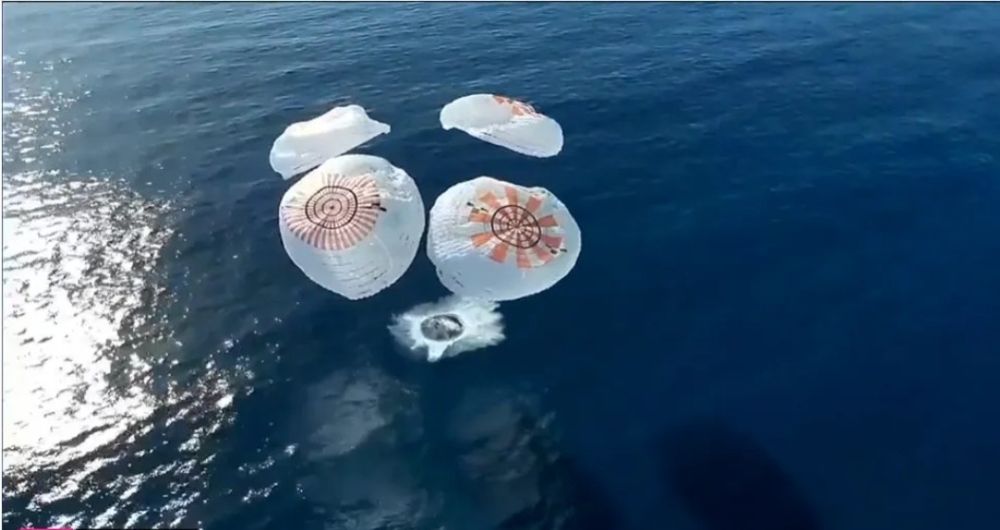


Watching the return of the Fram-2 astronauts last week (Figs. 1 & 2), just before ‘Space Notes’ went to press, I was struck yet again by the lengths the recovery crew go to, making sure there are no leaks from the Crew Dragon’s attitude control system, before they open the hatch to let the astronauts out. (See ‘Polaris Dawn 2′, Fig. 13, ON, 22nd September 2024.) It’s well worth doing: the capsule’s Draco thrusters use nitrogen tetroxide as oxidizer and monomethyl-hydrazine as fuel. Nobody wants a repeat of what happened on the last Apollo mission, the rendezvous with the Russian Soyuz, where the same propellant and oxidiser were released after the parachutes opened (Fig. 3).

To quote Wikipedia’s summary of the mission;
‘The only serious problem was during reentry and splashdown of the Apollo craft, during which the crew were accidentally exposed to toxic monomethyl hydrazine and nitrogen tetroxide fumes, caused by unignited reaction control system (RCS) hypergolic propellants venting from the spacecraft and re-entering a cabin air intake. The RCS was inadvertently left on during descent, and the toxic fumes were sucked into the spacecraft as it drew in outside air. Brand briefly lost consciousness, while Stafford retrieved emergency oxygen masks, put one on Brand, and gave one to Slayton. The three astronauts were hospitalized for two weeks in Honolulu, Hawaii.’

Escapes from a capsule, particularly a returning one, can be as bad or worse. In 1971, after a demanding first mission to the Salyut-1 space station (Fig. 4), the Soyuz-11 crew were given permission to skip wearing their pressure suits for the return to Earth. When the re-entry capsule separated from the service module, a valve was jolted open and the cabin depressurised in little over a minute, asphyxiating all three cosmonauts (Figs. 5 & 6).


One of them may have tried to close the valve, which was located below one of their couches, but subsequent tests showed it would take at least two minutes to do so. To prevent any recurrence of the Soyuz-11 or Apollo-Soyuz fatalities or near-fatalities, it is now standard practise for returning astronauts and cosmonauts to wear full pressure suits for all descents.

Once the spacecraft was on deck, the Fram2 astronauts were called upon to exit without assistance, though helping hands were hovering all around them, and managed it with little difficulty (Fig. 7). Supposedly this was to test how astronauts would fare on Mars after months of weightlessness en route, but as the Fram2 crew had been in space for only 3.5 days, there didn’t seem much point. Apollo astronauts routinely walked from recovery helicopters across the decks of the aircraft carriers they were taken to, and that included the Command Module Pilots, who had remained in space while the others were on the Moon (Fig. 8).


Having come back without even landing on the Moon, the Apollo 13 astronauts had what must have seemed ‘a long stand’ during the prayer of thanks for their safe return (Fig. 9). The crews of the long-stay Gemini and Skylab missions needed more help, and returnees from space stations routinely go into chairs when they disembark (Fig. 10), but sometimes when they miss their landing sites they have to fend for themselves.

After watching it all, however, I had a recurrence of a dream I’d had before. I sometimes dream science fiction or fantasy stories, and have published several of them. Usually I can trace their origins – so much so that one friend of mine asked, ‘Is that a brain you’ve got there, or a so-and-so Kenwood Blender?’ I can’t say how far back this one goes, but it could be all the way back to 1970, when I started writing full-time, originally with SF. Had I dreamed the complete story or completed it awake, it would have been a murder mystery, a new departure for me, though in an SF context. It didn’t involve any contemporary or historical space hardware, unlike Chris Hadfield’s recent The Apollo Murders (review, ON, October 25th, 2022), and unlike that novel my story would have been a ‘whodunnit’. (One editor wanted me to review it that way, which would have been difficult since we know who the murderer is all along.) The central characters of my story ‘The Great Australian Vampyre’ are Queensland police officers, but it’s not a crime story in the usual form. But I do have to explain the astronomical background of the dream, to show its relevance to the opening paragraphs above.
In the first half of the 20th century it was generally assumed that the planet Jupiter was still in a fiery state in the aftermath of its creation, and internally it is still very hot, though conditions in the outer layers are different. Chesley Bonestell painted Jupiter with a solid, highly volcanic surface in 1948, a part of which was reproduced in The Conquest of Space by Willy Ley, two years later. Capt. W.E. Johns described it the same way in Return to Mars, the second of his young adult space novels, in 1955. In his classic story ‘Bridge’, 1952, later incorporated into They Shall Have Stars, James Blish pictured it with a solid surface, covered in various forms of ice; and Sydney Jordan gave us glimpses of a similar fortress, ‘far below the ammonia clouds’, in his Jeff Hawke story ‘Overlord’ (Daily Express, 1960 – Fig. 11). Clifford D. Simak’s City and Poul Anderson’s Three Worlds to Conquer both imagined the surface as sufficiently earthlike for humans to survive there with modifications.

But the version most widely accepted by astronomers was ‘the Wildt model’, strongly endorsed by Patrick Moore in his Guide to the Planets, so much so that he never wholly abandoned it and insisted to late in his life that Jupiter ‘must’ have a core of rock and metal, though no spacecraft had detected it. Wildt’s model of Jupiter was that a rock and metal core would be covered by dense layers of ice, then an ocean of liquefied gases, all at great depth. The general idea was supported by the Arran-based astronomer V.A. Firsoff, who suggested in his Strange World of the Moon (Hutcheson, 1957), that the Great Red Spot was a blob of frozen gases ejected from far below and embedded like an island, floating on the ocean and projecting out of the atmosphere, possibly a failed attempt to spin off a satellite in Jupiter’s early history. I adopted that idea for my Jupiter story ‘The Galilean Problem’, (Galaxy, September 1971, Fig. 12), in which I otherwise followed the Wildt model closely.

At that time, and for at least 30 years, the only gases detected in the atmosphere of Jupiter were methane and ammonia, and it had seemed natural to suppose that the bright cloud bands were of ammonia crystals (hence ‘the ammonia clouds’ above). As I reported in ‘The Sky Above You, February 2025’ (ON, 1st February 2025), it has now turned out that the cloud layers are too low in the atmosphere for that, and nobody’s sure what they are. The Pioneer spaceprobes of the mid-70s revealed that Jupiter consists almost entirely of hydrogen and helium, it’s just that methane and ammonia were easier to detect.

Similarly on Titan, the largest moon of Saturn, in 1948 Kuiper had detected what appeared to be a thin methane atmosphere (Fig. 13), but in the Voyager flybys of 1980 and 1981 it proved to be a very thick atmosphere of nitrogen, laced with organic compounds. Kuiper had also detected a thin methane atmosphere over Neptune’s moon Triton, and that turned out to be true, even for there to be a polar methane icecap (Fig. 14 ).

Back around 1960, I remember Dr. John Ebdon, senior lecturer at the London Planetarium, saying of the atmosphere of Jupiter, ‘It would be hard to think of a more unpleasant mixture’. Methane is now in use as a valuable substitute for liquid hydrogen in rocket propulsion, but back then it had a terrible reputation as ‘fire-damp’, the cause of explosions in coal mines. I can’t do better than to quote ‘The Gresford Disaster’, which was sung a lot around the folk clubs of the 60s, recorded by Ewan MacColl, Alex Campbell and others.
You’ve heard of the Gresford Disaster
Of the terrible price that was paid
Two hundred and forty two colliers were lost
And three men of the rescue brigade
It occurred in the month of September
At three in the morning the pit
Was racked by a violent explosion, dear God,
In the Dennis where gas lay so thick
Now the gas in the Dennis deep section
Was heaped there like snow in a drift
And many a man had to leave the coal-face
Before he had worked out his shift
Now a fortnight before the explosion
To the shotfirer Tomlinson cried
“If you fire that shot we’ll be all blown to hell!”
And no one can say that he lied…
So in this dream, which I have now had at least twice, a spacecraft is making a splashdown on an open-water area on the surface of a Wildt-model Jupiter, overlaid by an atmosphere primarily of methane. Unknown to the crew, valves on it have been rigged to admit methane, and as the gas is colourless, odourless and tasteless, they are unaware of it. Obviously, they have no canaries to warn them, nor Davy safety lamps within which open flames will change colour. Once an explosive mixture is reached, any spark will do to trigger an explosion, as it did for the astronauts in the supercharged oxygen atmosphere of the Apollo 1 capsule. And once the investigation reveals that it was sabotage, the investigators need to find out who did it and why. I have no idea where the story goes from here, or where I could set it – possibly on a waterworld version of a super-Earth.
As regards getting out of the spacecraft, had they landed successfully, there are problems if they’re normal humans. The surface gravity of Jupiter is 2.5 times Earth’s, and that would certainly make things difficult. Standing up in a fairground rotor is a test of strength, but when I went in one at the Kelvinhall Shows in the 1960s, all I could do was raise an arm. My friend Sandy Glover managed to get to his hands and knees, but that was all. The Red Arrows can perform precision manoeuvrers at 10g, and astronauts in form-fitting couches and full pressure suits can take 20g (in the film of Moonraker, Roger Moore supposedly does it without even spoiling the knot in his tie), but none of them have to move around. In Hal Clement’s novel Mission of Gravity (serialised in Astounding, 1953), his central character is effectively immobilised inside a pressurised vehicle (Fig. 15) and has to do everything by proxy even in 3g at the equator of the flattened planet Mesklin, let alone in the higher gravity of its poles (Fig. 16).


As I pointed out in ‘Jupiter’ (ON, September 5th, 2021), pilots could be acclimatised to Jupiter’s gravity in centrifuges, and as they’d be operating from O’Neill habitats in close orbit (Fig. 17), they could drive round the axes of their habitats at high speed, as the Skylab astronauts simulated gravity by running round the ring of lockers.


A further step would be to have 2.5g centrifuges in the habitats: the one-g one in 2001, A Space Odyssey was actually too big to fit inside the Discovery‘s crew sphere (Fig. 18), but these could be big enough for habitation. Chickens have been raised from embryo in centrifuges under simulated Jupiter gravity: they came out very big and powerful (Ed Regis, Great Mambo Chicken and the Transhuman Condition, Viking, 1980). There was no word of what they tasted like, and I for one wouldn’t be the first to try finding out. If human beings might be raised from embryos in the same way, like the estranged ‘space-born’ children of E.C. Eliot’s Kemlo novels in the 1950s, there could be big problems (literally) if they resented it. That could provide a motive for sabotaging the adults’ spaceships… I wonder if I’m going to dream any more?


As an ultimate extension of these ideas, in Man and the Planets (Ashgrove Press, 1983 – Fig. 19), the discussion project envisaged Jupiter being terraformed by converting enough of its hydrogen into oxygen, with flying fusion reactors (Fig. 20), to turn it into a huge ball of water. As the Chinese proverb has it, “with sufficient fire you can cook anything”. There could be a civilisation living in lagoons, on giant lily-pads, kept open in the ice by sub-surface fusion power plants. That image had come from a BBC documentary about life on the Amazon; the real-life ones are Victoria Regia, featured in David Attenborough’s The Private Life of Plants, and Victoria Boliviana (Figs. 21 and 22).


We suggested that to avoid becoming indolent the inhabitants should regard serving on the wind-power generators, mounted on the surrounding ice walls, as a form of National Service, like annual army duty in Switzerland; otherwise there would be a danger of evolving into two distinct forms, like the Eloi and Morlocks of The Time Machine – putting a whole new complexion on the words, “Come with me and I will make you fishers of men”. Not a nice thought for Easter – but to quote the Glasgow poet ‘alburt plethora’, “A’ the same, it myt hapn…”
Duncan’s stories ‘The Galilean Problem’ and ‘The Great Australian Vampyre’ are reprinted in his collection The Other Side of the Interface (Other Side Books, 2021); the poem ‘Venjinss’ by alburt plethora is in Starfield, Science Fiction by Scottish Writers (2nd edition, Shoreline of Infinity, 2018). Details of these and Duncan’s other books are on his website, www.duncanlunan.com.


Leave a Reply